Skip to main content
How to Onboard New Advisors Faster: The 2026 Blueprint for Scalable RIA Growth
There's a moment every growing RIA knows well. You've made the hire. The advisor is talented, the fit is right, and the opportunity is real. Then the clock starts, and so does the cost.
Every week an advisor isn't fully productive is revenue your firm hasn't earned. Every process they have to learn the hard way, every data entry task left to them to figure out, every system they access through a different login with a different workflow: it compounds. The gap between "hired" and "generating value" is where advisor growth strategies quietly break down.
In 2026, that gap is getting harder to ignore. The 2026 T3/Inside Information Software Survey, the largest advisor technology survey in the profession with 2,906 respondents, found that proposal generation and client onboarding tools jumped from 15.84% market penetration in 2025 to 21.45% this year. Firms are investing here. But adoption alone doesn't close the productivity gap. How you structure the onboarding process does.
This is a blueprint for RIA ops and HR leaders who want to onboard new advisors faster, with less friction, and in a way that scales as the firm grows.
Why Advisor Onboarding Is an Operational Problem, Not an HR One?
Most firms treat new advisor onboarding as an orientation function. Get the person their laptop, walk them through the compliance manual, and introduce them to the team. Done.
That's not onboarding. That's processing.
Real onboarding for an advisor means they can access client data, run a financial plan, generate a compliant proposal, record meeting notes, and hand off action items to operations without help within 30 days. For many RIAs, that timeline is closer to 90 days, and for some it stretches further.
The cost isn't just the salary you're paying while productivity ramps. It's the clients who don't get touched while the new advisor finds their footing. It's the referrals that get delayed. It's the experienced advisor who loses two hours a week pulling the new hire through systems they barely understood themselves.
This is an operational design problem. And like most operational problems, it has a structural solution.
What Slows New Advisors Down?
Before you can fix the onboarding timeline, you have to diagnose where it breaks. In most firms, the friction lives in three places.
Tech stack fragmentation: The average RIA uses a CRM, a financial planning tool, a portfolio management system, a document processor, a compliance tool, and some form of scheduling software, often none of which talk to each other natively. The 2026 T3 survey found CRM adoption at 91.08% across advisory firms and financial planning software at 83.3%. But most firms are running these as separate tools, each with its own data entry conventions and workflow logic. A new advisor has to learn not just the tools but the firm's workarounds between them.
Undocumented tribal knowledge: Every firm has a version of "how we actually do things here" that lives in the heads of senior advisors and ops staff. Prospect intake, client segmentation, meeting prep, post-meeting follow-up: these processes exist, but they aren't written down in a way that translates to a new hire. The new advisor is dependent on interrupting someone who already has a full book of business.
Compliance bottlenecks: Before a new advisor can start client-facing work, there's a credentialing and compliance setup process that varies by firm, custodian, and state. When that process is manual, with paper forms, email chains, and PDF attachments, it takes longer than it should and creates gaps in the audit trail that come back up in exams.
Each of these friction points is solvable. Not all at once, but in sequence.
Step One: Standardize Before You Automate
The instinct when onboarding is slow is to add tools. Buy the onboarding software. Subscribe to the AI assistant. Set up the workflow platform. That instinct is wrong, or at least premature.
Tools automate processes. If the process isn't defined, the tool just moves chaos faster.
Start by documenting what a fully productive advisor actually does in their first 30, 60, and 90 days. What systems do they need access to? In what order? What client-facing activities can they begin immediately, and what require supervisor sign-off? What does "ready to manage a book" mean at your firm, specifically?
That documentation becomes the onboarding playbook. It's the single source of truth that lets a new advisor navigate the first 90 days without constant hand-holding, and lets ops leaders identify exactly where delays are occurring when things go wrong.
This sounds simple. Most firms haven't done it.
Step Two: Audit the Tech Handoff
Once the process is documented, map it against the tech stack. For every step in the onboarding playbook, answer: which system handles this, who owns that system's setup, and how long does provisioning take?
This audit almost always reveals two things. First, there are more access dependencies than anyone realized: a new advisor can't fully use System B until they're set up in System A, which requires approval from a third party that takes five business days. Second, some steps in the process are entirely manual because no one ever built a better option, even when one exists.
It's also worth assessing whether the tools themselves are earning their place. The 2026 T3 survey found that CRM average user satisfaction jumped from 7.21 in 2025 to 7.70 in 2026, the sharpest single-year improvement of any major category. That shift reflects meaningful platform improvements across the market. If your CRM is one a new advisor finds frustrating to learn, that friction is now largely avoidable.
This is also where agentic AI starts to change the calculus. An agentic layer sitting across your tech stack can handle provisioning triggers, surface the right data at the right step, and route tasks to the right person automatically. That's not theoretical: it's how the most forward-looking firms are collapsing what used to be a five-step manual handoff into a single configured workflow.
The 2026 T3 survey found that AI notetaking tools, a category that barely existed two years ago, are now used by 42.86% of advisory firms. Firms that adopted early aren't using these tools just to capture meeting notes. They're using them to reduce the documentation burden on new advisors who are still learning how the firm expects meetings to be run. That's a meaningful unlock: a new advisor who can walk out of a client meeting with a structured summary, automated action items, and a draft follow-up message isn't behind. They're operating at the same output level as a five-year veteran.
Step Three: Build a Structured First-30-Days Protocol
The first 30 days are where most onboarding plans fall apart. There's a week of orientation, a handshake introduction to the tech stack, and then the new advisor is largely on their own while senior staff attend to their existing books.
A structured first-30-days protocol changes that. It specifies:
What the new advisor shadows in week one: not generic observation, but specific client interactions with debrief time built in.
What they own independently by week two: defined tasks with clear success criteria, not open-ended assignments.
What the ops team sets up before day one: every access credential, every system login, every compliance filing, so the new advisor starts their first morning ready to work rather than waiting on IT.
What the 30-day checkpoint looks like: a structured review that evaluates readiness against the playbook, not just a check-in conversation.
The firms that do this well aren't just faster at onboarding. They retain new advisors at higher rates. When someone's first 30 days are structured and supported, they're more likely to feel competent and more likely to stay. That matters more than most firms realize: Cerulli Associates estimates that roughly 18,000 advisors changed firms in a recent year, a level of movement that reflects how often the employer-advisor relationship breaks down early. RIA onboarding best practices aren't just an ops concern. They're a direct lever on whether the advisors you recruit actually stay.
Step Four: Connect Onboarding to Client Data Immediately
One of the most damaging onboarding patterns is keeping new advisors away from client data until they're "ready." The instinct is understandable: you don't want mistakes. But it creates a longer productivity ramp and builds a culture of gatekeeping that's hard to unwind.
The alternative is controlled access with guardrails. A new advisor should be able to view client portfolios, run planning scenarios, and generate draft proposals from day one, in a supervised or read-only capacity if needed, but with real data. That's how they learn the firm's methodology. That's how they develop judgment.
The 2026 T3 survey noted that account aggregation tools now serve 52.81% of advisory firms, and the best implementations give advisors a complete picture of client holdings across custodians and held-away accounts. For a new advisor trying to understand a book of business, this isn't a nice-to-have. It's the difference between learning in real context versus learning in the abstract.
Agentic AI amplifies this further. Rather than a new advisor manually pulling reports across systems, an agentic platform can surface the relevant client context automatically, prompt the advisor with the right next action, and log the interaction without any additional data entry. The advisor learns faster because the system is meeting them where they are, not the other way around.
If your firm's onboarding protocol delays access to client data for more than a week, you're not protecting clients. You're slowing down your own advisor growth timeline.
Step Five: Automate the Compliance Setup, Not Around It
Compliance onboarding tends to be the last piece firms think about and the first thing that creates delays. State registrations, Form ADV updates, custodian credentialing, archiving setup, email monitoring activation: every one of these has dependencies and lead times.
The solution isn't to rush compliance. It's to start it earlier and systematize it.
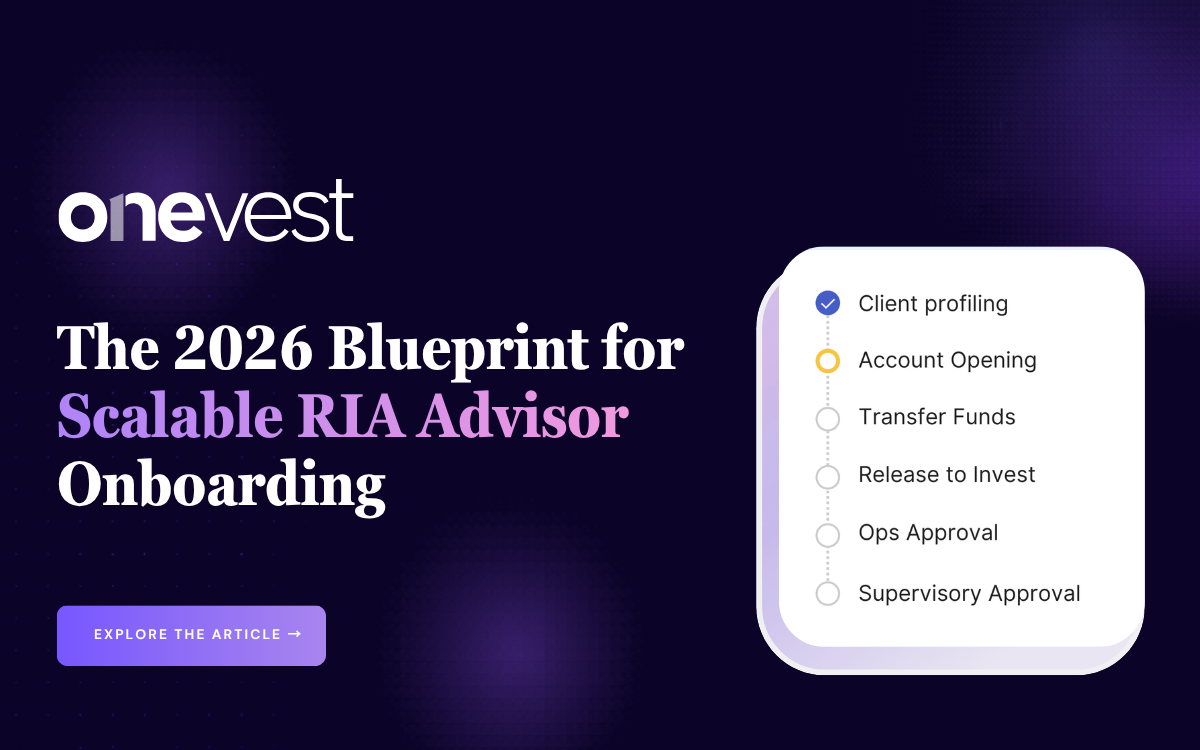
Build a compliance checklist that begins the moment an offer is accepted, not the moment the advisor shows up. Work backward from the first day they need to be client-ready and map every compliance step to that date. Assign ownership to each step: not "ops will handle it," but a specific person with a specific deadline.
This is another area where agentic AI is beginning to carry real weight. AI-driven compliance tools can monitor new advisor communications automatically, track required filings, flag issues in real time, and surface action items without manual review of every interaction. The 2026 T3 survey found compliance technology penetration at 30.15% of advisory firms, and the category is growing as firms realize that manual compliance review doesn't scale with headcount. For new advisors who are still learning what's permissible, an automated monitoring layer isn't surveillance. It's a safety net that protects both the advisor and the firm.
Onboarding Is Now a Recruiting Argument
There's a dimension to this that most ops teams underestimate. Advisors evaluating a move in 2026 are doing real diligence on the tech stack before they sign. They want to know what CRM the firm runs, whether workflows are documented, how long it typically takes a new advisor to get fully up to speed. The firms that can answer those questions clearly and confidently, with a playbook to show, have a material recruiting advantage over those that say "we'll figure it out once you're here."
The promise of a smooth, well-structured onboarding experience is increasingly part of the offer itself. Cerulli Associates estimates roughly 18,000 advisors changed firms in a recent year. A meaningful portion of those moves were shaped not just by compensation or equity, but by the technology and operational environment the receiving firm could credibly demonstrate. An advisor who has experienced chaotic onboarding at a previous firm will weigh that heavily in their next decision.
Firms that treat onboarding as an afterthought are not just slower to be productive. They're less competitive in recruiting. The two problems compound each other.
What Scalable Onboarding Actually Looks Like?
The firms that onboard advisors fastest share a few characteristics. They've built a playbook and maintain it: it's a living document that gets updated when the tech stack changes or when a new advisor surfaces a gap. They've reduced the number of systems a new advisor has to learn independently by choosing integrated platforms where possible. And they've made the ops team's role explicit: not to hand-hold advisors indefinitely, but to set up the conditions for independence as quickly as possible.
Scale matters here. A firm that onboards two advisors a year can absorb a slow, informal process. A firm that's growing through acquisition or aggressive recruiting needs a repeatable system, one that produces the same output regardless of which ops person is running it or which advisor is going through it.
The Agentic Wealth OS by OneVest is built around this kind of operational structure. When advisor workflows, client data, and compliance functions share a common agentic platform, onboarding isn't a manual process of provisioning access across seven different tools. It's a configuration, and configurations can be standardized, documented, and executed consistently. The agent works across the firm's systems so the new advisor doesn't have to.
The 2026 Benchmark to Hold Yourself To
If your new advisors are taking more than 60 days to run their first unsupervised client meeting, something in the onboarding process is broken. If they're still asking senior staff for help navigating the CRM after week four, the handoff was incomplete. If your ops team can't execute a new advisor setup in five business days, the process hasn't been systematized.
These aren't aggressive standards. They're achievable ones, for firms that treat onboarding as an operational design problem rather than an orientation task.
Advisor growth stalls when onboarding is slow. The revenue math is straightforward. The operational fix, if you've done the work to document and systematize it, is too.
The firms that figure this out in 2026 will have a durable advantage in recruiting, retention, and growth, not because they have better advisors, but because they've built a better environment for advisors to succeed faster.
Conclusion and Next Steps
Scalable advisor onboarding doesn't happen by accident. It's the result of documented processes, integrated technology, and an ops team that treats the new hire's first 90 days as a system to be run, not a period to be survived. The firms getting this right are shortening their productivity ramp, improving retention, and building a repeatable foundation for growth. And increasingly, they're winning recruits before the conversation even gets to compensation.
If you're ready to see what an agentic platform looks like in practice, explore the OneVest Agentic Wealth OS.
Frequently Asked Questions:
How long should it take to fully onboard a new advisor at an RIA?
A well-structured onboarding process should have a new advisor running their first unsupervised client meeting within 60 days and operating independently within 90. If it's taking longer, the bottleneck is usually one of three things: fragmented tech access, undocumented processes, or delayed compliance setup. All three are fixable with the right systems in place.
What's the biggest mistake RIAs make when onboarding new advisors?
Treating onboarding as an orientation rather than an operational handoff. Most firms get the new hire set up with a laptop and a compliance walkthrough, then leave them to figure out the rest. The firms that onboard fastest have a written playbook, a pre-day-one checklist for ops, and a defined 30-day checkpoint. That structure is what separates a 45-day ramp from a 120-day one.
How does advisor onboarding affect retention?
Significantly. A new advisor who feels competent and supported in their first 30 days is far more likely to stay. When onboarding is disorganized, new hires often interpret the chaos as a signal about the firm itself. RIA onboarding best practices aren't just about productivity: they're a retention strategy, especially in a market where advisor movement is high and recruits are evaluating firms more carefully than ever before.
Does the tech stack actually influence whether an advisor accepts an offer?
Increasingly, yes. Advisors who have lived through a fragmented, poorly integrated tech environment at a previous firm treat the technology conversation as part of their diligence, not a detail to figure out later. A firm that can walk a recruit through a documented onboarding process and demonstrate a modern, connected platform is making a materially stronger offer than one that says "we'll get you set up once you start."
Can agentic AI meaningfully improve advisor onboarding?
Yes, in ways that go beyond simple automation. An agentic platform can surface client context at the right moment, prompt a new advisor on the next best action, route compliance tasks automatically, and handle meeting documentation without additional data entry. The result is that a new advisor operates closer to full productivity from day one, rather than spending the first 60 days learning how to find things. The 2026 T3 survey found AI notetaking tool adoption at 42.86% of advisory firms, and that's just one layer of what agentic AI can do across the full onboarding workflow.
How do you onboard advisors faster without increasing compliance risk?
Start the compliance setup the moment an offer is accepted, not on day one. Build a checklist with named owners and hard deadlines for every step: state registration, Form ADV updates, custodian credentialing, archiving activation. Agentic AI tools can monitor new advisor communications in real time and flag issues automatically, which means compliance oversight doesn't have to slow the ramp. Controlled access to client data with supervisor review is also a practical middle ground: new advisors learn in real context without the risk of unsupervised errors.