Skip to main content
Advisors Are Choosing Firms Based on Their Wealth Management Platform: Here's What They're Looking For
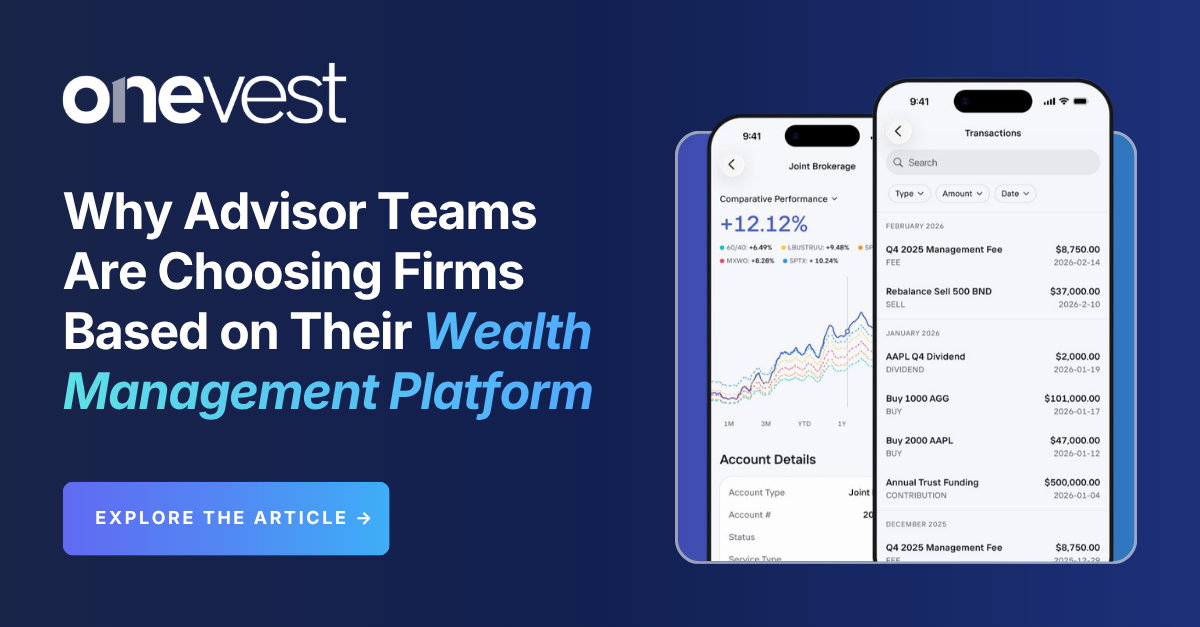
Every recruiting conversation an RIA, aggregator, or broker-dealer has with a high-producing advisor team now includes a question that used to be an afterthought: what wealth management platform will I be working on. The advisors driving today's recruiting market are not naive about technology. Most have spent years on a legacy CRM, a disconnected portfolio system, and an onboarding process that eats their first three months at any new firm. They know exactly what that costs them in client time, and they are done pretending it doesn't matter.
That shift changes what recruiting actually is. It used to be a compensation negotiation with a technology footnote. Now the footnote is part of the offer. Advisors weighing a move are giving up deferred comp, walking away from built-up equity, and taking on real career risk to get there, and the wealth management platform they will inherit on day one is a concrete part of how they weigh that risk against the upside. A firm that shows up with a fragmented, manual-heavy stack is asking an advisor to trade one set of frustrations for another. A firm that shows up with modern infrastructure is offering something the advisor can actually feel in their first ninety days: less time managing systems, more time in front of clients.
What the Old Recruiting Model Assumed
The pitch used to rest on three levers: payout, culture, and brand. Technology, if it came up at all, was framed as a support function. The firm's job was to sell the advisor on the economics and the relationships. The platform was something operations would sort out after the advisor said yes.
No real basis for comparison. That model assumed advisors had no way to compare systems, or that any modern-enough platform would be roughly interchangeable with any other. Neither assumption holds anymore. Advisors moving today are frequently coming from platforms that already do real automation, and they have watched peers go through transitions that took six months to feel normal again. They are no longer taking a firm's word for it that "our systems are great." They are asking pointed questions, and increasingly, they are asking to see the platform before they sign anything.
Recruiting doesn't end at the offer letter. The old model also assumed the conversation was over once the advisor said yes. In practice, the technology experience during the first ninety days is where a recruiting win either compounds or quietly unravels. An advisor who accepted an offer on the strength of culture and comp, only to spend the first quarter re-entering client data and chasing down account transfers, is an advisor already fielding calls from the firm they left.
What Advisors Are Actually Evaluating Now
Advisor due diligence on a firm's wealth management platform has gotten specific. Three questions come up consistently in transition conversations, and none of them are about feature lists.
Speed to productivity. How long before I can see my full book, service my clients, and stop operating out of spreadsheets and email. Advisors have learned that "the systems will be ready" and "the systems are ready" are very different promises, and they now ask firms to be precise about which one is on the table.
What happens to their book on day one. Advisors carrying an existing client relationship do not want to re-key data, re-explain account structures to a new ops team, or wait weeks for account transfers to clear before they can act on behalf of a client. A firm that can move a book of business onto its platform without that friction is offering something tangible: continuity for the advisor's clients, not just a new badge for the advisor.
What the technology does for them going forward. Advisors are increasingly aware of how much of their week goes to administrative work that has nothing to do with client judgment. A platform that visibly reduces that load, rather than simply digitizing the same manual steps, reads as a real upgrade rather than a lateral move.
What Firms Winning Recruiting Battles Have in Common
Firms consistently winning contested recruiting situations share a pattern, and it has less to do with signing bonuses than with how concretely they can answer the questions above.
They can show the platform, not just describe it. Recruiting conversations that include a live look at onboarding workflows, the client experience, and how an advisor's day-to-day actually runs are more persuasive than a slide deck of capabilities, because they let the advisor picture their own book moving through the system.
They have a defined transition process, not an improvised one. The firms that retain the advisors and clients they recruit have built a repeatable onboarding path for incoming books, one that does not require reinventing the process for every new hire or acquired team. That repeatability is what lets a firm tell a recruit, with confidence, exactly how long the transition will take.
They treat the advisor's book as data to be moved, not paperwork to be redone. Account transfers, disclosures, and client records carry compliance weight, and a firm that can move that information into its platform without manual re-entry is protecting both the advisor's time and the integrity of the client relationship during a vulnerable window.
They measure time to full productivity as a recruiting metric, not just an operations metric. Firms that track how long it actually takes a recruited advisor to reach pre-transition productivity are the ones that can keep improving that number, and the ones that can speak to it credibly in the next recruiting conversation.
The Decision Framework: Evaluating a Wealth Management Platform as Infrastructure, Not a Perk
For a CRO or head of growth building a recruiting strategy, the practical question is whether the platform can support the pace of recruiting it wants to do, not whether the technology is impressive in a demo.
Transition capacity. If the firm signs three advisor teams in a quarter, does onboarding get three times harder, or does the platform absorb that volume without a proportional increase in the operations team managing it. Firms whose transition process depends on manual coordination hit a ceiling fast: the second and third simultaneous transition compete for the same limited operations bandwidth, and every one of them slows down.
Day one versus day ninety. A firm that can walk a recruit through what their calendar, client list, and workflow will look like in the first week, specifically, is offering something a competitor with a vague "we'll get you set up" cannot match.
Whether the platform story holds up under scrutiny. Advisors with real leverage are asking for references from recently transitioned teams, and a firm whose last few transitions went smoothly has a recruiting asset that no amount of marketing can substitute for.
The Bottom Line
Recruiting has not stopped being about compensation and culture. It has added a third pillar that firms can no longer treat as a footnote. Advisors with options are weighing the wealth management platform they will inherit as seriously as the payout they will receive, because they have learned what a bad transition costs them in client trust and personal bandwidth.
The firms winning today's recruiting market are not necessarily the ones with the biggest checkbooks. They are the ones that can show, specifically and credibly, what an advisor's first ninety days will look like, and that have built the operational infrastructure to make that promise true at the pace their growth strategy requires. Every advisor team recruited without that infrastructure is a bet that manual coordination will hold. Every team recruited with it is a compounding advantage, because the next transition gets easier, not harder.
The next step for any CRO or head of growth is practical. Look at your last three advisor transitions and measure, honestly, how long they took from signed offer to full productivity. That number is either a recruiting asset or a liability, and it is worth knowing which one you are bringing into your next conversation with a recruit.
Check out OneVest's wealth management platform to see how we make onboarding and account opening easy for advisors moving their book of business.