Skip to main content
Agentic AI vs. AI-Assisted Wealth Software: What's the Actual Difference?
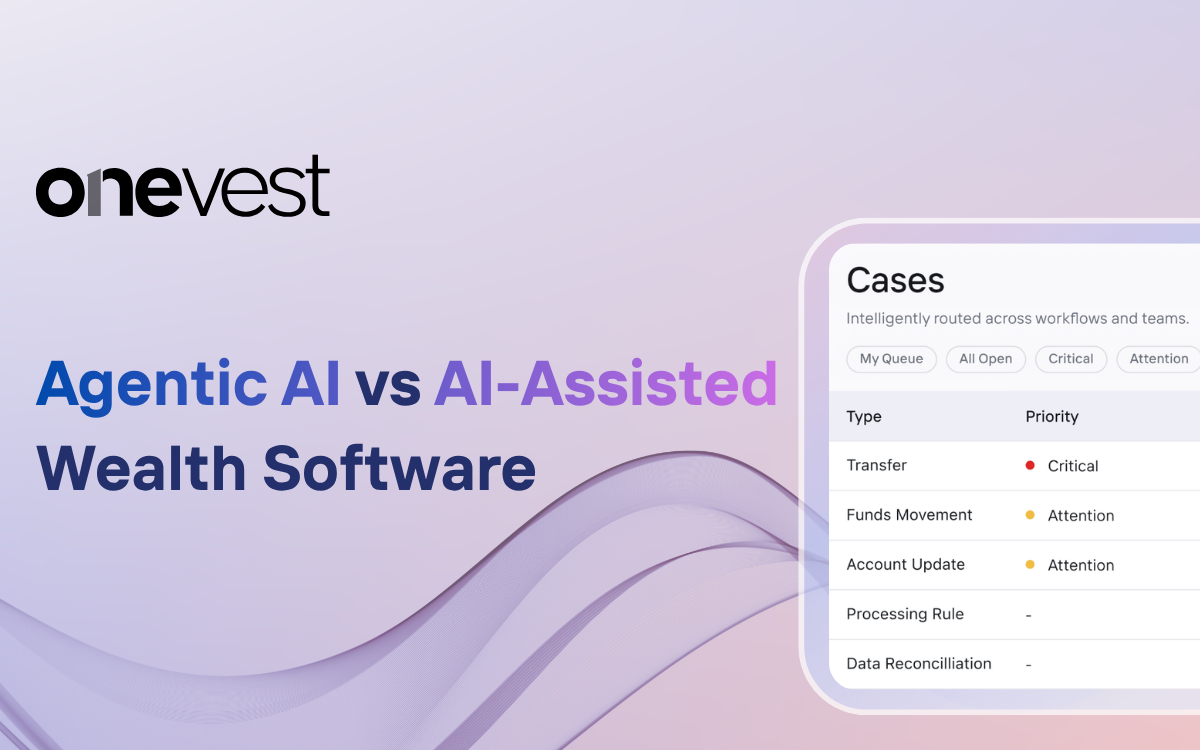
The wealth management industry is using the word "AI" the way it once used "digital" as a signal of modernity rather than a description of what the technology actually does. Every CRM vendor, portfolio management platform, and compliance tool now claims to be AI-powered. Most of them are not lying. They are just describing something much narrower than what the term implies.
The difference between AI-assisted and agentic wealth software is not a marketing distinction. It determines what your technology can actually do without someone managing it, and what it still cannot do without a human in the loop. For firms evaluating platforms or planning infrastructure investments in 2026, understanding that distinction is not optional.
One clarification belongs at the front: agentic AI in wealth management is not about making financial decisions on behalf of clients. It does not execute trades, rebalance portfolios, or take any financially impactful action without human authorization. That boundary is non-negotiable, both from a compliance standpoint and from a fiduciary one. What agentic AI does is handle the operational and coordination work that surrounds those decisions: the follow-ups, the data pulls, the document reads, the workflow handoffs, the exception routing, and the audit trail. It removes the friction that slows firms down without touching the judgment that defines their value.
What AI-Assisted Wealth Software Actually Does?
AI-assisted tools are, broadly, software that uses machine learning or language models to make a human's work faster or better. The human is still the primary actor. The AI is a sophisticated assistant.
In practice, this looks like a CRM that surfaces suggested next actions based on client activity patterns. It looks like a compliance tool that flags a document for review rather than requiring a coordinator to find it manually. It looks like a reporting system that generates a first draft of a client summary instead of requiring an advisor to write it from scratch.
These capabilities are genuinely useful. They reduce time on repetitive tasks. They catch things that humans miss when moving quickly. They lower the cognitive load on operations staff managing large books of business.
What they do not do is carry a workflow forward on their own. An AI-assisted tool surfaces the recommendation and may add intelligence to specific steps along the way, such as reading a document to extract key fields or scoring a risk flag. But progress through the workflow remains human-dependent. The follow-up to a flagged item, the exception that needs routing, the data connection that needs to be made, the next step that needs initiating: all of that still runs on human energy. The AI makes each individual touchpoint smarter. It does not reduce how many touchpoints the human has to manage.
What Agentic AI Changes About That Model?
Agentic AI shifts the architecture. Instead of a tool that assists a human through a process, an agentic system runs the process and surfaces only the exceptions that require human judgment.
The distinction is not about AI being smarter. It is about autonomy across multi-step workflows. An agentic system does not stop after generating a recommendation. It initiates the next step, monitors completion, reads the incoming document to extract the data it needs, connects to the relevant system to verify the result, and flags the edge cases where automated action is not appropriate.
In a wealth management context, this looks like a system that does not just identify a missing disclosure. It initiates the remediation workflow, reads the client file to confirm what version is on record, pulls the current regulatory requirement from the relevant source, tracks completion status, routes the unresolved item to the right reviewer on the right timeline, and maintains the audit trail. The compliance officer is not managing that process. They are reviewing a prioritized queue of items that actually need their attention.
To be precise about scope: this system is not deciding whether to update that disclosure, not advising on the content of it, and not taking any client-facing action without authorization. It is doing the coordination and data work that surrounds the human decision, so that when the compliance officer sits down to review, everything they need is already assembled.
The agentic AI use cases that matter most in this industry are not the ones that generate content or surface insights. They are the ones that close the gap between identifying a workflow item and completing it, without requiring a coordinator to manage each step in between.
What Agentic AI Is Not Doing in Wealth Management?
This point is worth its own section because the confusion is common and the stakes are high.
Agentic AI in a wealth management platform does not make investment decisions. It does not execute trades. It does not rebalance portfolios or move client assets. It does not send client-facing communications without approval. It does not take any action that has financial or regulatory consequences without a human in the authorization chain.
What it does do is the work that currently fills the hours of operations teams, advisors, and compliance staff before and after those decisions get made. It reads documents to pull the data a workflow needs rather than waiting for someone to do it manually. It connects to external systems through integrations to verify data without requiring a human to log in and check. It keeps workflows moving by following up on outstanding items, sending internal notifications, and surfacing what is blocked. It catches the step that would otherwise get missed when someone is managing fifteen other things simultaneously.
The value is not in replacing judgment. It is in removing the coordination tax that judgment currently pays.
The Technical Capabilities That Make It Work
Two capabilities underpin what separates a genuinely agentic wealth platform from one that is simply AI-assisted with better marketing.
The first is document reading and data extraction. An agentic system can read an uploaded document, a custodian statement, a compliance filing, or a client agreement and pull the relevant data points into the workflow without a human doing the extraction. This is not just optical character recognition. It is a contextual understanding of what a document contains, what fields matter for the current workflow, and what discrepancies exist between what the document says and what the system expects. The practical effect is that data entry errors decrease, processing time decreases, and the human reviewer receives a pre-analyzed file rather than a raw document.
The second is connectivity across systems through MCP server integration. A siloed AI tool can process what is in front of it. An agentic platform connected to the firm's broader technology ecosystem can pull live data from a custodian, cross-reference it against a CRM record, check a compliance system for outstanding flags, and push a completed status update back to the workflow system. That connectivity is what allows an agentic system to act rather than just advise. Without it, even a sophisticated AI is still dependent on humans to move information between systems.
Together, these capabilities mean the agentic system is operating with current, complete data rather than whatever happened to be loaded into it last. That matters for compliance accuracy. It matters for onboarding completeness. And it matters for the audit trail, which needs to reflect what actually happened, not what was manually entered after the fact.
Why the Distinction Matters for Firm Operations?
Most wealth management firms are not understaffed because they lack insight. They are understaffed because the operational workflows that keep a firm running, including onboarding, compliance monitoring, account servicing, and reporting, are built on manual coordination. People move information between systems. People follow up on incomplete items. People verify that the thing that was supposed to happen actually happened.
AI-assisted tools make those people more efficient. Agentic systems change the ratio of people to workflows.
This is where the operational case for agentic wealth software becomes concrete. A firm running fifty advisors with a five-person operations team is not limited by the intelligence of its tools. It is limited by how many workflows its operations team can actively manage. Add ten more advisors through an acquisition, and the firm does not need more intelligent tools. It needs tools that do not require the same per-unit coordination overhead.
Agentic AI use cases in wealth management are largely about removing that per-unit ceiling. Compliance monitoring that scales to cover an expanded advisor population without proportional headcount. Onboarding workflows that run to completion without requiring an ops coordinator to track each step. Account servicing exceptions that are identified, routed, and resolved without someone managing the queue manually. And all of it happening without eliminating the compliance checkpoints and human authorization steps that the firm's supervisory program requires.
Where AI-Assisted Tools Still Win?
It would be wrong to frame this as AI-assisted tools being obsolete. They are not, and for many use cases they are the right answer.
Tasks that are genuinely judgment-intensive, including constructing a financial plan, navigating a complex client conversation, and making portfolio allocation decisions, are not candidates for agentic automation. The value of AI assistance in those contexts is exactly the right framing: the technology augments human judgment without attempting to replace it.
The same logic applies to novel situations. Agentic systems operate well within defined workflow boundaries. When a situation falls outside those boundaries, such as an unusual client request, a regulatory question with no clear precedent, or a compliance finding that requires senior review, the right response is to route it to a human, not to attempt autonomous resolution.
A well-designed wealth AI platform does not try to automate everything. It automates what is appropriately automated and routes what is not. The sophistication is in knowing where that line is and building workflow architecture that respects it.
The Practical Evaluation Question
For a CTO or technology-forward advisor evaluating platforms, the distinction between AI-assisted and agentic wealth software translates into a set of concrete questions.
When the system identifies an exception or a required action, what happens next? If the answer is "it alerts someone to take action," that is AI assistance. If the answer is "it initiates the next step in the workflow and alerts someone only when human judgment is required," that is agentic behavior.
Can the system read documents and extract data into a workflow without manual input? Can it connect to external systems to pull live data rather than relying on what was last manually entered? These are the capabilities that separate operational automation from operational intelligence.
How does the system handle multi-step processes? AI-assisted tools are typically single-step: they help with a discrete task. Agentic systems maintain state across a workflow. They know where a process is, what has been completed, and what needs to happen next without a human tracking it.
Does the system scale without proportional coordination overhead? An AI-assisted tool scales with the humans using it. An agentic system scales with the volume of workflows it is managing. For firms growing through acquisition or advisor headcount, this is the practical question that determines whether the technology actually changes their operational capacity.
What This Means for Platform Selection in 2026?
The wealth AI conversation has moved past the question of whether AI belongs in wealth management. That debate is over. The question now is which category of AI capability a platform actually delivers and whether the answer matches what a firm's operational model actually requires.
For firms at steady state with a stable advisor population and manageable workflow volume, AI-assisted tools may be exactly sufficient. The ROI is real. The efficiency gains are meaningful.
For firms growing through acquisition, adding advisor headcount, or operating in a regulatory environment that demands complete supervisory documentation at scale, AI assistance is not enough. The coordination burden does not shrink as the firm grows. It compounds. The tools that help individuals work faster do not change the underlying ratio of people to workflows.
Agentic wealth software exists to change that ratio. It does not remove judgment from the equation, and it does not touch the decisions that belong to advisors and compliance officers. It removes the coordination overhead that consumes the time and bandwidth that judgment requires.
The firms evaluating technology through that lens, not feature breadth, not marketing language, but actual workflow autonomy, are the ones building infrastructure that will hold up as the operational surface area expands.
Frequently Asked Questions:
What is the main difference between AI-assisted and agentic wealth software?
AI-assisted tools help humans work faster on individual tasks by surfacing recommendations, drafting content, or flagging exceptions. Agentic wealth software goes further: it carries the workflow forward, connects to external systems to pull live data, reads documents to extract what it needs, and routes only genuine exceptions to human reviewers. The human is still in the loop, but for judgment calls, not coordination.
Does agentic AI make investment or trading decisions for clients?
No, and this distinction matters. Agentic AI in a regulated wealth management context does not execute trades, rebalance portfolios, or take any financially impactful action without human authorization. Its role is operational: moving workflows forward, reading and processing documents, connecting to data sources, following up on outstanding items, and surfacing what needs human attention. The financial decisions remain with the advisor and the client.
What are the most common agentic AI use cases in wealth management?
The highest-impact use cases are operational: advisor onboarding workflows that run to completion without manual tracking, compliance monitoring that extends automatically to a growing advisor population, document reading and data extraction that eliminates manual entry errors, and account servicing exception management. These capabilities do not replace compliance checkpoints or human authorization steps. They handle the coordination work that surrounds them.
How does document reading fit into an agentic wealth platform?
Document reading allows the system to ingest a client agreement, custodian statement, or compliance filing and extract the relevant data into the workflow without requiring a human to do it manually. This reduces data entry errors, speeds up processing, and means the human reviewer receives a pre-analyzed file with discrepancies already flagged rather than a raw document to interpret from scratch.
Is agentic AI a replacement for human advisors or compliance staff?
No. Agentic systems handle defined, repeatable workflows, not judgment-intensive decisions. A well-built agentic platform routes novel situations, complex client needs, and regulatory edge cases to humans. The goal is to remove coordination overhead so that advisors and compliance professionals can focus on the work that actually requires their expertise.
How does OneVest approach agentic AI in wealth management?
OneVest's platform is built around agentic workflow automation across the core operational functions of a wealth management firm: onboarding, compliance monitoring, client account management, and servicing exceptions. The system reads documents to extract data, connects to external systems through MCP integrations to pull live information, maintains continuous oversight across advisor activity, routes exceptions for human review, and generates a complete audit trail, all without requiring manual coordination at each step. Financial decisions and client-facing actions remain with authorized humans. Learn more about OneVest's agentic AI capabilities.
The Bottom Line
The difference between AI-assisted and agentic wealth software is not a technical nuance. It is the difference between tools that make individuals more efficient and infrastructure that changes how many workflows a firm can manage without adding headcount.
Neither category replaces the human judgment that wealth management is built on. The financial decisions, the compliance calls, the client relationships: those stay with the people whose names are on the license. What agentic software takes off their plate is the coordination tax: the follow-ups, the data pulls, the document reads, the exception routing, and the status tracking that currently consumes hours that should be spent on higher-value work.
Both categories have a place. The question is whether the platform a firm is evaluating actually matches the operational demands it is trying to meet and whether the AI capabilities being marketed are the ones that will still hold up when the firm is twice its current size.
Ready to see what agentic AI actually looks like inside a wealth management platform?
Explore how OneVest helps firms move from coordination-heavy operations to scalable, agentic infrastructure.