Blog & Newsroom
Expert perspectives on modern wealth management, platform innovation, and the technology shaping the future of financial services.
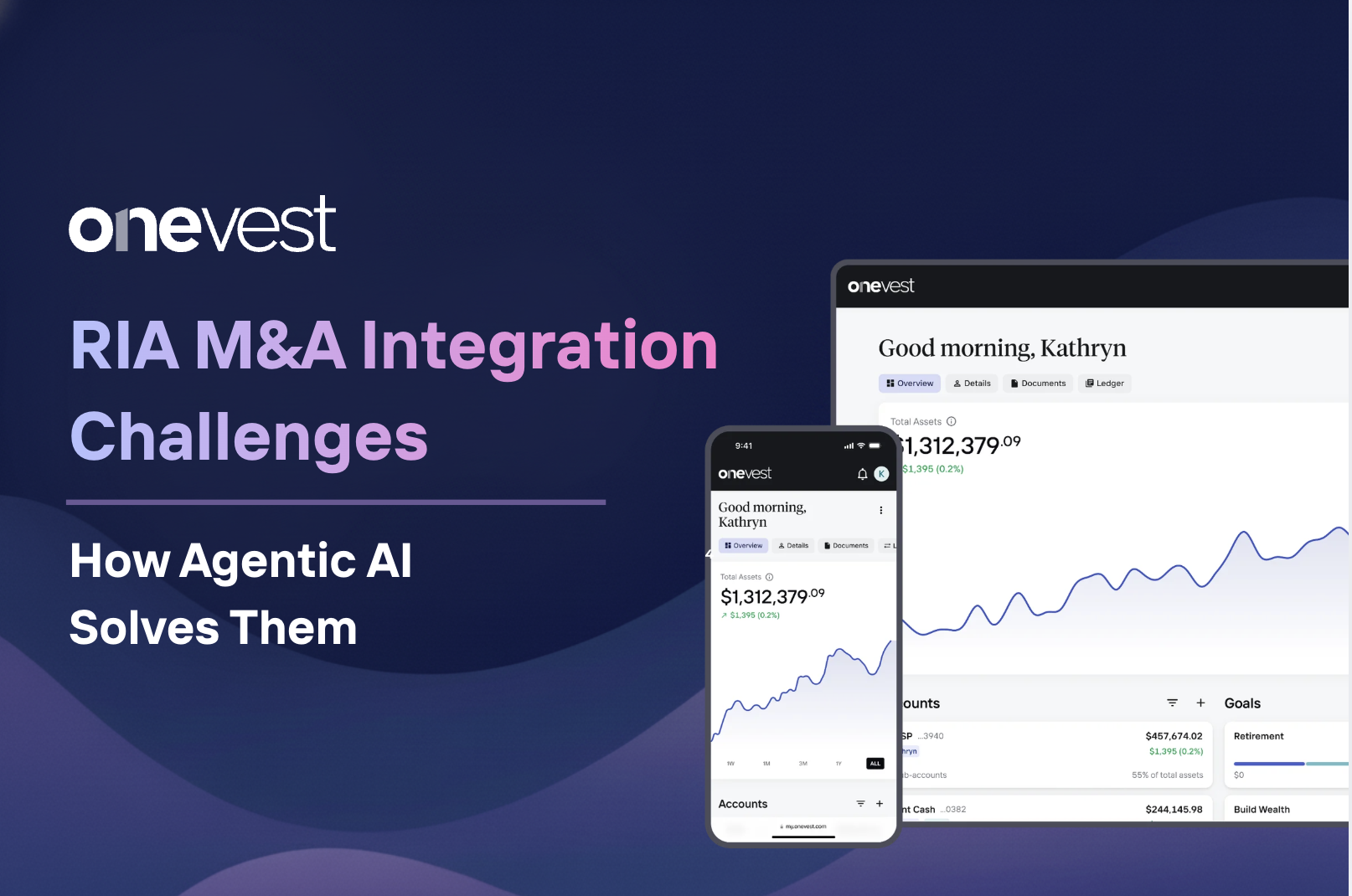
BlogRIA M&A Integration Challenges and How Agentic AI Solves Them
RIA M&A activity has not slowed down. The number of transactions hitting the market each year continues to rise, deal multiples remain competitive, and acquiring firms are under pressure to close faster, integrate faster, and demonstrate growth faster than the cycle before. What has not kept pace with the deal volume is the integration infrastructure most firms bring to the table after signing. The challenges of RIA M&A integration are not new, but they are getting worse. Acquiring firms are absorbing practices with incompatible technology stacks, fragmented client data, and advisor teams that operate with habits built around systems that are about to change. The window between deal close and full operational integration is where acquisitions either generate the value they promised or quietly consume it. Agentic AI is changing what is operationally possible in that window. Not by making integration painless, but by compressing the timeline and reducing the manual coordination burden that has defined post-merger operations for the past decade. Why Post-Merger Integration Fails Quietly? Most RIA acquisitions do not fail loudly. The firm does not collapse. The advisors do not all leave on day one. What happens instead is slower and more expensive: the integration takes longer than projected, clients experience service gaps, compliance documentation falls behind, and the advisors who were supposed to drive growth spend the first six to twelve months managing operational friction instead. The root cause is almost always the same. Post-merger integration is treated as a project with a finish line, a checklist of systems to connect and processes to migrate, rather than as an ongoing operational challenge that requires scalable infrastructure to manage. When a firm closes two or three acquisitions in a single year, as many growth-oriented RIAs are now doing, there is no clean finish line. The integration work is perpetual. The challenges of RIA M&A integration compound quickly when firms are running multiple integrations simultaneously. Technology workflows built for a single custodian relationship have to accommodate new ones. Compliance oversight programs designed for one firm's practices have to expand to cover advisor teams with different habits, different documentation standards, and different client communication norms. Onboarding processes that work at steady state break under the volume that an acquisition introduces. The Technology Stack Problem Is Bigger Than It Looks RIA tech stack modernization is consistently cited as one of the top post-merger priorities and one of the most consistently underestimated challenges. On paper, technology consolidation looks like a finite project. In practice, it is an extended negotiation between operational continuity and the long-term goal of running a unified platform. The acquired firm's advisors built their practices around the tools they have. Their CRM contains years of client interaction history. Their portfolio management system has customized model structures, fee schedules, and reporting configurations that took time to build. Moving those advisors onto a new platform is not just a technical migration. It is a behavioral change management challenge wrapped inside a technical one. The typical approach is to run parallel systems through the transition period, maintaining the acquired firm's existing infrastructure while building toward consolidation. This limits disruption but creates its own problems. Compliance oversight has to cover two sets of systems. Client data exists in two environments. Any report that requires a consolidated view of the combined firm requires manual aggregation from multiple sources. Without RIA tech stack modernization that is designed for integration from the ground up, this parallel-system period stretches. What was projected as a six-month transition becomes eighteen months. The operational drag accumulates, and the growth thesis that justified the acquisition gets deferred. Technology Is Now a Recruiting Asset, Not Just an Operational One There is a dimension of the technology conversation that acquiring firms often underweight: advisor teams evaluating a potential home are paying close attention to the platform they will be working on. These moves are not casual decisions. Advisors making a transition to a new firm are often leaving behind equity, deferred compensation, or other incentives. The bonuses tied to these moves are significant, and so is the career risk. When an advisor team is weighing their options, the quality of the technology they will inherit is a concrete part of the calculus. A firm with a fragmented, manual-heavy operational environment is asking advisors to trade a known platform for one that will slow them down. A firm with modern, integrated technology infrastructure is offering something different: the ability to spend more time on client relationships and less time managing operational noise. For high-producing advisor teams with real leverage in the negotiation, that distinction can be the deciding factor. This means that RIA tech stack modernization is not just about internal efficiency. It is a competitive differentiator in the market for advisor talent. Firms that have invested in their operational platform are not just running more efficiently. They are winning deals that firms with legacy infrastructure are losing, because the best advisor teams have choices and they choose environments where they can produce. Advisor Onboarding Is Where Value Leaks Out The deal was built on advisor productivity. The acquiring firm modeled what those advisors would generate once they were operating on the combined platform with access to broader capabilities, better technology, and more scalable operations. That model only works if the transition does not break what made those advisors productive in the first place. Advisor onboarding in the context of an acquisition is more complex than standard new-hire onboarding. These advisors are not starting fresh. They are carrying existing client relationships, compliance history, and operational habits that have to be mapped to a new environment. Every client account has to be reviewed and transitioned. Every disclosure has to be updated. Every workflow the advisor uses has to have a functioning equivalent on the new platform before they can operate without disruption. The manual version of this process is sequential, slow, and heavily dependent on the bandwidth of operations staff who are already managing everything else that comes with post-merger integration. It creates a bottleneck that delays advisor productivity and generates compliance risk when documentation and disclosure updates fall behind the pace of account transfers. The firms absorbing acquisitions without a structured, technology-supported advisor onboarding process are not just slowing down. They are creating concentrated risk in the first ninety days of every deal, exactly when client retention and advisor satisfaction are most sensitive. What Agentic AI Changes About the Integration Model? Agentic AI does not eliminate the complexity of RIA M&A integration. What it does is change how much of that complexity requires manual coordination. The core value is continuity across multi-step, multi-system processes. Where a traditional workflow requires a coordinator to pull data from the acquired firm's CRM, reconcile it against the acquiring firm's records, identify gaps, and route action items to the right people, an agentic system moves through those steps continuously and surfaces the exceptions that require human attention without someone managing the process end to end. In practice, this looks like a system that monitors advisor onboarding status across every account in the acquired book, surfaces missing documentation and disclosure gaps in real time, tracks completion against defined timelines, and routes unresolved items to the appropriate reviewer before they become compliance findings. The operations staff are not coordinating the process manually. They are managing a prioritized queue of items that actually require judgment. The same logic applies to compliance oversight across a newly expanded firm. An agentic compliance layer can extend supervisory monitoring to advisor teams from the acquired firm from the moment they are onboarded to the platform, tracking account activity, document status, and servicing exceptions without requiring the compliance team to build out new manual workflows for each acquisition. This capability matters most for firms running multiple acquisitions. Each new deal does not require building a new integration process from scratch. The infrastructure scales. The marginal cost of the next acquisition, measured in operational overhead and compliance exposure, decreases rather than increasing proportionally with deal volume. The Compliance Dimension of Integration Is Underestimated The challenges of RIA M&A integration have a compliance dimension that deal teams often underweight during diligence and then confront at scale during integration. The acquired firm operated under its own compliance program. It may have had different documentation standards, different supervisory procedures, and different policies around areas like outside business activities, marketing, or fee disclosures. On day one after close, those advisors are operating under the acquiring firm's compliance obligations, but the documentation infrastructure that supports oversight of their activity has to be built. Regulators do not grant grace periods for post-merger integration. An SEC examination that occurs twelve months after a transaction closes will expect to see supervisory documentation that covers the full period of the combined firm's operations, including the accounts and advisors absorbed through the acquisition. If those records exist in a legacy system that was not fully integrated, or if they were maintained through manual processes that created gaps, the examination exposure is real. The firms managing this well are the ones that deploy compliance infrastructure before the deal closes, not after. Due diligence surfaces the compliance profile of the target. The integration plan defines how supervisory monitoring will extend to the acquired team from day one. The technology makes that extension operationally sustainable. Building an Integration Infrastructure That Scales The distinction that separates firms that integrate well from those that struggle is not the size of the integration team. It is whether the firm has built integration infrastructure or is assembling integration process from scratch with each deal. Infrastructure means that the key workflows, including advisor onboarding, compliance oversight expansion, client account migration, and document and disclosure tracking, have defined processes supported by technology that can be activated for a new acquisition without rebuilding from scratch. It means that the firm can run multiple integrations simultaneously without each one competing for the same pool of operational bandwidth. For firms running the integration as a manual project, each acquisition is roughly as hard as the last one. The team learns from experience, but the underlying process remains labor-intensive, and the compliance exposure in the transition period remains largely unchanged. For firms operating on a platform designed to support growth through acquisition, the second deal is easier than the first. The third is easier than the second. The infrastructure compounds in the same direction as the growth thesis. What to Look for in a Platform Built for Acquisition-Driven Growth? Not all wealth management platforms handle the operational demands of acquisition-driven growth equally. Evaluating technology through the lens of integration capability rather than steady-state functionality changes the criteria considerably. Integration depth matters more than feature breadth. A platform that connects deeply with the custodians and data sources the acquired firm relies on is worth more than one with an impressive feature list that requires manual data bridges to function. The first question is always whether the platform can absorb the acquired firm's data environment without a prolonged parallel-systems period. Onboarding workflow automation is a practical differentiator. Platforms that support structured advisor onboarding, tracking completion status, surfacing gaps, and routing exceptions, reduce the manual coordination burden that slows every transition. Compliance scalability is non-negotiable for firms planning serial acquisitions. Every deal that closes increases the compliance surface area. A compliance oversight model that requires adding headcount proportionally to acquisition volume is a model with a ceiling. Firms that want to grow through acquisition without proportional compliance infrastructure growth need a platform whose supervisory tools extend automatically as the firm expands. Frequently Asked Questions What are the most common reasons RIA acquisitions underperform their growth projections? The most frequent cause is post-merger integration taking longer and consuming more operational resources than projected. Advisor productivity is deferred while teams manage technology transitions. Compliance documentation falls behind account transfers. Client service gaps during the transition period create retention risk. These are operational failures, not strategic ones, and they are preventable with the right infrastructure. How long does advisor onboarding typically take during an RIA acquisition? Without structured, technology-supported workflows, full onboarding of an acquired advisor team, including account transfers, disclosure updates, and compliance documentation, typically takes three to six months per deal. Firms running multiple acquisitions simultaneously often find these timelines extending further as operations resources are pulled in multiple directions. Automated onboarding workflows can reduce this significantly by eliminating the manual coordination bottleneck. What role does technology play in RIA due diligence? Technology assessment should be a standard component of acquisition due diligence, not an afterthought. The acquired firm's tech stack determines the complexity and cost of integration. Evaluating CRM, portfolio management, and custodian relationships before close allows the acquiring firm to build a realistic integration timeline and cost model, and to identify whether its own platform can absorb the acquired firm's environment without an extended parallel-systems period. Does the quality of an acquiring firm's technology affect its ability to recruit advisor teams? It does, and more than many firms realize. Advisor teams evaluating a move are making a high-stakes decision. The compensation tied to these transitions is significant, and advisors with strong books have real options. A modern, integrated operational platform is a tangible differentiator in those conversations. Firms with legacy or fragmented technology are asking advisors to accept an operational downgrade. Firms that have invested in their platform are offering advisors a path to doing more with less friction. How does OneVest support firms growing through acquisition? OneVest provides an integrated operational platform built to scale with acquisition-driven growth. Advisor onboarding workflows, compliance supervisory monitoring, and client account management extend to acquired teams from day one, without requiring firms to rebuild integration processes from scratch with each deal. The platform's agentic AI layer continuously monitors activity across the combined firm, surfaces exceptions for human review, and maintains a complete audit trail, allowing compliance and operations teams to manage a growing advisor population without proportional headcount increases. [LINK: learn more about OneVest for acquisition-driven RIAs → OneVest platform overview] Conclusion and Next Steps The challenges of RIA M&A integration are not going to get simpler. Deal volume is not declining, advisor teams are scrutinizing technology more carefully than ever, and regulatory expectations for supervisory documentation do not pause for transition periods. Firms growing through acquisition are operating in an environment where each deal adds complexity that has to be absorbed, and where the gap between firms with modern integration infrastructure and those still managing the process manually is widening with every transaction. The firms executing acquisition-driven growth effectively right now are not necessarily the ones with the largest integration teams. They are the ones that have built scalable operational infrastructure underneath their advisors, infrastructure that extends onboarding workflows, compliance monitoring, and client account management to each new team without rebuilding from scratch. That infrastructure is what allows the third acquisition to be easier than the second and the fifth to be easier than the third. Every advisor team a firm absorbs, every custodian relationship it adds, every market it enters through acquisition increases the operational surface area that has to be managed. That surface area becomes manageable when the firm is operating on a platform designed to scale with it. Without that platform, each expansion creates new exposure and defers the productivity the deal model was built on. The next step for any M&A-focused RIA principal or growth officer is practical. Map your current integration workflow from deal close to full advisor productivity. Identify where manual coordination is creating delays, where compliance documentation is falling behind account transfers, and where your current technology would break under the volume of two or three simultaneous integrations. Then evaluate whether your operational platform can support the pace of growth your strategy demands. Modern integration infrastructure is not about removing the judgment that makes acquisitions work. It is about giving that judgment the operational support it needs to function at scale and at speed. Ready to build an acquisition infrastructure that scales? Join leading RIA firms already using OneVest to integrate advisor teams, automate onboarding workflows, and maintain exam-ready compliance documentation across every deal. Explore OneVest.
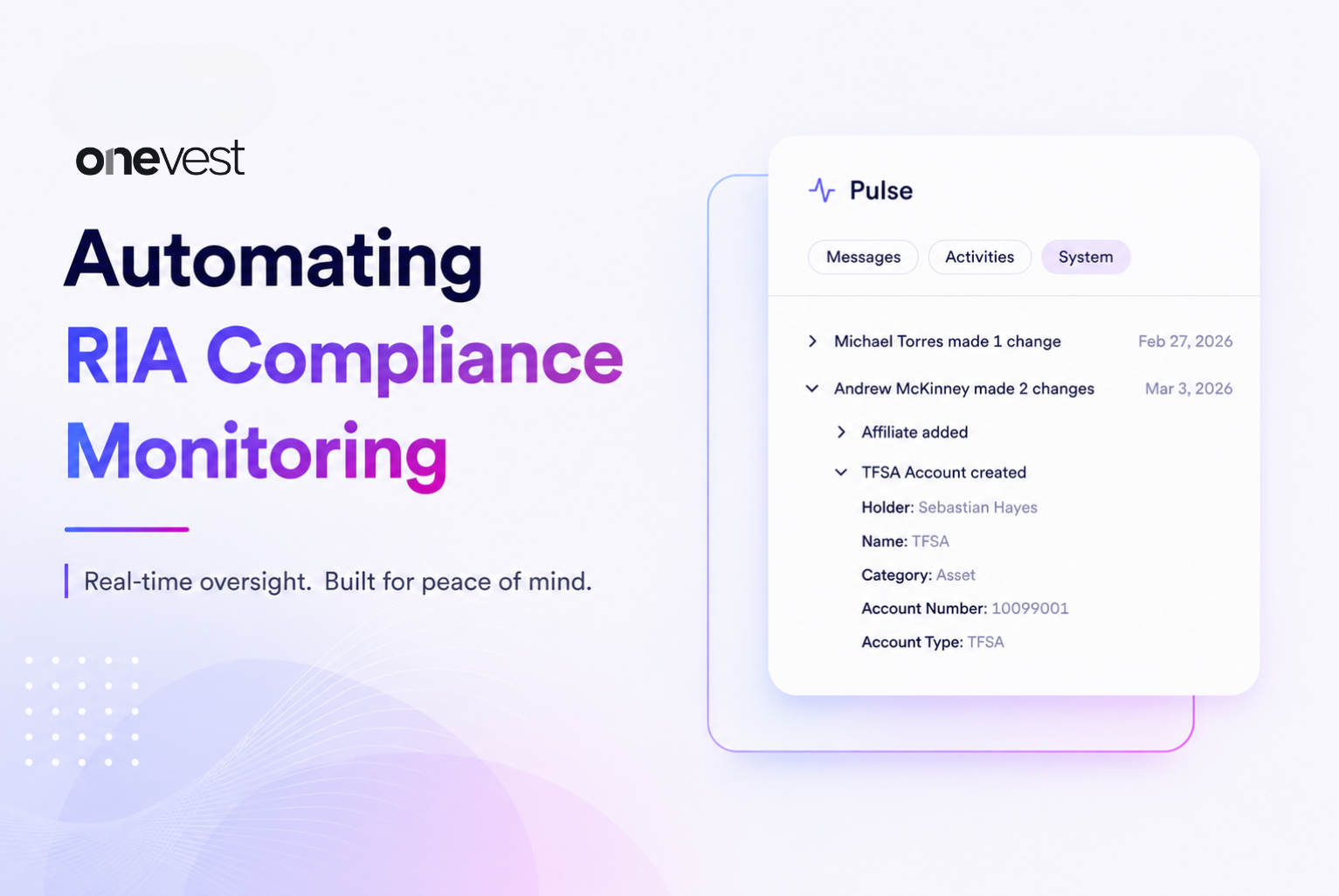
BlogAutomating RIA Compliance Monitoring: What Firms Need to Know in 2026
The SEC examination cycle is not getting quieter. In 2026, RIA compliance officers are managing more regulatory surface area, including heightened scrutiny of AI-driven investment tools, evolving cybersecurity disclosure requirements, and rising expectations around supervisory documentation, while the number of compliance staff at most firms has not kept pace. Something has to give. For a growing number of firms, what's giving way is the manual process model that has defined compliance monitoring for the past two decades. Automating RIA compliance monitoring is no longer a technology project for large enterprise firms with dedicated innovation teams. It is a practical necessity for any RIA that wants to manage compliance risk without building a larger headcount infrastructure to do it. Why Manual Compliance Monitoring Is a Structural Problem, Not a Staffing One? The standard response to compliance pressure has been to add staff. Hire another compliance analyst. Assign a dedicated reviewer to client communications. Build a checklist-heavy review process for account activity. This approach works until it doesn't, and in 2026, it is failing at scale. The problem is not that compliance teams lack skill or diligence. The problem is that the volume of touchpoints that require monitoring has grown faster than any team can absorb manually. A mid-sized RIA managing 500 client relationships generates continuous compliance-relevant activity: account changes, fee disclosures, client communication, third-party data integrations, and more. Tracking all of it through spreadsheets, periodic audits, and after-the-fact reviews creates gaps, and those gaps are exactly where examination findings live. Manual monitoring is also inherently reactive. By the time a supervisory review surfaces an issue, the violation has already occurred. Remediation takes longer than prevention, and regulators treat pattern failures more seriously than isolated incidents. According to the SEC's 2024 examination priorities report, deficiencies in compliance programs and supervisory procedures remain among the most frequently cited findings across registered investment advisers. Firms that continue to treat compliance monitoring as a headcount problem will keep hiring into a structural gap. The answer is infrastructure, not personnel. What Automating RIA Compliance Monitoring Actually Means? "Automated compliance" is a phrase that gets applied loosely. It is worth being precise about what it means in practice, because the distinction between basic rule-based alerts and genuinely intelligent compliance infrastructure is significant. Rule-based compliance tools run conditional logic against structured data. If a trade exceeds a size threshold, flag it. If a client document is missing a field, block submission. These tools reduce obvious errors, and most firms have some version of them already. What they cannot do is monitor the full operational lifecycle of a client relationship across systems, surface patterns that suggest emerging risk, or adapt to regulatory changes without manual reconfiguration. Modern automated compliance monitoring does all of that. It connects to the firm's data infrastructure, including CRM, portfolio management, custodian feeds, and communication logs, and monitors activity continuously. It applies rules that can be updated centrally as guidance evolves. It generates exception reports that direct compliance staff to the issues that require human judgment, rather than requiring them to manually search for problems across siloed systems. The practical effect: compliance officers spend less time collecting data and more time acting on it. How Agentic AI Changes the Compliance Monitoring Model? Agentic AI takes automation a meaningful step further. Where traditional compliance tools wait for a rule to be triggered, agentic systems actively work through multi-step monitoring processes. They gather data across systems, cross-reference it against policy requirements, identify patterns that warrant attention, and surface prioritized findings for review. They do not wait to be asked. They move through the work continuously and bring the right issues forward. In practice, this looks like an intelligent layer that reconciles trade activity against client suitability profiles, tracks document and disclosure status across the full client base, monitors account servicing activity for exceptions, and flags issues with context, all without a compliance analyst having to manually pull and compare data across platforms. What agentic AI does not do is make compliance determinations. That distinction matters enormously. The system's role is to do the investigative legwork: identify the anomaly, assemble the relevant context, and route it to the right person with enough information to make a sound judgment quickly. The compliance officer or principal remains the decision-maker. Every finding the system surfaces is a prompt for human review, not a conclusion. This is the correct model, not just from a regulatory standpoint where human supervisory accountability is a non-negotiable requirement, but from a practical one. Compliance decisions involve nuance, client context, and professional judgment that no automated system should be substituting for. The value of agentic AI is that it makes the human decision-maker faster, better-informed, and less likely to miss something. It does not remove them from the loop. The Key Gaps That Supervisory Tools Close For compliance officers, the value of automated supervisory tools is most visible in four areas where manual processes consistently fall short. Trade and fee monitoring: Regulation Best Interest obligations require ongoing documentation that investment recommendations are in the client's best interest. Automated monitoring can cross-reference trade activity against client profiles, flag potential outliers, and generate the documentation trail that supports supervisory sign-off in real time rather than at the end of the quarter. Document and disclosure tracking: Missing disclosures, stale Form ADV language, and unsigned acknowledgments are perennial exam findings. An automated system tracks document status across all client accounts and surfaces gaps before they become deficiencies, not after. Account servicing oversight: Changes to account details, money movement requests, and administrative updates all carry compliance implications. Automated workflows log every action, flag exceptions that fall outside defined parameters, and create a clean record for supervisory review without requiring a coordinator to manually track each transaction. Third-party and vendor oversight: RIAs increasingly rely on third-party technology providers and model portfolio vendors, which creates compliance obligations around due diligence, data security, and conflicts of interest. Automated workflows can maintain a live inventory of vendor relationships and trigger periodic review requirements without relying on a compliance team member to remember to do it. The Regulatory Landscape Driving Urgency Right Now Several intersecting regulatory developments make 2026 a particularly important moment to assess compliance infrastructure. AI adoption across wealth management has added a new compliance dimension. Firms using AI-assisted investment tools, client communication platforms, or data analytics services face expectations around explainability, oversight, and documentation of how those tools influence client outcomes. Manual compliance processes were not designed for this level of operational complexity. Cybersecurity rules have expanded the compliance perimeter further. The SEC's cybersecurity disclosure requirements demand documented policies, tested procedures, and timely reporting of material incidents, all of which require operational infrastructure, not just written protocols. Regulation Best Interest continues to generate examination activity. Firms need to demonstrate ongoing, documented processes for evaluating whether recommendations serve client interests, not one-time policy adoption. That documentation burden falls directly on compliance and operations teams and is difficult to sustain at scale without automated record-keeping and monitoring. Taken together, these regulatory developments are adding compliance monitoring requirements that will not be absorbed by current staffing models without something changing in how the work gets done. Building the Internal Case for Compliance Automation Compliance officers and RIA principals who understand the operational need often face a harder challenge internally: making the case for investment when the cost of compliance failure is invisible until it isn't. The argument is strongest when framed around three quantifiable risks. The first is examination readiness. Firms that cannot produce clean, organized documentation of supervisory activity during an SEC exam face findings that consume significant time and legal resources to remediate. Automated systems generate that documentation as a byproduct of normal operations. The second is the cost of manual labor applied to low-judgment tasks. A compliance analyst spending 40 percent of their time pulling data from disparate systems, reconciling records, and building status reports is not doing compliance work. They are doing data work. Automation redirects that capacity toward the analysis and judgment that compliance professionals are actually hired to provide. The third is the risk of scaling without scaling compliance infrastructure. Every advisor added, every new custodian relationship, every expanded service offering increases the compliance surface area. If monitoring capacity does not scale with the firm, risk accumulates silently until an examination or incident surfaces it. What Implementation Actually Looks Like? Deloitte’s industry data suggests that firms implementing structured compliance automation reduce the time spent on manual monitoring tasks by 40 to 60 percent within the first year, with the largest gains in document tracking and trade surveillance. A survey by the Investment Adviser Association found that 74 percent of RIAs cited technology investment as a top priority for improving compliance program effectiveness, yet fewer than a third described their current tools as fully integrated. The steps below reflect a practical, staged approach that builds confidence without requiring a full systems overhaul. Step 1: Operational Audit. Map every manual compliance workflow. Identify where data is pulled from, who reviews what, and where handoffs between systems and people occur. Step 2: Define Scaling Objectives. Set specific targets for examination readiness, supervisory coverage ratios, and documentation standards. These targets guide system configuration. Step 3: Prioritize High-Volume, Low-Judgment Workflows. Start with document status tracking, trade monitoring, and account servicing exceptions. These deliver the fastest reduction in compliance risk and staff burden. Step 4: Configure Human-in-the-Loop Oversight. Define precisely what the system escalates and who reviews it. Automation surfaces exceptions. Compliance officers make the calls. Step 5: Build Audit Trail Architecture. Design for auditability from day one. The documented evidence of supervisory activity is what protects firms in examinations, not the automation itself. Step 6: Establish a Governance Cadence. Assign ownership for maintaining rule logic, reviewing exception rates, and incorporating regulatory changes. Automation reduces ongoing labor but does not eliminate governance responsibility. Step 7: Measure, Iterate, and Expand. Track supervisory coverage, exception volumes, and staff time recaptured. Use data to guide expansion into more complex compliance functions and to build the ongoing case for investment. The Stakes for Firms That Wait Compliance infrastructure investment has a compounding return. Firms that automate their supervisory workflows now are not just reducing today's risk. They are building a documented supervisory history that serves them in every future examination and a monitoring capacity that scales with growth without proportional headcount increases. The firms waiting for the compliance landscape to stabilize before making this investment are likely waiting for a moment that will not come. Regulatory expectations for documentation, surveillance, and oversight will not decrease. The operational complexity of managing client relationships across modern wealth management infrastructure will not decrease. The pressure on compliance staff to do more with flat or limited resources will not decrease. Automating RIA compliance monitoring is how compliance officers stop managing compliance risk reactively and start getting ahead of it. The infrastructure exists. The regulatory pressure is real. The case for action in 2026 is clear. Frequently Asked Questions: How does agentic AI differ from the compliance software many RIAs already use? Most existing compliance tools are reactive. They flag a problem after a rule is broken or require a person to manually run a report to check for issues. Agentic systems are proactive. They continuously work through multi-step monitoring processes across systems, surfacing prioritized exceptions for human review rather than waiting to be queried. The practical difference is that compliance officers are managing a curated queue of issues that need judgment rather than spending their time collecting data to find out whether issues exist. Can a firm implement compliance automation without replacing its existing technology stack? In most cases, yes. Modern compliance automation platforms are designed to integrate with existing CRM, portfolio management, and custodian infrastructure rather than replace it. The starting point is an operational audit that maps current workflows and identifies where manual steps can be automated within the existing environment. Full system replacement is rarely required and rarely the right first step. What should a compliance officer look for when evaluating automated supervisory tools? The most important criteria are integration depth, auditability, and configurability. The tool needs to connect to the systems where compliance-relevant activity actually occurs, generate a retrievable audit trail of every action taken, and allow compliance staff to configure escalation rules as regulatory guidance evolves. Firms should also evaluate the vendor's track record with SEC examination support and their approach to regulatory change management. How do you maintain human oversight when compliance workflows are largely automated? The key is designing escalation into the system from the start, not bolting it on afterward. Every automated workflow should have defined points where the system routes a finding to a compliance officer or principal for review and sign-off. High-stakes actions, including final account approvals, large fund movements, and exception handling, should require human validation before execution. The compliance officer's role shifts from manually hunting for problems to reviewing a prioritized queue of issues the system has already identified and contextualized. How does OneVest support compliance monitoring within its platform? OneVest provides integrated supervision powered by agentic AI, built directly into the operational workflows of the platform rather than sitting alongside them as a separate tool. The system continuously monitors activity across onboarding, account servicing, money movement, and client data, surfacing exceptions and routing them to the appropriate compliance reviewer with the context needed to make a fast, informed decision. Every action is logged automatically, creating a complete and retrievable audit trail without additional manual documentation effort. Compliance determinations remain with the firm's own principals and compliance officers. OneVest's role is to make sure nothing is missed and that every decision is supported by clean, organized, exam-ready documentation. Conclusion and Next Steps Automating RIA compliance monitoring is not a trend to watch from a distance. It is the operational standard defining competitive advantage in 2026, particularly for RIA firms managing growing advisor teams, expanding client bases, and increasing regulatory surface area. The firms that are staying ahead of compliance risk right now are not necessarily the ones with the largest compliance teams. They are the ones that have built intelligent supervisory infrastructure underneath their compliance officers, infrastructure that continuously monitors, surfaces, and documents issues without requiring a person to manually coordinate every step. Every advisor a firm adds, every new custodian relationship it opens, every acquisition it integrates increases the compliance workload. That workload becomes manageable when the firm is operating on infrastructure designed to scale with it. Without that infrastructure, each expansion creates new exposure. The gap between firms that have made this investment and those that have not will only widen as regulatory expectations continue to rise through 2027 and beyond. The next step for any compliance officer or RIA principal is practical. Audit your current supervisory workflows, identify where manual processes are creating gaps or delays, and evaluate whether your current technology can support the oversight obligations that come with the firm you are building toward. Intelligent compliance infrastructure is not about replacing the judgment that makes your compliance program effective. It is about giving that judgment the operational support it needs to work at scale. Ready to modernize your firm's compliance infrastructure? Join leading RIA firms already using OneVest to build supervisory workflows that scale without scaling headcount. Explore OneVest.
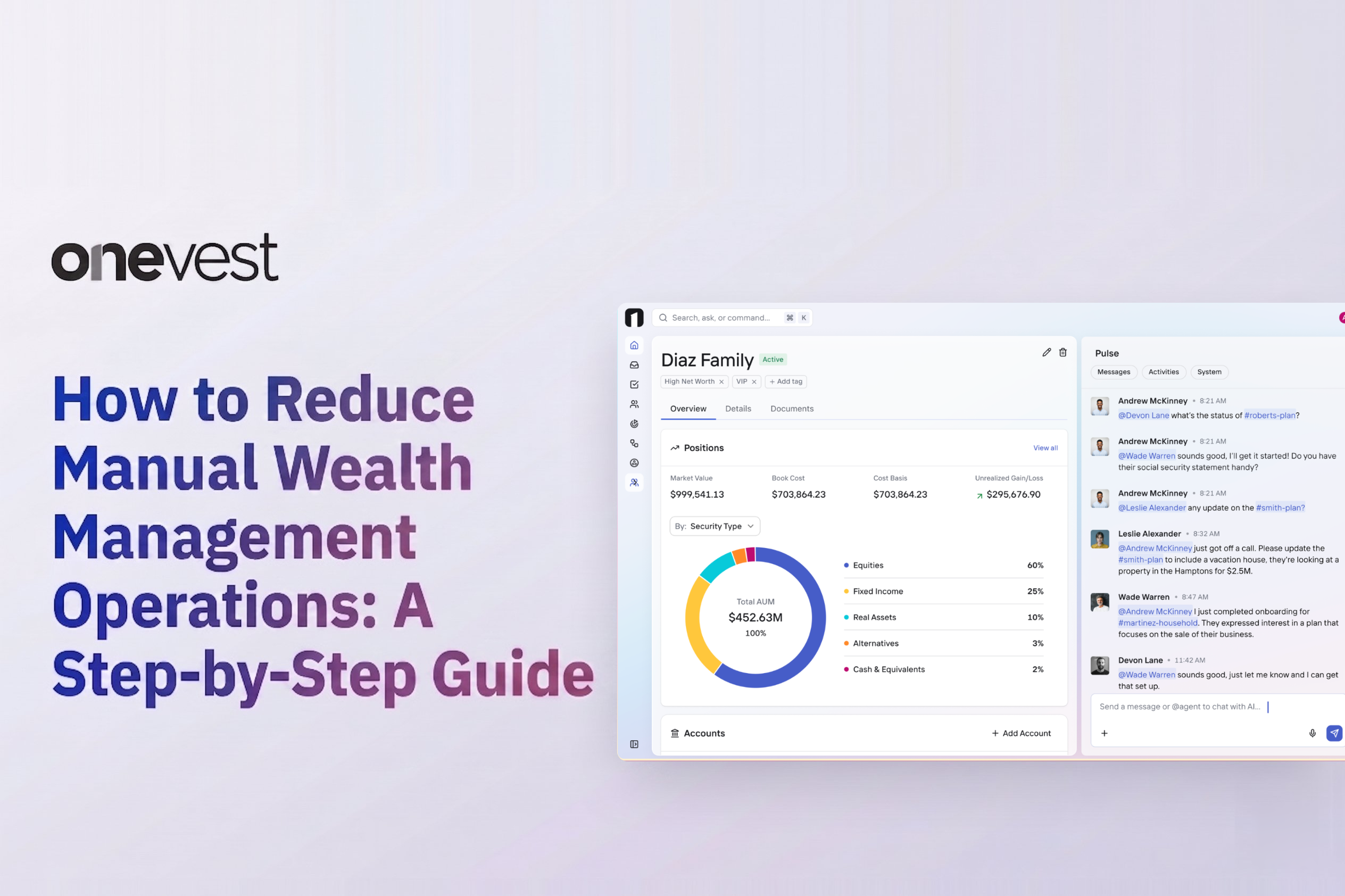
BlogHow to Reduce Manual Wealth Management Operations: A Step-by-Step Guide
Manual Processes Are Costing Wealth Management Firms More Than They Realize In 2026, wealth management firms that eliminate operational drag are unlocking faster growth, stronger compliance posture, and better client outcomes. The firms falling behind are not short on talent. They are short on infrastructure. Executive Summary Wealth ops automation meaningfully reduces the time advisors spend on administrative tasks, freeing capacity for revenue-generating work. Operational drag quietly costs mid-sized firms in lost advisor productivity and error-driven rework. Firms that adopt scalable wealth platforms consistently report faster onboarding, fewer compliance incidents, and improved client satisfaction within the first few months of implementation. The 2026 to 2030 outlook favors firms that prioritize fintech integration solutions and back-office optimization now. What Does "Manual Wealth Management Operations" Actually Mean? Manual wealth management operations refer to any back-office or middle-office task performed by people without automation support. This includes data entry, trade reconciliation, client onboarding paperwork, compliance reporting, and fee billing. According to experts in financial operations streamlining, these tasks consume a significant portion of a typical advisor's working week. That figure represents a substantial administrative burden reduction opportunity for firms willing to act. The problem is not a lack of skilled people. The problem is skilled people doing work that technology handles better. A back-office optimization strategy reclaims that time and redirects it toward client-facing and revenue-generating activity. Why Operational Drag Is a Growth Killer in 2026? Operational drag compounds silently. Every manual touchpoint adds latency, introduces error risk, and consumes headcount. In 2026, most wealth management firms are still carrying more of it than they realize. The administrative burden on advisory teams remains substantial. A meaningful portion of the work week across firms of all sizes gets absorbed by tasks that could be automated or eliminated, leaving advisors less time for the work that actually moves the needle. The financial cost is real, even if it often goes unmeasured. Inefficient data reconciliation and manual compliance workflows quietly erode margins, and the larger the firm, the larger the bleed. What looks like a process inefficiency on paper translates directly into lost revenue at scale. Client experience suffers too. Slow onboarding remains one of the leading reasons clients leave a firm, which means operational drag is not just an internal cost. It is a retention risk. Tightening those workflows is not just about efficiency. It is about giving clients a reason to stay. What Are the Biggest Sources of Manual Work in Wealth Ops? According to experts across the fintech integration solutions space, five categories dominate manual workload in wealth operations. Client onboarding tops the list. Gathering KYC documents, verifying identity, and populating account data manually takes far longer in firms without client onboarding automation than it should. Compliance reporting ranks second. Manual compliance task automation gaps force operations teams to compile regulatory reports by hand, increasing error rates compared to automated alternatives. Data reconciliation is the third major driver. Discrepancies between custodians, portfolio management systems, and CRMs require daily human review in most firms. Fee billing and calculation introduces another layer of manual risk. Complex billing structures applied manually generate billing errors at a rate that is simply not sustainable as firms scale. Performance reporting rounds out the top five. Producing customized client reports without automation is a time-intensive process that limits how frequently firms can deliver meaningful reporting to clients. Step-by-Step: How to Reduce Manual Wealth Management Operations This is the operational framework that leading firms use in 2026 to eliminate manual bottlenecks systematically. Step 1: Conduct a full operational audit. Map every manual task across the client lifecycle. Document frequency, time cost, and error rate. This baseline makes the ROI case undeniable. Step 2: Prioritize by impact and feasibility. Rank tasks using a simple matrix: high time cost plus high error rate equals highest priority. Client onboarding automation and compliance task automation typically surface at the top. Step 3: Select scalable wealth platforms that integrate with existing systems. Technology-driven advisory firms avoid rip-and-replace migrations. The priority is fintech integration solutions that connect to current custodians and CRMs. Step 4: Automate client onboarding first. This delivers the fastest visible ROI. Digital onboarding workflows dramatically reduce new client setup time in most implementations. Step 5: Implement compliance task automation. Automate regulatory data aggregation, report generation, and audit trail logging. This step alone reduces compliance labor costs considerably on average. Step 6: Address data reconciliation processes. Deploy reconciliation software that pulls from all data sources automatically. Daily exceptions shrink from hours of review to minutes. Step 7: Automate billing and performance reporting. Connect billing logic directly to portfolio data. Eliminate manual calculation entirely. Step 8: Train operations teams on exception management. Staff shift from task execution to oversight. This is the culture change that sustains automation gains long term. Step 9: Measure, report, and iterate. Track time saved, error rates, and client satisfaction quarterly. Use data to identify the next automation priority. Which Workflow Automation Tools Are Leading the Market in 2026? The workflow automation landscape in 2026 has moved beyond static, rule-based layers to agentic AI workflows and integrated operating systems designed specifically for the complexities of advisory firms. Unlike previous generations of automation, these systems utilize the Model Context Protocol (MCP) to create a standardized, secure connection between AI agents and fragmented financial data sources. Experts note that the most effective implementations leverage these connected MCP tools to allow AI agents to securely navigate between custodians, CRM data, and compliance engines. This protocol eliminates the "context rot" common in older systems, ensuring that AI agents have the real-time, high-fidelity data needed to execute multi-step tasks, such as rebalancing portfolios or flagging nuanced compliance risks, without manual intervention. Firms are reporting the highest operational efficiency gains by adopting platforms that offer end-to-end agentic orchestration across onboarding, billing, and reporting within a single environment. By moving away from fragmented point solutions and toward unified, agent-enabled ecosystems, firms are eliminating the operational drag of manual data syncing and finally achieving truly autonomous middle-office operations. How Does Client Onboarding Automation Change the Game? Client onboarding automation is the single highest-leverage automation investment a wealth ops team can make in 2026. The impact is direct. Firms using digital onboarding workflows process new accounts significantly faster than manual counterparts. Client satisfaction scores rise meaningfully within months of implementation, according to fintech research from 2026. Beyond speed, client onboarding automation dramatically reduces document errors. Digital forms with built-in validation eliminate the back-and-forth that frustrates both clients and staff. An operations manager implementing onboarding automation also reduces the risk of non-compliance at the point of account opening, since required fields and checks are enforced automatically. What Role Does Compliance Task Automation Play? Compliance task automation addresses one of the most persistent sources of administrative burden in wealth management. By offloading high-volume, low-discretion tasks to agentic AI workflows, firms are fundamentally shifting the compliance-to-admin ratio. Regulatory complexity increases every year. In 2026, wealth firms manage compliance obligations across multiple regulatory frameworks simultaneously. Manual processes simply cannot scale with that complexity. Connected MCP tools now handle the heavy lifting of data aggregation, report formatting, deadline tracking, and audit logging without human intervention. According to experts in financial operations streamlining, firms using these automated layers reduce regulatory review time substantially year over year. The true power of this automation lies in the reclamation of time. By automating the time-sink admin tasks, like cross-referencing trade logs or manual document filing, compliance officers are finally free to focus on activities that move the needle: Proactive Education: Designing and delivering tailored training programs that foster a culture of compliance rather than just checking boxes. Industry Foresight: Dedicating time to analyze emerging standards and shifting global regulations before they become bottlenecks. Strategic Oversight: Utilizing powerful, AI-driven analytics to identify subtle risk patterns that traditional manual sampling would likely miss. Beyond efficiency, this shift reduces regulatory penalties. Firms with automated compliance workflows report significantly fewer late or inaccurate regulatory submissions, allowing the compliance department to evolve from a defensive cost center into a strategic partner in firm growth. How Do Data Reconciliation Processes Benefit From Automation? Data reconciliation processes represent one of the most time-intensive manual activities in wealth operations. Portfolio data, custodian feeds, and client records rarely align perfectly without intervention. Manual reconciliation at a firm managing thousands of accounts can absorb the better part of a full workday. Automated reconciliation tools complete the same task in a fraction of the time, flagging only genuine exceptions for human review. The financial operations streamlining impact extends beyond time savings. Automated reconciliation reduces data errors substantially and provides real-time position accuracy that manual processes cannot match. Firms without automated reconciliation will face meaningful competitive disadvantages in reporting speed and data integrity as the industry continues to evolve. What Operational Efficiency Gains Can Firms Realistically Expect? The operational efficiency gains from wealth ops automation are well-documented in 2026. Here is what firms report after 12 months of systematic automation implementation. Advisor capacity increases meaningfully as administrative tasks are removed from their plates. Back-office headcount requirements drop without reducing service quality. Client onboarding time falls from days to hours. Billing error rates decline sharply. Compliance reporting time drops substantially. These outcomes represent conservative industry expectations. Firms with legacy system complexity may see slower initial gains. Firms with modern infrastructure report results at the higher end of these ranges. How Do Ops Managers Build the Business Case for Automation? An ops manager or COO building the case for back-office optimization should anchor the argument in three areas: cost, risk, and growth capacity. On cost, the math is direct. Identify current labor hours spent on manual tasks, multiply by fully loaded hourly cost, and compare against automation platform fees. Most firms see payback within months, not years. On risk, quantify current error rates and the cost of rework, compliance penalties, and client attrition linked to slow or inaccurate operations. Operational bottleneck elimination reduces all three. On growth capacity, present the advisor capacity data. A firm growing AUM without growing headcount proportionally requires automation as the enabling infrastructure. According to experts, a business case that combines all three dimensions secures executive alignment faster than cost reduction arguments alone. What Does Digital Transformation in Wealth Management Look Like by 2030? Digital transformation in wealth management accelerates sharply between 2026 and 2030. According to current industry projections, the vast majority of wealth management firms will operate fully automated back-office functions before the end of the decade. Technology-driven advisory models will become the baseline expectation rather than a differentiator. Firms that delay automation investment will face compounding competitive disadvantages in talent acquisition, client acquisition, and regulatory standing. Scalable wealth platforms that offer modular, API-first architecture will dominate the market through 2030. The firms that build on those platforms now develop compounding operational advantages over the next four years. Fintech integration solutions will increasingly include AI-powered anomaly detection, predictive compliance monitoring, and intelligent client communication workflows. The administrative burden reduction achievable by 2028 will far exceed what is possible today. FAQ: Reducing Manual Wealth Management Operations What is the fastest way to reduce manual wealth management operations? According to experts, client onboarding automation delivers the fastest measurable ROI. Most firms reduce onboarding time dramatically within the first 60 days of implementation. It requires minimal disruption to existing systems and produces immediate client satisfaction improvements. How much does wealth ops automation typically cost? Platform costs vary significantly by firm size and feature set. Mid-sized firms typically invest in comprehensive automation platforms on an annual basis. Most achieve full payback within 9 to 12 months through labor cost reduction and error elimination. Is compliance task automation safe from a regulatory standpoint? Yes, when implemented correctly. Automated compliance tools create more complete and accurate audit trails than manual processes. Regulators in 2026 increasingly view automated compliance infrastructure as a positive indicator of operational control. How does operational drag affect advisor retention? High operational drag is a significant advisor attrition driver. Industry research consistently shows that a notable share of advisors who leave their firms cite excessive administrative burden as a primary factor. Eliminating that burden improves advisor satisfaction scores on average. Can smaller advisory firms afford wealth ops automation? Yes. The 2026 market includes scalable wealth platforms designed specifically for smaller and mid-sized firms. Many operate on subscription models with pricing tied to AUM or account volume, making automation economically accessible at earlier stages of growth. How long does a full automation implementation take? A phased implementation covering onboarding, compliance, and reconciliation typically takes 90 to 180 days. Firms that attempt to automate everything simultaneously report longer timelines and higher change management costs. A step-by-step approach produces faster operational efficiency gains. Conclusion: The Operational Imperative for Wealth Firms in 2026 Operational drag is not a background inconvenience. It is a direct tax on growth, advisor productivity, and client experience. Firms that eliminate manual wealth management operations through systematic wealth ops automation position themselves for compounding advantages through 2030. The step-by-step framework outlined here gives ops managers and COOs a practical starting point. Begin with an audit. Prioritize by impact. Implement client onboarding automation first. Build from there. The firms leading the wealth management market in 2030 are making these decisions in 2026. The window for building operational competitive advantage through digital transformation in finance is open now. Ready to grow your advisory firm? Join leading advisory firms already using OneVest to modernize client experiences.
BlogThe Agentic Wealth OS: How Growing RIA Firms Are Scaling AUM Without Adding Operations Headcount
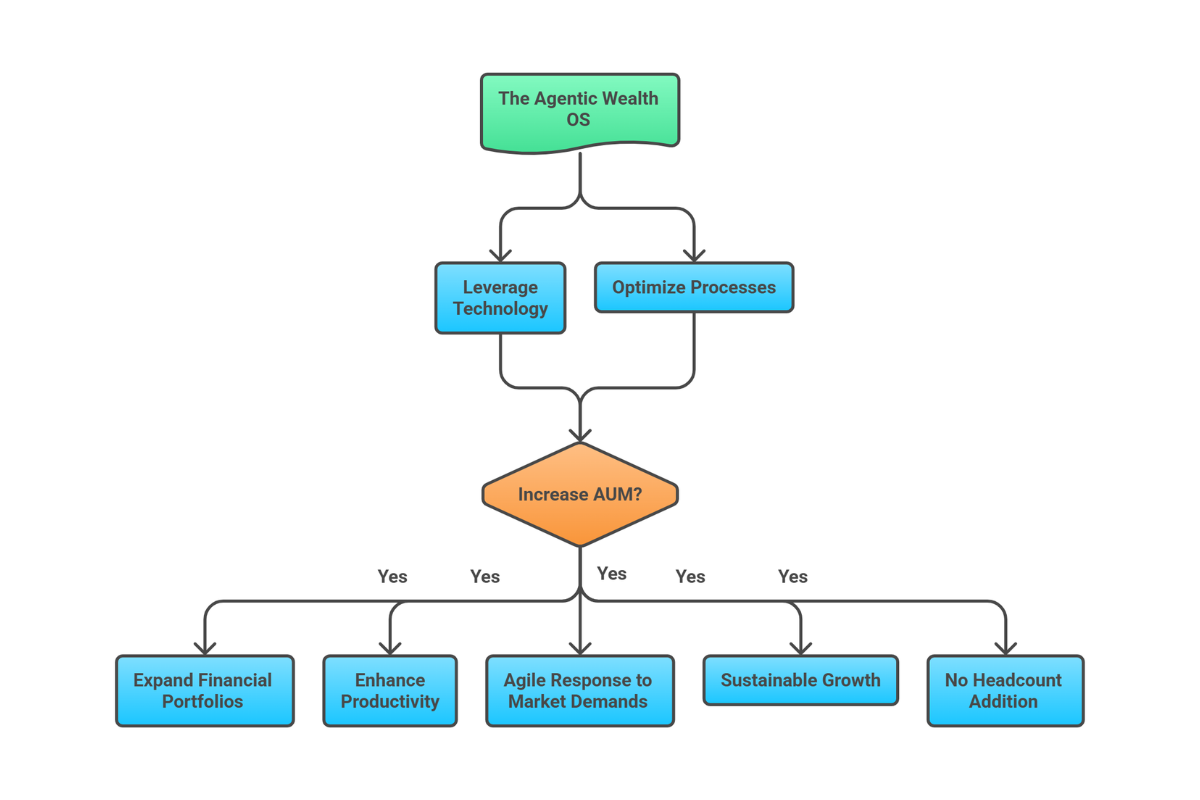
Agentic wealth management is reshaping how RIA firms grow. In 2026, the most competitive firms are not adding a back-office hire for every advisor they bring on. They are deploying intelligent, autonomous infrastructure that handles operational complexity at a pace and scale no manual team can match alone. Executive Summary Agentic AI platforms now manage end-to-end wealth management workflow operations, from client onboarding to account servicing and reporting, without requiring proportional increases in operations or administrative staff.RIA firms growing through consolidation and advisor recruitment are doing so without the traditional burden of scaling their back office in lockstep.Scaling AUM in 2026 requires infrastructure, not just advisors. The Agentic Wealth OS model is becoming the competitive standard for firms that want to grow without operational drag.RIA executives who adopt agentic systems now are positioning their firms for the 2026 to 2030 growth cycle, whether that growth comes through M&A, recruiting, or organic advisor expansion. 1. What Does "Agentic" Mean in the World of Wealth Management? Agentic wealth management refers to AI systems that execute workflows on behalf of a firm. These systems do not simply generate recommendations. They coordinate, execute, and manage client and operational workflows with minimal human oversight. The term "agentic" comes from AI research. It describes models capable of goal-directed, multi-step action. Applied to wealth management operations, this means an intelligent system that moves a new client through onboarding, triggers the right compliance checks, coordinates account opening across custodians, surfaces the next advisor action, and logs everything for audit, all without a coordinator manually orchestrating each step. For RIA firms, agentic infrastructure means the firm's operational capacity scales with the platform, not with the headcount behind it. 2. Why Traditional RIA Scaling Models Are Breaking Down For decades, RIA growth followed a predictable formula: bring on more advisors, add more clients, grow revenue, and hire proportional operations and administrative staff to support them. That model faces serious structural pressure in 2026. Every advisor added through a recruitment or acquisition has historically come with a corresponding demand for back-office support: client service associates, onboarding coordinators, compliance administrators, and reporting staff. Firms growing through consolidation face this multiplied. Each acquired practice brings its own operational complexity, and integrating it without additional headcount has historically been close to impossible. At the same time, client expectations have risen sharply. Clients increasingly expect proactive, personalized communication and fast, error-free onboarding and account servicing. Manual processes cannot meet that standard at scale without a growing operations team. The result is a capacity gap that hits hardest during consolidation. Firms that stick with traditional operating models find that growth through acquisition or recruiting creates immediate operational strain, slowing the very momentum they are trying to build. 3. What Does an Agentic Wealth OS Actually Look Like? The Agentic Wealth OS treats a firm's technology stack as an operating system rather than a collection of disconnected point solutions. It integrates client data, portfolio management, compliance, communication, and reporting into a single intelligent infrastructure layer. OneVest's Agentic Wealth OS is purpose-built for this. It is the operational infrastructure that sits underneath advisors and enables firms to run complex, multi-step wealth management workflows: onboarding, account opening, money movement, servicing, and reporting, without requiring a person to manually coordinate each step. Key components include: Agentic onboarding workflows that move new clients from KYC collection through account opening across custodians without manual handoffsIntelligent account servicing that coordinates money movement, updates, and administrative tasks automaticallyUnified data infrastructure that gives advisors a single, accurate view of each client without switching between disconnected systemsEmbedded compliance and audit logging that surfaces exceptions for human review rather than requiring manual oversight of every actionProactive advisor workflows that surface the next best action based on client data, portfolio state, and firm-defined rules The firm's advisors and investment decisions remain entirely in control. The OS handles the operational complexity underneath them. 4. How Are Firms Scaling AUM Without Adding Headcount? The answer lies in breaking the link between growth and operational headcount. When a firm acquires another practice or recruits a new advisor team, the traditional playbook demands immediate investment in operations support: someone to onboard the new clients, someone to handle the paperwork, someone to manage the data migration, someone to coordinate with custodians. That overhead slows integration, compresses margins, and limits how aggressively a firm can pursue consolidation. Firms operating on an Agentic Wealth OS break that equation. The platform handles the operational workflows that would otherwise require dedicated staff. A firm that acquires two practices in a quarter does not need to hire two new operations coordinators, because the infrastructure absorbs the volume. The same dynamic applies to organic advisor growth. As advisors join and build their books, the OS scales with them. Advisors are not waiting on overloaded ops teams to process paperwork or open accounts. The platform moves it forward automatically, with human oversight built into the points that require it. The result: AUM and advisor count grow, while operations headcount stays flat or grows far more slowly than it would under a traditional model. Each advisor on the platform can serve a larger book with less administrative friction, and the firm can pursue growth through M&A, recruiting, or both, without hitting operational capacity walls. 5. What Role Does Wealth Management Workflow Automation Play? Workflow automation is the connective tissue of the Agentic Wealth OS. It ensures that every client action, market event, or compliance requirement triggers the right response automatically and routes it to the right person or system without a coordinator in the middle. When a client completes onboarding or updates a financial goal, the platform surfaces the next required actions across CRM, portfolio management, and compliance, without manual handoffs or duplicate data entry. Advisors remain in control, but operational effort shifts from task management to oversight and client engagement. The point of automation is not to remove the human touch. It is to make that human touch possible at scale. No advisor can independently track hundreds of clients' birthdays, tax situations, and life goals simultaneously, and no operations team can manually coordinate account opening and servicing across a large concurrent client base without errors and delays. A well-configured agentic system can, and it frees advisors and operations teams to focus on the work that actually requires their judgment. 6. Who Is Already Using Agentic Wealth Systems? Adoption is accelerating across firm sizes. Larger RIAs and enterprise wealth management firms pursuing active consolidation strategies have been the earliest movers, drawn by the scalability benefits when integrating acquired practices. But mid-sized independents are closing the gap quickly as agentic platforms become more accessible and implementation timelines shorten. The pattern is consistent: firms that deploy this infrastructure early are expanding advisor and client capacity without proportional headcount growth in their operations functions, and that advantage compounds with each subsequent acquisition or advisor hire. 7. How Do Firms Implement an Agentic Wealth OS? Implementation does not require a complete technology overhaul. A structured approach reduces risk and accelerates time to value. Step 1: Audit current operational bottlenecks. Map every manual process in the client and advisor lifecycle. Identify where operations and admin staff spend time on tasks that do not require human judgment: data entry, status coordination, document collection, account follow-up. Step 2: Define scaling objectives. Set specific targets for AUM growth, advisors per operations FTE, integration timelines for acquisitions, and service quality benchmarks. These targets guide platform configuration. Step 3: Select unified infrastructure over point solutions. OneVest's Agentic Wealth OS provides integrated infrastructure rather than disconnected tools. Integration reduces the friction that creates the need for manual coordination in the first place. Step 4: Begin with high-volume, high-friction workflows. Start with client onboarding and account opening, the areas where manual coordination is most expensive and error-prone. Build operational confidence before expanding to more complex agentic functions. Step 5: Train advisors as system orchestrators. Advisors in an agentic model shift from task executors to relationship strategists. Their role is to review, approve, and engage, not to coordinate paperwork. Investment in this role transition is critical to adoption. Step 6: Configure human-in-the-loop oversight. Build in approval steps for high-stakes actions: large transfers, final account approvals, exception handling. The system should surface decisions that require human judgment, not replace it. Step 7: Measure, iterate, and expand. Track advisor capacity, operations team workload, AUM per advisor, and integration timelines for new practices. Use data to guide system expansion and to build the business case for continued investment. Frequently Asked Questions What is an Agentic Wealth Operating System? An Agentic Wealth OS is a unified, AI-native infrastructure designed to orchestrate the complex operational workflows of a wealth management firm. Unlike traditional software that records data and requires people to act on it, an agentic system uses intelligent agents to execute multi-step workflows such as client onboarding, account opening, money movement, and account servicing, with high precision and without manual coordination at every step. It acts as the firm's operational backbone, handling the complexity underneath advisors so they can focus on client relationships and growth. How does "agentic AI" differ from standard automation? Standard automation follows linear, rule-based logic: if this, then that. Agentic systems are goal-oriented. They can navigate multi-step processes, adapt to new data inputs, coordinate across multiple systems, and handle exceptions, all in service of completing a workflow outcome. This shift moves firms away from static, siloed tools toward a dynamic infrastructure layer that actively manages the operational lifecycle of the firm without requiring a person to manage the automation itself. Is there human oversight in an agentic system? Absolutely. Modern agentic platforms are built on a human-in-the-loop philosophy. The technology handles the operational heavy lifting while ensuring that people remain the ultimate decision-makers. This is managed through: Embedded approvals: High-stakes actions such as final account approvals or large fund transfers require human validation before execution.Exception management: The system is configured to flag inconsistencies and edge cases for expert human review rather than proceeding with incomplete or potentially flawed data.Audit trails: Every action taken by the system is logged, creating a transparent record for compliance, supervisory review, and regulatory purposes. What is an MCP server, and why does it matter for wealth tech? The Model Context Protocol (MCP) is an open standard that enables seamless integration between AI models and the data sources and tools they need to act on. OneVest offers MCP servers that allow firms to connect their proprietary AI or third-party LLMs directly to their wealth management data and workflows. This gives the AI the operational context it needs to surface accurate insights or initiate tasks within a secure, controlled environment, without compromising data integrity or requiring custom engineering work for every integration. How is client data protected within these systems? Data sovereignty is a core design principle. OneVest functions as a secure processor, acting strictly on the instructions of the firm. Security is maintained through enterprise-grade, role-based access controls that ensure only authorized personnel can view sensitive client information, and through infrastructure built to align with modern regulatory guidance, including SEC cybersecurity standards, using bank-grade encryption for data at rest and in transit. Which workflows should a firm prioritize first? To see the fastest results and build organizational confidence, firms should prioritize the high-friction operational workflows that sit between the advisor, the client, and the custodian: Digital onboarding: Automating KYC collection, document extraction, and the coordination required to move a prospect to a funded client without manual handoffs.Account servicing: Streamlining money movement requests, administrative updates, and routine account maintenance that currently require operations staff to coordinate manually.Unified data consolidation: Bringing fragmented client and portfolio data into a single source of truth so advisors are not jumping between legacy platforms to get a complete picture of a client's situation. Conclusion and Next Steps Agentic wealth management is not a trend to watch from a distance. It is the operating model defining competitive advantage in 2026, particularly for RIA firms pursuing growth through consolidation, advisor recruitment, and expanding books of business. The firms winning right now are not necessarily the ones with the most advisors. They are the ones that have built intelligent operational infrastructure underneath their advisors, infrastructure that absorbs the complexity of growth without requiring a proportional expansion of the back office. Every acquisition a firm makes, every advisor team it recruits, every new client relationship it opens, these become leverage points when the firm is operating on an Agentic Wealth OS. Without it, each one creates operational drag. The gap between firms that have made this infrastructure investment and those that have not will only widen as the pace of consolidation accelerates through 2027 and beyond. The next step for any RIA executive is practical. Audit your current operational workflows, identify where manual coordination is the bottleneck to growth, and evaluate whether your current technology stack can support the advisor count and AUM targets your firm is building toward. Intelligent wealth infrastructure is not about replacing what makes your firm great. It is about giving that greatness the operational room to scale. Ready to Grow Your Advisory Firm? Join leading RIA firms already using OneVest to scale their operations without scaling their headcount. Explore OneVest
NewsOnevest Recognized as a 5-Star Wealth Tech Provider by Wealth Professional
We're proud to share that Onevest has been recognized as a 2026 5-Star Wealth Tech Provider by Wealth Professional. The annual report highlights the firms genuinely moving the needle for modern advisors, solving the problems wealth managers face every day, from onboarding and planning through monitoring, reporting, and compliance. The award recognizes a specific set of standout features that the 5-Star providers share: automating low-value work across the lifecycleleveraging specialized, explainable AIdelivering personalized, digital-first client experiencesbeing purpose-built and deeply aligned with regulatory and operating realitiesclearly expanding advisor capacity, reach, and economics For wealth managers and advisors, the question is no longer whether to invest in technology, but which providers are genuinely solving real-world problems. The 5-Star Wealth Tech Providers are the partners firms turn to when legacy systems slow growth, when data is scattered across platforms, or when manual processes can no longer keep pace with regulatory and client demands. Being named to this list reflects the work we've done alongside our clients to build a platform that scales with them. At the centre of that work is the Onevest Agentic Wealth OS, our platform built directly around the needs of modern wealth management firms. It unifies onboarding, planning, portfolio management, monitoring, reporting, and compliance on a single foundation, with a specialized AI agent that takes on the repetitive work that has traditionally consumed advisor time. The Agentic Wealth OS is shaped by the same forces this award recognizes: rising client expectations, mounting compliance demands, fragmented data, and the need to grow capacity without growing headcount. It is our answer to the problems the firms on this list set out to solve. We're proud to be acknowledged on each of these dimensions, and equally proud of the company we're keeping on the list. To our clients, partners, and the Onevest team, thank you. Read the full report on Wealth Professional
NewsOneVest opens the Agentic Wealth OS with MCP for real-time AI data access and agentic action
For RIAs, banks, and broker-dealers, the OneVest MCP Server unlocks secure, real-time AI access to live data, portfolio positions, and pipeline activity, and accelerates what becomes possible when AI tools work together across an entire wealth management ecosystem. NEW YORK, NY – April 28, 2026 – Today, we’re launching the OneVest MCP Server, a Model Context Protocol bridge designed to securely expose wealth management workflows to Large Language Models. Where OneVest's recently released Agentic Wealth OS delivers execution across the wealth management enterprise, the MCP server extends that intelligence into any MCP-compatible AI tool, including Anthropic's Claude, Cursor, and others, connecting it directly to a firm's live environment: live data, current pipeline, outstanding tasks and much more. The AI works from inside the system of record, in real time, not from a snapshot or a data export. Built on an open standard, the OneVest MCP Server does not operate in isolation. It works alongside any other MCP-compatible tool in the market, unlocking use cases that compound as more of the wealth management industry adopts the standard. OneVest customers will now be positioned at the center of that ecosystem. The Result? Agentic Can Now Go Further. The OneVest MCP Server enables wealth management firms to operate with a level of AI connectivity that most platforms are still building toward. Advisors and wealth managers can interact with live data, manage their full book of business, and execute workflows through natural language, without leaving the AI tools they already use. Firms that deploy MCP-connected systems today are building a competitive advantage that compounds over time, and the OneVest MCP Server is how firms get there now. “The Agentic Wealth OS was built to eliminate the manual labor tax on advisors and operations teams. The MCP server is what makes that promise portable,” said Jakob Pizzera, COO of OneVest. “Now the AI our clients use every day, whatever tool that is, connects directly to live data and executes real wealth management work. That is the vision of the Agentic Wealth OS fully realized: intelligence that acts, wherever the advisor already is.” One Secure Connection, Across Every Workflow and Every Tool. The OneVest MCP Server delivers a single, secure connection into the entire wealth management workflow. An advisor who prefers working in Claude can now chat with Claude and execute directly inside the OneVest system, pulling a full client briefing, searching their book of business, logging a call, or updating a record through natural language. Operations teams can query live AUM, track opportunity pipelines, and generate custom reports, all without the manual overhead. Every MCP session is authenticated and strictly scoped to each user and each firm, with no cross-firm data access possible by design, giving banks, RIAs, and broker-dealers the compliance posture they require without any additional infrastructure to manage. The OneVest MCP Server is built on an open standard, it works alongside any other MCP-compatible tool a firm connects, from research and market data to document management and internal systems, all inside the same AI session and under the same authenticated identity. For the firm, every new connection compounds the value of the ones already in place. What the OneVest MCP Connects The MCP server gives AI agents live, secure access to the core of the wealth management workflow. It is not read-only. The AI can query and write back to the CRM, creating and updating clients, contacts, accounts, positions, transactions, and more, all scoped to the authenticated user’s permissions. Because OneVest implements the open MCP standard, firms are not committed to a single AI vendor. The integration works with any MCP-compatible AI today and with whatever tools emerge tomorrow. The firm chooses the AI. OneVest provides the live connection. “No firm should ever have to choose between the AI tools they want and the wealth platform they trust,” said Nathan Di Lucca, CTO of OneVest. “The MCP server is how the Agentic Wealth OS becomes truly ambient. It is the execution layer that lets any AI agent move from conversation to action, inside the system of record, in real time. Most wealth management platforms have this on a roadmap. OneVest offers this today.” The New Standard: An Agentic Wealth OS That Meets Advisors Where They Are OneVest is setting a new benchmark in wealth technology. Not just an AI-native platform that executes inside its own walls, but one that extends that execution to any AI tool a firm chooses to deploy. The intelligence layer and the system of record are now one, regardless of where the advisor is working. Most wealth management platforms are still describing this future. OneVest’s clients are already operating in it. About OneVest OneVest is a financial technology company redefining wealth management through an intelligent, agentic operating system. By advancing fragmented legacy software with a unified, AI-native platform built for autonomous execution, OneVest enables firms to operate with greater speed, control, and scale. Its open architecture deploys intelligence across the enterprise, transforming operations and freeing advisors to grow. OneVest serves financial institutions across the U.S., Canada, and global markets. Contact marketing@onevest.com
NewsTwo awards. One vision: wealth management, reimagined.
PWM Wealth Tech Awards 2026 We’re proud to announce that OneVest has been named a winner in two categories at the 2026 PWM Wealth Tech Awards, one of wealth management’s most respected industry recognitions, published annually by Private Wealth Management, a Financial Times publication. PWM Wealth Tech Awards 2026: WINNERS Best Supplier for Use of AIBest Supplier for Client Onboarding Technology These awards reflect the work our team has been doing to fundamentally rethink how wealth management firms operate. Not just digitize the old way of doing things, but rebuild from the ground up. In March 2026, we launched the Agentic Wealth Operating System: an AI-native platform designed to automate the operational workflows that slow wealth management firms down from account opening and document processing to compliance checks and data handling. The Agentic Wealth OS moves beyond simple alerts and notifications. It’s a true “Jobs to be Done” engine, one that understands context, takes action, and improves the fragmented, paper-heavy processes that have long burdened advisors and operations teams. The result: less time on administration, more time with clients. Being recognized in both AI and onboarding is meaningful to us, because those two categories aren’t separate. The future of onboarding is AI-powered, and the future of AI in wealth management is only as good as the client experience it creates. A thank you to our team, our partners, and the firms who trust us to power the future of wealth management. Check out the full list of PWM Wealth Tech Awards winners here.
NewsMackenzie Investments Selects OneVest’s Operating System to Advance its Digital Transformation for Advisors and Investors
Mackenzie to leverage OneVest’s highly configurable platform to launch a modern suite of advisor, investor, and onboarding solutions. TORONTO, ON- April 20, 2026 - OneVest, a leading provider of next-generation wealth management technology, today announced it is partnering with Mackenzie Investments ("Mackenzie"), a leading global asset manager, as the firm advances its digital experience transformation strategy. Through this joint initiative, Mackenzie will introduce its new digital client and advisor portals with modern, scalable infrastructure, supported by OneVest’s wealth management operating system later this year. This collaboration with OneVest represents an important milestone in Mackenzie’s broader digital transformation and its client experience ecosystem, spanning digital platforms, data infrastructure, and servicing capabilities to reduce friction and better support advisors and investors. As Mackenzie continues to evolve its digital ecosystem, the firm demanded a high-velocity, API-first architecture capable of integrating seamlessly with its complex enterprise environment. To enable this strategy, Mackenize selected OneVest’s platform for its unique ability to deliver a highly configurable, white-labelled user interface that eliminates administrative friction for the firm’s network of more than 40,000 financial advisors and their clients. “Mackenzie is a visionary institution that deeply understands the importance of elevating the advisor and investor experience in a rapidly changing market,” said Amar Ahluwalia, CEO of OneVest. “Modern asset management requires a shift from rigid, legacy systems to agile, modular environments. Our technology doesn’t force firms to change their business; it provides the flexible engine needed to accelerate it. By supporting Mackenzie’s new digital experiences, we’re providing the high-velocity infrastructure they need to deliver a refined, state-of-the-art experience for their clients.” The Power of Modern Enterprise Technology The collaboration highlights the strength of OneVest’s model in delivering sophisticated, adaptable solutions for the world’s leading financial institutions. Key highlights of the collaboration include: Next-Gen Digital Portals: A new, curated user interface designed to empower advisors to manage their operational workflow more efficiently through, while elevating investor experience through a new investor portal and mobile app.Modular Enterprise Flexibility: OneVest’s architecture is designed specifically for the enterprise customer, offering the ability to integrate flexibly back into established systems and iterate quickly on user experiences.High-Velocity Data Architecture: Universal data orchestration architecture that ensures high-speed performance and data integrity across Mackenzie’s enterprise-scale user base, maintaining a secure and streamlined flow of information. “Delivering a seamless, high-quality experience for advisors and investors is central to our strategy,” said Luke Gould, President and CEO of Mackenzie Investments. “As we continue to modernize our platforms, data, and service model, we are investing in flexible, scalable technology that enables us to move with greater speed and precision. Our collaboration with OneVest strengthens our ability to reduce complexity, better support advisors, and deliver a more intuitive and connected experience for the clients we serve.” About OneVest OneVest is a financial technology company redefining wealth management through an intelligent, agentic operating system. By advancing fragmented legacy software with a unified, AI-native platform built for autonomous execution, OneVest enables firms to operate with greater speed, control, and scale. Its open architecture deploys intelligence across the enterprise, transforming operations and freeing advisors to grow. OneVest serves financial institutions across the U.S., Canada, and global markets. Please visit www.onevest.com for more information. About Mackenzie Investments Mackenzie Investments (“Mackenzie”) is a Canadian investment management firm with approximately $246 billion in assets under management as of March 31, 2026. Mackenzie seeks to create a more invested world by delivering strong investment performance and offering innovative portfolio solutions and related services to more than one million retail and institutional clients through multiple distribution channels. Founded in 1967, it is a global asset manager with offices across Canada as well as in Beijing, Boston, Dublin, Hong Kong and London. Mackenzie is a member of IGM Financial Inc. (TSX: IGM), part of the Power Corporation group of companies and one of Canada’s leading diversified wealth and asset management organizations with approximately $314 billion in total assets under management and advisement as of March 31, 2026. For more information, visit mackenzieinvestments.com
BlogOneVest Pulse: The Live Activity Stream Where Conversation Becomes Command
Fast-growing wealth management firms require solutions that can keep pace with the shifting operational needs of wealth management firms and their advisors. As firms scale, the way teams collaborate becomes a critical factor in their success. When we look closely at the challenges that slow firms down, fragmented collaboration and repetitive manual work are consistently the biggest hurdles. Advisors and operations teams often find that email is the ultimate "swivel-chair" tool, it is where they live, yet it is disconnected from their core systems. Constantly toggling between an inbox and a wealth platform to move a single task forward creates a drag on productivity. Bridging the Gap Between Chat and Execution To solve the friction of "operational drag," firms need more than just another internal chat tool; they require a unified interface where communication and data exist in the same space. The ideal solution is a system that bridges the gap between high-level advisor conversations and back-office execution. It should allow team members to communicate, assign tasks, and trigger complex workflows without ever losing the context of the client or the account they are discussing. By centralizing these interactions, a firm can ensure that every decision is logged, every handoff is seamless, and every team member, from the advisor to the home office, is looking at a single source of truth. OneVest Pulse was created as a direct response to these specific challenges. It serves as a live command layer that integrates real-time messaging, team collaboration, and agentic execution into a single, context-aware stream. Pulse runs alongside the main content of every workspace, whether you are viewing a client, an opportunity, or a specific case. It provides a chronological, audit-ready history of every action taken within the firm, finally enabling advisors and their teams to communicate and execute in one place. Why Pulse is the Strategic Link in Your Tech Stack 1. Unified Integration with Microsoft Teams & Slack The biggest barrier to institutional speed is the disconnect between communication and execution. OneVest Pulse bridges this gap: Centralized Visibility: Pulse syncs your team chats and assigned tasks directly with Slack and Microsoft Teams so updates exist in both places. This ensures that whether a task is assigned in the platform or discussed in a channel, the entire team stays aligned in real-time.Bi-Directional AI Command: Beyond simple notifications, you can chat directly with the OneVest agent within Slack or Teams. This allows you to create tasks, trigger cases, and execute workflows using natural language from your mobile device or desktop without ever leaving your primary communication tool. 2. Context-Aware Messaging & Smart Tagging Unlike a standard chat app, every entry in Pulse is inherently linked to a specific record. Smart Mentions (@): Tag specific users, teams, or the AI Agent to bring them into a workflow.Email Synchronization: On client pages, Pulse syncs emails from connected inboxes, placing client communications directly alongside internal notes and system events.Secure Client-to-Advisor Chat: Pulse serves as the bridge between the advisor team and the client. Through secure messaging, advisors and operations can communicate directly with clients via the client app. These conversations flow into the same Pulse stream, keeping all client-facing and internal dialogue in one organized, context-rich location. In a world of increasing financial fraud, this encrypted channel provides clients with the peace of mind that they are always interacting within a verified, protected environment rather than over vulnerable email. 3. Ask Anything, Execute Anywhere Pulse introduces a conversational interface for firm-wide data. Using the + Quick Actions menu or natural language chat, teams can: Log Activities: Enter recorded calls, meetings, or notes as activities for the rest of the team to see.Execute: Launch new Tasks or Opportunities that are automatically linked to the current client or account. You can ask Pulse to start workflows like onboarding, account opening or money movement.AI Enrichment: Use the AI Enrich action to extract key data from stored emails and attachments, transforming raw text into actionable insights.Voice-to-Action Commands: Use natural voice language to command and refine tasks on the fly. Simply speak to Pulse to update records or adjust workflows, making it faster to execute and manage operations while on the go. The Benefits of Unified Team Collaboration OneVest Pulse serves as a high-speed collaboration hub, enabling seamless chat communication between advisors, operations, and home office teams. By housing these interactions in one place, firms can move away from scattered email threads and siloed spreadsheets. Centralized Communication: Pulse enables real-time chat between advisors and their support teams, ensuring everyone is aligned on client needs without leaving the platform.Organization by Context: Because messages and discussions are attached directly to relevant files and records, teams stay organized. You no longer spend time looking for the "latest version" of a document or the status of a request; the context is always right there.Operational Efficiency: Collaboration happens more efficiently when the data is adjacent to the discussion. Teams can resolve questions and move workflows forward in significantly less time.Compliance & Audit Readiness: Compliance teams have a full audit trail available at their fingertips. Every internal discussion, file attachment, and system change is logged, making regulatory reviews straightforward and transparent. From Back-Office Productivity to Front-End Client Results OneVest Pulse serves as the central hub for the entire firm, housing all communication between advisors, operations, support, and home office teams in one place. By centralizing these chats, firms ensure that every internal stakeholder stays aligned without the need for fragmented email chains. For Advisors Advisors can manage their book of business more efficiently by triggering commands via conversation. By interacting with the AI Agent via Slack or Teams, they can pull data or launch workflows while on the move, reducing time spent on administrative data entry and manual follow-ups with support teams. For Operations & Support Teams Pulse places operations and support at the center of a streamlined flow. Because the communication with the advisor is housed directly alongside the record, teams have immediate context. With Related Items such as upcoming tasks and open opportunities on display, they no longer have to dig through menus to identify what requires attention. For the Home Office & Compliance By consolidating advisor, ops, and support communications into one place, Pulse provides the Home Office with a "Master View" of firm activity. Every action, whether human-driven or AI-driven, is logged in a permanent, read-only audit trail. Compliance teams can filter by System events to see a transparent history of record changes, ensuring the firm remains audit-ready at all times. Frequently Asked Questions What is an Agentic Wealth OS? An Agentic Wealth OS is a comprehensive platform where AI does more than just summarize data. It acts as an agent capable of executing complex workflows, routing approvals, and managing back-office tasks autonomously. OneVest Pulse serves as the interface for this interaction. How does AI improve wealth management platforms? AI increases firm capacity by automating repetitive administrative tasks, such as data extraction and meeting logging. In OneVest, the AI Assistant provides context-aware support directly within the Pulse feed to help teams make faster, data-driven decisions. Why is integration with Slack and Microsoft Teams important for RIAs? Most wealth management communication happens outside the CRM. By integrating with Slack and Teams, OneVest Pulse ensures that these conversations are captured, compliant, and linked to actual operational tasks. Can OneVest Pulse help with regulatory compliance? Yes. Pulse maintains a permanent, read-only audit trail of all system and audit events. This ensures that every record change or approval is logged and traceable, simplifying the reporting process for compliance officers. How does Context-Awareness work in a wealth platform? Context-awareness means the system knows exactly which client, account, or task you are discussing. When you post in Pulse on a client’s page, the system automatically links that data, preventing the information silos common in traditional software. Stop Managing Software. Start Deploying Intelligence. The future of wealth management is found in the elimination of friction. By integrating with Microsoft Teams and Slack and turning every message into a context-aware command, OneVest Pulse ensures your firm moves as fast as the markets. Book a Demo Today and see how we’re turning talk into action.
BlogThe Investor-Led Revolution: How Client Expectations Are Redefining Wealth Management Software for RIAs
The strategic mandate for 2026 is clear: digital wealth management has become the primary interface of trust. In this AI-native era, the investor is now the primary architect of your technology requirements. We have moved beyond the days when digital tools were merely an option; they are now the foundation of the advisor-client relationship. As investors’ lives become more complex, their expectations for wealth management software have shifted from simple portfolio reporting to a demand for a complete picture of their financial health. This article is the first installment in our comprehensive series, The Top 7 Criteria for an AI-Native Wealth Management Platform: A Buyer’s Guide for Growing RIA Firms. As the wealth management industry enters an AI-native era, firm leaders must evaluate technology not just as a tool, but as a strategic operating system that drives advisor productivity and scales hyper-personalization for investors. This guide provides a roadmap for CEOs, CTOs, and Heads of Wealth at mid-sized RIAs to identify the critical features, from data unification to agentic workflows, that will distinguish market leaders by 2030. You can read the full guide here: The Top 7 Criteria for an AI-Native Wealth Management Platform: A Buyer’s Guide 1. Transparency Through Unified Household Management The modern investor no longer views their finances as a collection of isolated accounts. They expect their advisor to provide a "single pane of glass" view that encompasses taxable accounts, 401(k)s, and private market holdings. For a CTO, this means client portal software for financial advisors must move away from fragmented data toward true unification. 84% of advisors now view the ability to manage a client’s entire household through a single, coordinated portfolio as a "valuable" or "significant" advantage for the investor.Currently, 63% of firms report their data is mostly or fully unified, meaning data flows seamlessly or with only minor manual processes.Despite the push for modernization, 34% of advisors admit their data is only "minimally unified," requiring manual entry or reconciliation. Strategic Insight: For mid-sized firms, data unification isn't just an operational preference; it is a retention strategy. The ability to show an investor their "Total Wealth" in real-time is the new baseline for the HNW experience. Source: Orion 2026 Advisor Wealthtech Survey 2. Reclaiming the "Human Premium" Through Automation Investors no longer want to pay for an advisor to handle paperwork; instead, they are looking for wisdom, behavioral coaching, and help with complex problems. While modern clients are explicitly asking for more one-on-one time, many advisors are bogged down by administrative tasks that keep them away from their investors. This "time scarcity" cycle means that instead of delivering high-value engagement, advisors are trapped doing manual work that could be handled by a more efficient system. Advisors currently spend a staggering 59% of their time on non-client-facing tasks like administration, compliance, and firm management (Fidelity: The Time-Value Equation, 2025).Shifting just five hours a week toward client-facing activities could generate an additional $270,000 in annual revenue per advisor (Fidelity: The Time-Value Equation, 2025). Strategic Insight: CEOs must view wealth management software as a capacity-building tool. Every manual hour reclaimed from the back office is an hour reinvested into the "human premium" that keeps investors loyal. Source: Fidelity: The Time-Value Equation (2025) 3. Hyper-Personalization and the Alts Surge The "next-gen" investor is not interested in a standardized 60/40 model. They expect hyper-personalization that includes tax-loss harvesting at the individual security level and access to institutional-grade alternative assets. 77% of advisors managing portfolios for investors in the $3M to $5M range and $6M to $10M range expect to have dedicated allocations to alternative assets by the end of 2026.High fees are cited by 31% of advisors as the primary challenge in helping clients invest in alternatives.28% of advisors state that simplified onboarding and subscription processes are the most helpful technological capability for incorporating these assets. Strategic Insight: For a Head of Wealth, the "product" is no longer just the investment; it is the access and the experience. Modern digital wealth management must make complex assets as easy to subscribe to as a mutual fund. Source: Orion 2026 Advisor Wealthtech Survey 4. The Human-AI Hybrid: Scaling High-Touch Trust As we move toward 2030, the investor’s relationship with technology will shift from "tool" to "intelligence." The expectation is that AI will provide the analytical heavy lifting, while the advisor provides the ethical and emotional guardrails. Only 38% of affluent investors currently report being comfortable with AI technology in their financial relationships, highlighting a significant "trust gap" that advisors must bridge (Cerulli Associates, February 2026).One-quarter of large-scale RIAs are now moving beyond back-office automation to use AI for client engagement tracking and CRM updates, aiming to create more personalized investor touchpoints (Cerulli Associates, January 2026). The shift toward an AI-augmented model is less about replacing the advisor and more about refining their role. As AI agents begin to handle complex decision flows and data processing, the advisor's value proposition moves toward "advice intellectual property", the unique ability to navigate emotional nuances and ethical dilemmas that machines cannot yet grasp. For mid-sized firms, the goal is to build an infrastructure where AI acts as a "client brain," consolidating data to ensure that every recommendation is grounded in the investor's specific life context. Strategic Insight: For the CTO, an AI strategy isn't about replacing the advisor; it's about providing the advisor with "superpowers." Investors want an advisor who is augmented by AI, not one who is distracted by it. Source: Cerulli Associates: Billion-Dollar RIAs Accelerate AI and Data Investments (January 29, 2026); Cerulli Associates: Investors remain skeptical of AI in financial advice (March 17, 2026) Frequently Asked Questions: Wealth Management Software and the AI-Native RIA What is the role of wealth management software in the modern RIA firm? Wealth management software serves as the primary operating system for a firm, integrating portfolio management, client communication, and back-office workflows into a single ecosystem. In the AI-native era, this software has shifted from a simple record-keeping tool to a "force multiplier" that uses automation to amplify advisor effectiveness and firm-wide growth. How does a seamless mobile experience benefit both the advisor and the investor? Seamless mobile experience ensures that wealth relationships keep moving, regardless of location. For the investor, it provides "always-on" access to their unified household records and portfolio data, which is essential for building trust in a digital-first era. For the advisor, a mobile-optimized application like OneVest Go allows for instant client readiness, enabling them to search communications, answer questions, and view automated activity summaries directly from their device. This mobility reduces the administrative "noise" of jumping between tools and ensures that prospecting and client management happen in a continuous, efficient stream of work. How does digital wealth management software help firms meet investor expectations? Investors today expect a "Personal CFO" experience characterized by high transparency and hyper-personalization. Modern digital wealth management platforms meet these demands by providing unified household reporting and the ability to seamlessly incorporate complex assets, like private equity or private credit, into a coordinated portfolio strategy. What are the key features to look for in a client portal software for financial advisors? A high-quality client portal software for financial advisors should prioritize data unification, ensuring that information flows seamlessly across all systems without requiring manual reconciliation. Key features include real-time access to holistic performance data, secure document management, and AI-driven insights that help investors understand their financial progress in the context of their personal goals. Can wealth management software effectively solve "time scarcity" for advisors? Yes. By automating administrative "heavy lifting", such as meeting preparation, compliance monitoring, and data management, wealth management software allows advisors to reclaim significant portions of their day. Modern platforms specifically target the "administrative drag" of onboarding, reducing the constant back-and-forth between advisors, admins, and clients through simplified subscription processes and automated data extraction. Research suggests that cutting down these manual hurdles is essential for shifting focus back to the client-facing activities that drive organic growth. Reducing this friction ensures that wealth relationships keep moving forward rather than getting stuck in a cycle of paperwork and repetitive follow-ups. What is the benefit of an AI-native approach to wealth management? An AI-native platform eliminates traditional data silos and enables "agentic" workflows where the software can anticipate client needs automatically. This allows mid-sized firms to scale their operations and deliver a sophisticated, white-glove investor experience without a proportional increase in operational headcount. Why is data unification critical for the future of wealth management? Disconnected systems and point solutions are currently the top pain point for advisors, leading to incomplete data that cannot be aggregated. A unified platform ensures a single source of truth, which is vital for building investor trust and providing the high-level, data-driven advice that will distinguish successful firms in the coming years.
NewsOneVest Launches OneVest GO: The AI-Native Wealth Relationship Workspace Built for the Modern Independent Advisor
A collaboration-first, AI-native platform designed for Agile RIAs and Solo Practitioners who demand elite technology without the enterprise bloat. NEW YORK, NY – March 16th, 2026 – Following the successful launch of its Agentic Wealth Operating System, OneVest today announced OneVest GO. This standalone, AI-native wealth relationship workspace is built specifically for the independent powerhouse—the agile advisor and focused RIA team who prioritize client impact over administrative complexity. OneVest GO delivers an AI-native foundation that allows independent firms to manage prospects, clients, and complex workflows with unprecedented speed. By moving beyond the limitations of legacy CRMs and disconnected communication tools, OneVest GO empowers advisors to operate with the sophisticated infrastructure of a global institution while maintaining the personalized touch of an independent practice. “Independent advisors don’t need more software to manage; they need a system that actually moves work forward,” said Jakob Pizzera, COO at OneVest. “OneVest GO is built for the way agile firms actually operate: fast-paced, relationship-driven, and growth-focused. It’s designed to keep wealth relationships moving without the friction of traditional platforms.” Built for the Practitioner, Not the Administrator Traditional CRM tools were designed as static databases. OneVest GO is built for business momentum. Instead of requiring constant manual entry, the platform embeds intelligence directly into the advisor's daily routine: Zero-Friction Sync: Communications and calendars across Outlook and Google are captured and organized automatically.Autonomous Follow-ups: AI analyzes meetings to generate immediate action items, summaries, and client-ready notes.Intelligent Surfaces: The system proactively highlights the "next best action," ensuring that every prospect and client receives elite-level attention. The Wealth Relationship Workspace OneVest Go is more than a system of record; it is a dynamic Wealth Relationship Workspace built for the speed of modern advisory teams. By moving beyond the static data entry of traditional CRMs, we’ve created an AI-native environment where intelligence is embedded directly into your daily flow automating follow-ups and surfacing "next best actions" as you work. This is a workspace that is leveraging OneVest’s new Pulse feature, where messaging, meetings, and client history live in one continuous stream, allowing your team to collaborate in context instead of jumping between fragmented tools. OneVest GO unifies the disparate tools advisors use every day into one high-velocity workspace: Holistic Household Records: Deep relationship mapping, tagging, and real-time net worth tracking.AI Conversational Intelligence: Search your entire firm’s history using natural language to get instant summaries and insights.Kanban Opportunity Pipelines: A visual, intuitive way to move prospects through the conversion cycle.AI-Driven Document Management: Secure storage with automated data extraction to eliminate manual filing.Global Capabilities: Multi-language and multi-currency support to serve a modern, mobile client base. Start Agile. Scale Without Limits. OneVest GO allows solopreneurs and independent teams to start with a lean, powerful foundation. As a practice grows, the platform evolves naturally ensuring that workflows, conversations, and client histories remain connected without the need for future migrations or system resets. “For the advisor ready to evolve beyond spreadsheets and fragmented inboxes, OneVest GO offers the modern foundation built for the speed of today’s wealth management landscape,” added Pizzera. Whether you are prospecting or managing a long-term household, OneVest GO ensures your practice stays always on and always moving, providing a simple, scalable foundation that grows with your firm without the friction of new platform migrations. For more information and to get started, visit www.onevest.com/go. About OneVest OneVest is a financial technology company redefining wealth management through an intelligent, agentic operating system. By advancing fragmented legacy software with a unified, AI-native platform built for autonomous execution, OneVest enables firms to operate with greater speed, control, and scale. OneVest serves financial institutions and independent advisory firms across the U.S., Canada, and global markets. Media Contact: marketing@onevest.com
NewsOneVest and Merit Financial Advisors Forge Strategic Partnership to Fuel Next-Gen Growth and Advisor Innovation
OneVest and Merit Financial Advisors Forge Strategic Partnership to Fuel Next-Gen Growth and Advisor Innovation The collaboration unites Merit’s aggressive national expansion strategy with OneVest’s elite wealth operating system to redefine the RIA experience. NEW YORK, NY — March 5th, 2026 — OneVest, a leading provider of modern wealth management technology, and Merit Financial Advisors (“Merit”), a premier national wealth management firm, today announced a strategic partnership designed to accelerate Merit’s vision of building the “RIA of the Future.” This collaboration arrives as Merit enters its most acquisitive year to date, targeting 15 additional acquisitions in 2026 following a milestone year where it doubled its assets to over $24 billion. The partnership centers on delivering an enterprise-resilient, unified operating model that supports Merit’s rapid scale while maintaining its signature focus on exceptional advisor care. By integrating OneVest’s game-changing platform, frequently cited as the most sophisticated and agile architecture in the market, Merit is equipping its growing network with an engine designed to eliminate the "manual labor tax" that often plagues legacy wealth management firms. “As we continue our rapid growth trajectory and welcome more advisor teams to the Merit family, our priority is providing them with the absolute best-in-class infrastructure,” said Rick Kent, CEO of Merit Financial Advisors. “We aren't just looking for tools; we are looking for a partner that helps us move faster without compromising the personalized experience our advisors and clients deserve. OneVest is that partner, offering the technology designed for the scale we are achieving today and the innovation we need for tomorrow.” Empowering Growth Through Innovation OneVest’s platform is purpose-built for the modern growth firm, moving beyond simple dashboards to provide an intelligent execution and collaboration engine. The partnership directly supports Merit’s strategic goals, including: Accelerated Advisor Integration: Streamlining the onboarding of new teams through a unified, modern workflow that eliminates the fragmentation of M&A and allows new offices to hit the ground running.Industry-Leading Advisor Care: Leveraging the most advanced tech stack available today to automate administrative burdens. This liberates advisors from acting as "system integrators," allowing them to move from task-managers back to relationship-leaders.Unified Client Experience: Merging complex multi-custodial, performance and financial planning data into a single, cohesive interface that defines the modern standard for client engagement.A Forward-Looking Technology Partnership: Merit’s leadership has emphasized partnering with firms that share its long-term vision. As the industry evolves, the firm is exploring how emerging, intelligent technologies can enhance advisor support and improve operational efficiency at scale, shifting from software that shows you work, to an engine that does the work. “Merit is a visionary firm that understands technology is no longer just a support function, it is a competitive differentiator,” said Amar Ahluwalia, CEO of OneVest. “Our platform was engineered to be the premier choice for the elite wealth enterprise, providing the battle-tested, high-velocity power required for firms like Merit to scale without limits. Together, we are setting a new standard for how wealth management firms can grow while delivering a frictionless experience that keeps the advisor at the center of the story.” About OneVest OneVest is a financial technology company redefining wealth management through an intelligent, agentic operating system. By advancing fragmented legacy software with a unified, AI-native platform built for autonomous execution, OneVest enables firms to operate with greater speed, control, and scale. Its open architecture deploys intelligence across the enterprise, transforming operations and freeing advisors to grow. OneVest serves financial institutions across the U.S., Canada, and global markets. Please visit www.onevest.com for more information. About Merit Financial Advisors Merit Financial Group, LLC, doing business as Merit Financial Advisors (“Merit”), is a national wealth management firm that supports both the independent broker-dealer and RIA models. Merit exists to enrich the lives of those they serve, and its mission is to revolutionize the client experience by building the wealth management firm of the future. Based in Atlanta, Georgia, Merit has over 55 offices throughout the U.S. and managed $24.69 billion in assets as of January 1, 2026 ($17.86 billion in advisory, $2.73 billion in brokerage assets, $2.3 billion in retirement assets, $1.8 billion in ESOP). For more information, please visit www.meritfinancialadvisors.com, Investment advice offered through Merit Financial Group, LLC, an SEC registered investment adviser.
Ready to get started
Experience the future of wealth management, tailored to your firm's needs.