Skip to main content
Automating RIA Compliance Monitoring: What Firms Need to Know in 2026
The SEC examination cycle is not getting quieter. In 2026, RIA compliance officers are managing more regulatory surface area, including heightened scrutiny of AI-driven investment tools, evolving cybersecurity disclosure requirements, and rising expectations around supervisory documentation, while the number of compliance staff at most firms has not kept pace.
Something has to give. For a growing number of firms, what's giving way is the manual process model that has defined compliance monitoring for the past two decades.
Automating RIA compliance monitoring is no longer a technology project for large enterprise firms with dedicated innovation teams. It is a practical necessity for any RIA that wants to manage compliance risk without building a larger headcount infrastructure to do it.
Why Manual Compliance Monitoring Is a Structural Problem, Not a Staffing One?
The standard response to compliance pressure has been to add staff. Hire another compliance analyst. Assign a dedicated reviewer to client communications. Build a checklist-heavy review process for account activity.
This approach works until it doesn't, and in 2026, it is failing at scale.
The problem is not that compliance teams lack skill or diligence. The problem is that the volume of touchpoints that require monitoring has grown faster than any team can absorb manually. A mid-sized RIA managing 500 client relationships generates continuous compliance-relevant activity: account changes, fee disclosures, client communication, third-party data integrations, and more. Tracking all of it through spreadsheets, periodic audits, and after-the-fact reviews creates gaps, and those gaps are exactly where examination findings live.
Manual monitoring is also inherently reactive. By the time a supervisory review surfaces an issue, the violation has already occurred. Remediation takes longer than prevention, and regulators treat pattern failures more seriously than isolated incidents. According to the SEC's 2024 examination priorities report, deficiencies in compliance programs and supervisory procedures remain among the most frequently cited findings across registered investment advisers.
Firms that continue to treat compliance monitoring as a headcount problem will keep hiring into a structural gap. The answer is infrastructure, not personnel.
What Automating RIA Compliance Monitoring Actually Means?
"Automated compliance" is a phrase that gets applied loosely. It is worth being precise about what it means in practice, because the distinction between basic rule-based alerts and genuinely intelligent compliance infrastructure is significant.
Rule-based compliance tools run conditional logic against structured data. If a trade exceeds a size threshold, flag it. If a client document is missing a field, block submission. These tools reduce obvious errors, and most firms have some version of them already. What they cannot do is monitor the full operational lifecycle of a client relationship across systems, surface patterns that suggest emerging risk, or adapt to regulatory changes without manual reconfiguration.
Modern automated compliance monitoring does all of that. It connects to the firm's data infrastructure, including CRM, portfolio management, custodian feeds, and communication logs, and monitors activity continuously. It applies rules that can be updated centrally as guidance evolves. It generates exception reports that direct compliance staff to the issues that require human judgment, rather than requiring them to manually search for problems across siloed systems.
The practical effect: compliance officers spend less time collecting data and more time acting on it.
How Agentic AI Changes the Compliance Monitoring Model?
Agentic AI takes automation a meaningful step further. Where traditional compliance tools wait for a rule to be triggered, agentic systems actively work through multi-step monitoring processes. They gather data across systems, cross-reference it against policy requirements, identify patterns that warrant attention, and surface prioritized findings for review. They do not wait to be asked. They move through the work continuously and bring the right issues forward.
In practice, this looks like an intelligent layer that reconciles trade activity against client suitability profiles, tracks document and disclosure status across the full client base, monitors account servicing activity for exceptions, and flags issues with context, all without a compliance analyst having to manually pull and compare data across platforms.
What agentic AI does not do is make compliance determinations. That distinction matters enormously. The system's role is to do the investigative legwork: identify the anomaly, assemble the relevant context, and route it to the right person with enough information to make a sound judgment quickly. The compliance officer or principal remains the decision-maker. Every finding the system surfaces is a prompt for human review, not a conclusion.
This is the correct model, not just from a regulatory standpoint where human supervisory accountability is a non-negotiable requirement, but from a practical one. Compliance decisions involve nuance, client context, and professional judgment that no automated system should be substituting for. The value of agentic AI is that it makes the human decision-maker faster, better-informed, and less likely to miss something. It does not remove them from the loop.
The Key Gaps That Supervisory Tools Close
For compliance officers, the value of automated supervisory tools is most visible in four areas where manual processes consistently fall short.
Trade and fee monitoring: Regulation Best Interest obligations require ongoing documentation that investment recommendations are in the client's best interest. Automated monitoring can cross-reference trade activity against client profiles, flag potential outliers, and generate the documentation trail that supports supervisory sign-off in real time rather than at the end of the quarter.
Document and disclosure tracking: Missing disclosures, stale Form ADV language, and unsigned acknowledgments are perennial exam findings. An automated system tracks document status across all client accounts and surfaces gaps before they become deficiencies, not after.
Account servicing oversight: Changes to account details, money movement requests, and administrative updates all carry compliance implications. Automated workflows log every action, flag exceptions that fall outside defined parameters, and create a clean record for supervisory review without requiring a coordinator to manually track each transaction.
Third-party and vendor oversight: RIAs increasingly rely on third-party technology providers and model portfolio vendors, which creates compliance obligations around due diligence, data security, and conflicts of interest. Automated workflows can maintain a live inventory of vendor relationships and trigger periodic review requirements without relying on a compliance team member to remember to do it.
The Regulatory Landscape Driving Urgency Right Now
Several intersecting regulatory developments make 2026 a particularly important moment to assess compliance infrastructure.
AI adoption across wealth management has added a new compliance dimension. Firms using AI-assisted investment tools, client communication platforms, or data analytics services face expectations around explainability, oversight, and documentation of how those tools influence client outcomes. Manual compliance processes were not designed for this level of operational complexity.
Cybersecurity rules have expanded the compliance perimeter further. The SEC's cybersecurity disclosure requirements demand documented policies, tested procedures, and timely reporting of material incidents, all of which require operational infrastructure, not just written protocols.
Regulation Best Interest continues to generate examination activity. Firms need to demonstrate ongoing, documented processes for evaluating whether recommendations serve client interests, not one-time policy adoption. That documentation burden falls directly on compliance and operations teams and is difficult to sustain at scale without automated record-keeping and monitoring.
Taken together, these regulatory developments are adding compliance monitoring requirements that will not be absorbed by current staffing models without something changing in how the work gets done.
Building the Internal Case for Compliance Automation
Compliance officers and RIA principals who understand the operational need often face a harder challenge internally: making the case for investment when the cost of compliance failure is invisible until it isn't.
The argument is strongest when framed around three quantifiable risks.
The first is examination readiness. Firms that cannot produce clean, organized documentation of supervisory activity during an SEC exam face findings that consume significant time and legal resources to remediate. Automated systems generate that documentation as a byproduct of normal operations.
The second is the cost of manual labor applied to low-judgment tasks. A compliance analyst spending 40 percent of their time pulling data from disparate systems, reconciling records, and building status reports is not doing compliance work. They are doing data work. Automation redirects that capacity toward the analysis and judgment that compliance professionals are actually hired to provide.
The third is the risk of scaling without scaling compliance infrastructure. Every advisor added, every new custodian relationship, every expanded service offering increases the compliance surface area. If monitoring capacity does not scale with the firm, risk accumulates silently until an examination or incident surfaces it.
What Implementation Actually Looks Like?
Deloitte’s industry data suggests that firms implementing structured compliance automation reduce the time spent on manual monitoring tasks by 40 to 60 percent within the first year, with the largest gains in document tracking and trade surveillance. A survey by the Investment Adviser Association found that 74 percent of RIAs cited technology investment as a top priority for improving compliance program effectiveness, yet fewer than a third described their current tools as fully integrated. The steps below reflect a practical, staged approach that builds confidence without requiring a full systems overhaul.
Step 1: Operational Audit. Map every manual compliance workflow. Identify where data is pulled from, who reviews what, and where handoffs between systems and people occur.
Step 2: Define Scaling Objectives. Set specific targets for examination readiness, supervisory coverage ratios, and documentation standards. These targets guide system configuration.
Step 3: Prioritize High-Volume, Low-Judgment Workflows. Start with document status tracking, trade monitoring, and account servicing exceptions. These deliver the fastest reduction in compliance risk and staff burden.
Step 4: Configure Human-in-the-Loop Oversight. Define precisely what the system escalates and who reviews it. Automation surfaces exceptions. Compliance officers make the calls.
Step 5: Build Audit Trail Architecture. Design for auditability from day one. The documented evidence of supervisory activity is what protects firms in examinations, not the automation itself.
Step 6: Establish a Governance Cadence. Assign ownership for maintaining rule logic, reviewing exception rates, and incorporating regulatory changes. Automation reduces ongoing labor but does not eliminate governance responsibility.
Step 7: Measure, Iterate, and Expand. Track supervisory coverage, exception volumes, and staff time recaptured. Use data to guide expansion into more complex compliance functions and to build the ongoing case for investment.
The Stakes for Firms That Wait
Compliance infrastructure investment has a compounding return. Firms that automate their supervisory workflows now are not just reducing today's risk. They are building a documented supervisory history that serves them in every future examination and a monitoring capacity that scales with growth without proportional headcount increases.
The firms waiting for the compliance landscape to stabilize before making this investment are likely waiting for a moment that will not come. Regulatory expectations for documentation, surveillance, and oversight will not decrease. The operational complexity of managing client relationships across modern wealth management infrastructure will not decrease. The pressure on compliance staff to do more with flat or limited resources will not decrease.
Automating RIA compliance monitoring is how compliance officers stop managing compliance risk reactively and start getting ahead of it. The infrastructure exists. The regulatory pressure is real. The case for action in 2026 is clear.
Frequently Asked Questions:
How does agentic AI differ from the compliance software many RIAs already use?
Most existing compliance tools are reactive. They flag a problem after a rule is broken or require a person to manually run a report to check for issues. Agentic systems are proactive. They continuously work through multi-step monitoring processes across systems, surfacing prioritized exceptions for human review rather than waiting to be queried. The practical difference is that compliance officers are managing a curated queue of issues that need judgment rather than spending their time collecting data to find out whether issues exist.
Can a firm implement compliance automation without replacing its existing technology stack?
In most cases, yes. Modern compliance automation platforms are designed to integrate with existing CRM, portfolio management, and custodian infrastructure rather than replace it. The starting point is an operational audit that maps current workflows and identifies where manual steps can be automated within the existing environment. Full system replacement is rarely required and rarely the right first step.
What should a compliance officer look for when evaluating automated supervisory tools?
The most important criteria are integration depth, auditability, and configurability. The tool needs to connect to the systems where compliance-relevant activity actually occurs, generate a retrievable audit trail of every action taken, and allow compliance staff to configure escalation rules as regulatory guidance evolves. Firms should also evaluate the vendor's track record with SEC examination support and their approach to regulatory change management.
How do you maintain human oversight when compliance workflows are largely automated?
The key is designing escalation into the system from the start, not bolting it on afterward. Every automated workflow should have defined points where the system routes a finding to a compliance officer or principal for review and sign-off. High-stakes actions, including final account approvals, large fund movements, and exception handling, should require human validation before execution. The compliance officer's role shifts from manually hunting for problems to reviewing a prioritized queue of issues the system has already identified and contextualized.
How does OneVest support compliance monitoring within its platform?
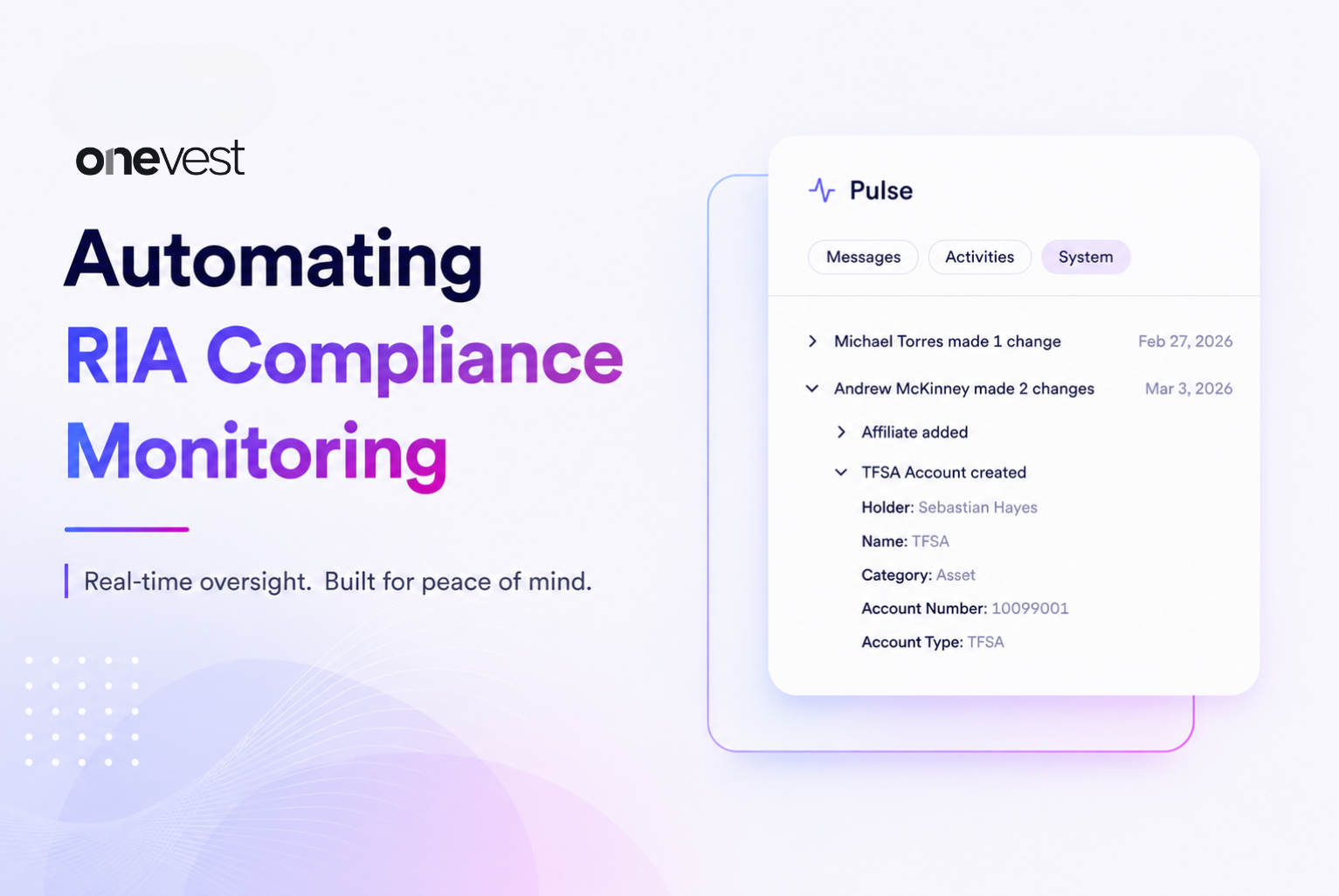
OneVest provides integrated supervision powered by agentic AI, built directly into the operational workflows of the platform rather than sitting alongside them as a separate tool. The system continuously monitors activity across onboarding, account servicing, money movement, and client data, surfacing exceptions and routing them to the appropriate compliance reviewer with the context needed to make a fast, informed decision. Every action is logged automatically, creating a complete and retrievable audit trail without additional manual documentation effort. Compliance determinations remain with the firm's own principals and compliance officers. OneVest's role is to make sure nothing is missed and that every decision is supported by clean, organized, exam-ready documentation.
Conclusion and Next Steps
Automating RIA compliance monitoring is not a trend to watch from a distance. It is the operational standard defining competitive advantage in 2026, particularly for RIA firms managing growing advisor teams, expanding client bases, and increasing regulatory surface area.
The firms that are staying ahead of compliance risk right now are not necessarily the ones with the largest compliance teams. They are the ones that have built intelligent supervisory infrastructure underneath their compliance officers, infrastructure that continuously monitors, surfaces, and documents issues without requiring a person to manually coordinate every step.
Every advisor a firm adds, every new custodian relationship it opens, every acquisition it integrates increases the compliance workload. That workload becomes manageable when the firm is operating on infrastructure designed to scale with it. Without that infrastructure, each expansion creates new exposure. The gap between firms that have made this investment and those that have not will only widen as regulatory expectations continue to rise through 2027 and beyond.
The next step for any compliance officer or RIA principal is practical. Audit your current supervisory workflows, identify where manual processes are creating gaps or delays, and evaluate whether your current technology can support the oversight obligations that come with the firm you are building toward. Intelligent compliance infrastructure is not about replacing the judgment that makes your compliance program effective. It is about giving that judgment the operational support it needs to work at scale.
Ready to modernize your firm's compliance infrastructure? Join leading RIA firms already using OneVest to build supervisory workflows that scale without scaling headcount. Explore OneVest.