The Agentic Wealth OS: How Growing RIA Firms Are Scaling AUM Without Adding Operations Headcount
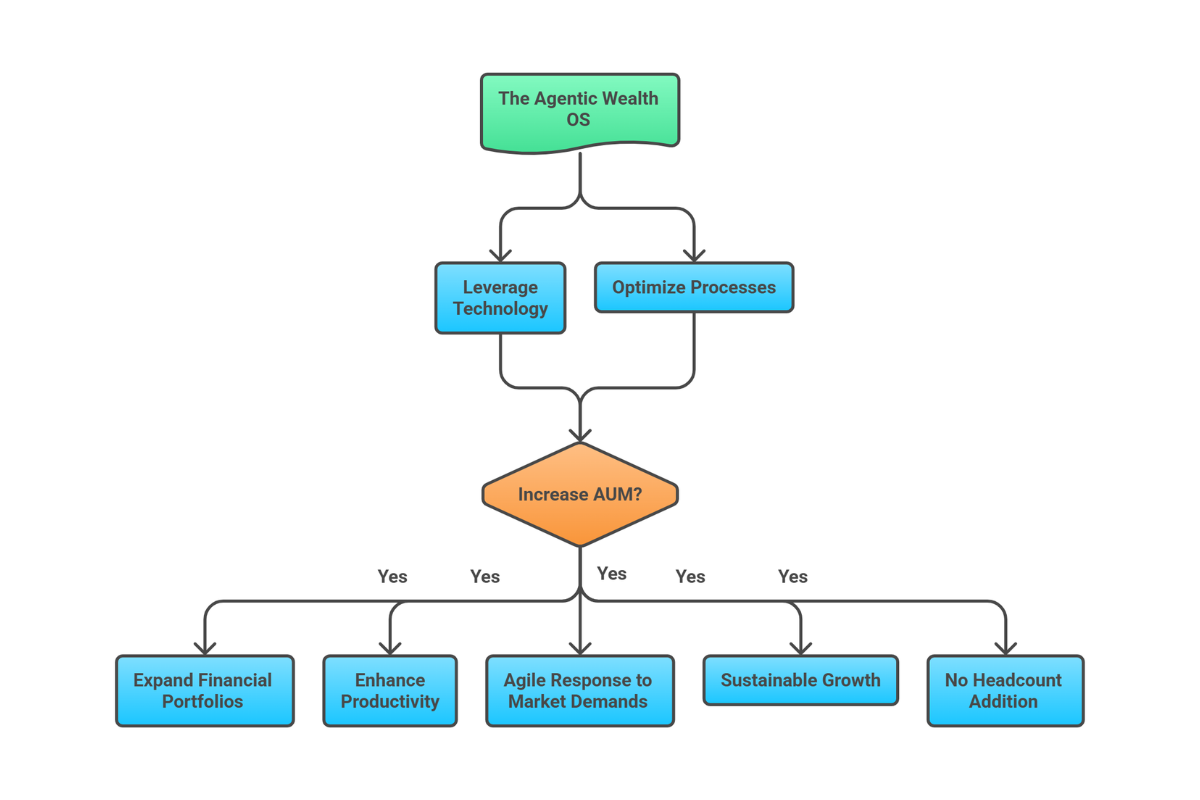
Agentic wealth management is reshaping how RIA firms grow. In 2026, the most competitive firms are not adding a back-office hire for every advisor they bring on. They are deploying intelligent, autonomous infrastructure that handles operational complexity at a pace and scale no manual team can match alone.
Executive Summary
Agentic AI platforms now manage end-to-end wealth management workflow operations, from client onboarding to account servicing and reporting, without requiring proportional increases in operations or administrative staff.
RIA firms growing through consolidation and advisor recruitment are doing so without the traditional burden of scaling their back office in lockstep.
Scaling AUM in 2026 requires infrastructure, not just advisors. The Agentic Wealth OS model is becoming the competitive standard for firms that want to grow without operational drag.
RIA executives who adopt agentic systems now are positioning their firms for the 2026 to 2030 growth cycle, whether that growth comes through M&A, recruiting, or organic advisor expansion.
1. What Does "Agentic" Mean in the World of Wealth Management?
Agentic wealth management refers to AI systems that execute workflows on behalf of a firm. These systems do not simply generate recommendations. They coordinate, execute, and manage client and operational workflows with minimal human oversight.
The term "agentic" comes from AI research. It describes models capable of goal-directed, multi-step action. Applied to wealth management operations, this means an intelligent system that moves a new client through onboarding, triggers the right compliance checks, coordinates account opening across custodians, surfaces the next advisor action, and logs everything for audit, all without a coordinator manually orchestrating each step.
For RIA firms, agentic infrastructure means the firm's operational capacity scales with the platform, not with the headcount behind it.
2. Why Traditional RIA Scaling Models Are Breaking Down
For decades, RIA growth followed a predictable formula: bring on more advisors, add more clients, grow revenue, and hire proportional operations and administrative staff to support them. That model faces serious structural pressure in 2026.
Every advisor added through a recruitment or acquisition has historically come with a corresponding demand for back-office support: client service associates, onboarding coordinators, compliance administrators, and reporting staff. Firms growing through consolidation face this multiplied. Each acquired practice brings its own operational complexity, and integrating it without additional headcount has historically been close to impossible.
At the same time, client expectations have risen sharply. Clients increasingly expect proactive, personalized communication and fast, error-free onboarding and account servicing. Manual processes cannot meet that standard at scale without a growing operations team.
The result is a capacity gap that hits hardest during consolidation. Firms that stick with traditional operating models find that growth through acquisition or recruiting creates immediate operational strain, slowing the very momentum they are trying to build.
3. What Does an Agentic Wealth OS Actually Look Like?
The Agentic Wealth OS treats a firm's technology stack as an operating system rather than a collection of disconnected point solutions. It integrates client data, portfolio management, compliance, communication, and reporting into a single intelligent infrastructure layer.
OneVest's Agentic Wealth OS is purpose-built for this. It is the operational infrastructure that sits underneath advisors and enables firms to run complex, multi-step wealth management workflows: onboarding, account opening, money movement, servicing, and reporting, without requiring a person to manually coordinate each step.
Key components include:
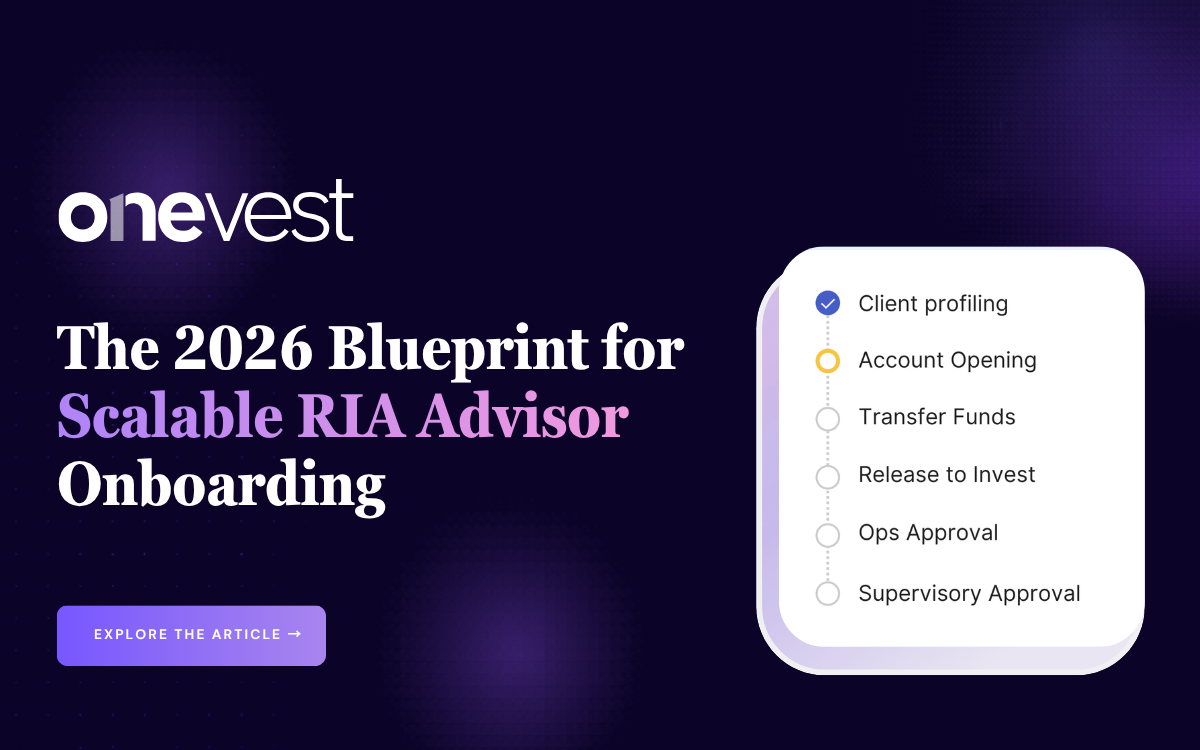
Agentic onboarding workflows that move new clients from KYC collection through account opening across custodians without manual handoffs
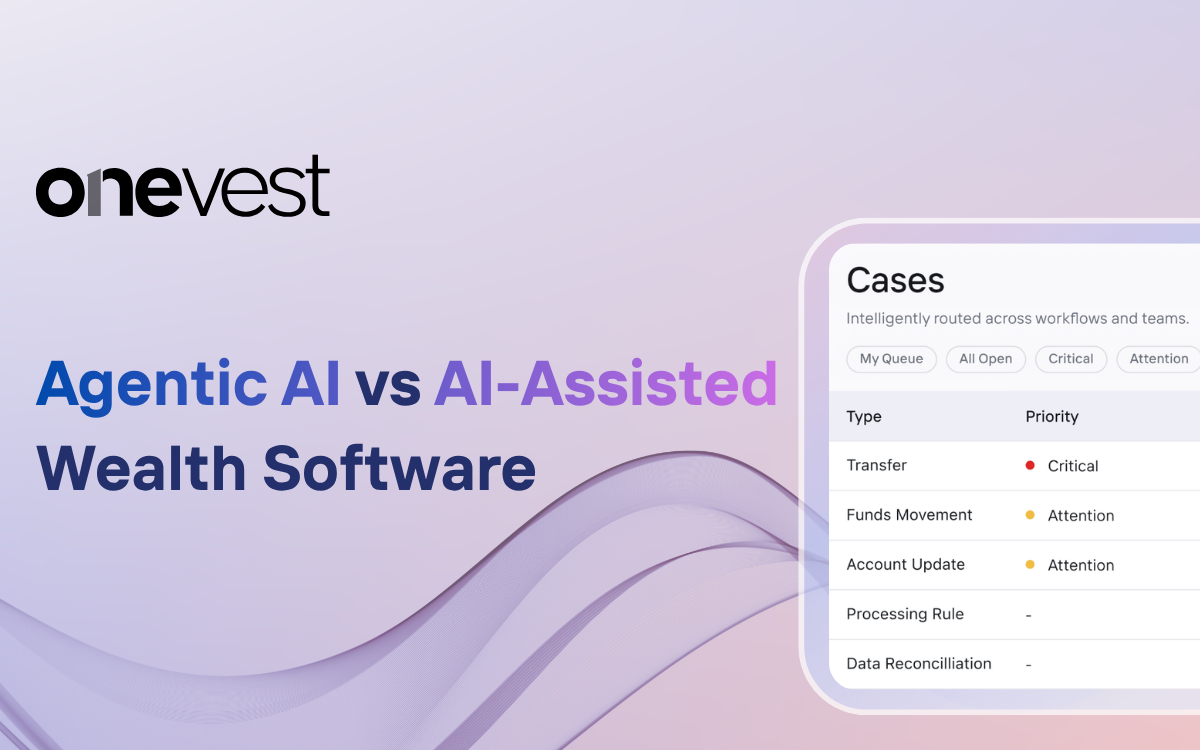
Intelligent account servicing that coordinates money movement, updates, and administrative tasks automatically
Unified data infrastructure that gives advisors a single, accurate view of each client without switching between disconnected systems
Embedded compliance and audit logging that surfaces exceptions for human review rather than requiring manual oversight of every action
Proactive advisor workflows that surface the next best action based on client data, portfolio state, and firm-defined rules
The firm's advisors and investment decisions remain entirely in control. The OS handles the operational complexity underneath them.
4. How Are Firms Scaling AUM Without Adding Headcount?
The answer lies in breaking the link between growth and operational headcount.
When a firm acquires another practice or recruits a new advisor team, the traditional playbook demands immediate investment in operations support: someone to onboard the new clients, someone to handle the paperwork, someone to manage the data migration, someone to coordinate with custodians. That overhead slows integration, compresses margins, and limits how aggressively a firm can pursue consolidation.
Firms operating on an Agentic Wealth OS break that equation. The platform handles the operational workflows that would otherwise require dedicated staff. A firm that acquires two practices in a quarter does not need to hire two new operations coordinators, because the infrastructure absorbs the volume.
The same dynamic applies to organic advisor growth. As advisors join and build their books, the OS scales with them. Advisors are not waiting on overloaded ops teams to process paperwork or open accounts. The platform moves it forward automatically, with human oversight built into the points that require it.
The result: AUM and advisor count grow, while operations headcount stays flat or grows far more slowly than it would under a traditional model. Each advisor on the platform can serve a larger book with less administrative friction, and the firm can pursue growth through M&A, recruiting, or both, without hitting operational capacity walls.
5. What Role Does Wealth Management Workflow Automation Play?
Workflow automation is the connective tissue of the Agentic Wealth OS. It ensures that every client action, market event, or compliance requirement triggers the right response automatically and routes it to the right person or system without a coordinator in the middle.
When a client completes onboarding or updates a financial goal, the platform surfaces the next required actions across CRM, portfolio management, and compliance, without manual handoffs or duplicate data entry. Advisors remain in control, but operational effort shifts from task management to oversight and client engagement.
The point of automation is not to remove the human touch. It is to make that human touch possible at scale. No advisor can independently track hundreds of clients' birthdays, tax situations, and life goals simultaneously, and no operations team can manually coordinate account opening and servicing across a large concurrent client base without errors and delays. A well-configured agentic system can, and it frees advisors and operations teams to focus on the work that actually requires their judgment.
6. Who Is Already Using Agentic Wealth Systems?
Adoption is accelerating across firm sizes. Larger RIAs and enterprise wealth management firms pursuing active consolidation strategies have been the earliest movers, drawn by the scalability benefits when integrating acquired practices. But mid-sized independents are closing the gap quickly as agentic platforms become more accessible and implementation timelines shorten.
The pattern is consistent: firms that deploy this infrastructure early are expanding advisor and client capacity without proportional headcount growth in their operations functions, and that advantage compounds with each subsequent acquisition or advisor hire.
7. How Do Firms Implement an Agentic Wealth OS?
Implementation does not require a complete technology overhaul. A structured approach reduces risk and accelerates time to value.
Step 1: Audit current operational bottlenecks. Map every manual process in the client and advisor lifecycle. Identify where operations and admin staff spend time on tasks that do not require human judgment: data entry, status coordination, document collection, account follow-up.
Step 2: Define scaling objectives. Set specific targets for AUM growth, advisors per operations FTE, integration timelines for acquisitions, and service quality benchmarks. These targets guide platform configuration.
Step 3: Select unified infrastructure over point solutions. OneVest's Agentic Wealth OS provides integrated infrastructure rather than disconnected tools. Integration reduces the friction that creates the need for manual coordination in the first place.
Step 4: Begin with high-volume, high-friction workflows. Start with client onboarding and account opening, the areas where manual coordination is most expensive and error-prone. Build operational confidence before expanding to more complex agentic functions.
Step 5: Train advisors as system orchestrators. Advisors in an agentic model shift from task executors to relationship strategists. Their role is to review, approve, and engage, not to coordinate paperwork. Investment in this role transition is critical to adoption.
Step 6: Configure human-in-the-loop oversight. Build in approval steps for high-stakes actions: large transfers, final account approvals, exception handling. The system should surface decisions that require human judgment, not replace it.
Step 7: Measure, iterate, and expand. Track advisor capacity, operations team workload, AUM per advisor, and integration timelines for new practices. Use data to guide system expansion and to build the business case for continued investment.
Frequently Asked Questions
What is an Agentic Wealth Operating System?
An Agentic Wealth OS is a unified, AI-native infrastructure designed to orchestrate the complex operational workflows of a wealth management firm. Unlike traditional software that records data and requires people to act on it, an agentic system uses intelligent agents to execute multi-step workflows such as client onboarding, account opening, money movement, and account servicing, with high precision and without manual coordination at every step. It acts as the firm's operational backbone, handling the complexity underneath advisors so they can focus on client relationships and growth.
How does "agentic AI" differ from standard automation?
Standard automation follows linear, rule-based logic: if this, then that. Agentic systems are goal-oriented. They can navigate multi-step processes, adapt to new data inputs, coordinate across multiple systems, and handle exceptions, all in service of completing a workflow outcome. This shift moves firms away from static, siloed tools toward a dynamic infrastructure layer that actively manages the operational lifecycle of the firm without requiring a person to manage the automation itself.
Is there human oversight in an agentic system?
Absolutely. Modern agentic platforms are built on a human-in-the-loop philosophy. The technology handles the operational heavy lifting while ensuring that people remain the ultimate decision-makers. This is managed through:
Embedded approvals: High-stakes actions such as final account approvals or large fund transfers require human validation before execution.
Exception management: The system is configured to flag inconsistencies and edge cases for expert human review rather than proceeding with incomplete or potentially flawed data.
Audit trails: Every action taken by the system is logged, creating a transparent record for compliance, supervisory review, and regulatory purposes.
What is an MCP server, and why does it matter for wealth tech?
The Model Context Protocol (MCP) is an open standard that enables seamless integration between AI models and the data sources and tools they need to act on. OneVest offers MCP servers that allow firms to connect their proprietary AI or third-party LLMs directly to their wealth management data and workflows. This gives the AI the operational context it needs to surface accurate insights or initiate tasks within a secure, controlled environment, without compromising data integrity or requiring custom engineering work for every integration.
How is client data protected within these systems?
Data sovereignty is a core design principle. OneVest functions as a secure processor, acting strictly on the instructions of the firm. Security is maintained through enterprise-grade, role-based access controls that ensure only authorized personnel can view sensitive client information, and through infrastructure built to align with modern regulatory guidance, including SEC cybersecurity standards, using bank-grade encryption for data at rest and in transit.
Which workflows should a firm prioritize first?
To see the fastest results and build organizational confidence, firms should prioritize the high-friction operational workflows that sit between the advisor, the client, and the custodian:
Digital onboarding: Automating KYC collection, document extraction, and the coordination required to move a prospect to a funded client without manual handoffs.
Account servicing: Streamlining money movement requests, administrative updates, and routine account maintenance that currently require operations staff to coordinate manually.
Unified data consolidation: Bringing fragmented client and portfolio data into a single source of truth so advisors are not jumping between legacy platforms to get a complete picture of a client's situation.
Conclusion and Next Steps
Agentic wealth management is not a trend to watch from a distance. It is the operating model defining competitive advantage in 2026, particularly for RIA firms pursuing growth through consolidation, advisor recruitment, and expanding books of business.
The firms winning right now are not necessarily the ones with the most advisors. They are the ones that have built intelligent operational infrastructure underneath their advisors, infrastructure that absorbs the complexity of growth without requiring a proportional expansion of the back office.
Every acquisition a firm makes, every advisor team it recruits, every new client relationship it opens, these become leverage points when the firm is operating on an Agentic Wealth OS. Without it, each one creates operational drag. The gap between firms that have made this infrastructure investment and those that have not will only widen as the pace of consolidation accelerates through 2027 and beyond.
The next step for any RIA executive is practical. Audit your current operational workflows, identify where manual coordination is the bottleneck to growth, and evaluate whether your current technology stack can support the advisor count and AUM targets your firm is building toward. Intelligent wealth infrastructure is not about replacing what makes your firm great. It is about giving that greatness the operational room to scale.
Ready to Grow Your Advisory Firm? Join leading RIA firms already using OneVest to scale their operations without scaling their headcount. Explore OneVest
Keep Reading
BlogOneVest Pulse: The Live Activity Stream Where Conversation Becomes Command
Fast-growing wealth management firms require solutions that can keep pace with the shifting operational needs of wealth management firms and their advisors. As firms scale, the way teams collaborate becomes a critical factor in their success. When we look closely at the challenges that slow firms down, fragmented collaboration and repetitive manual work are consistently the biggest hurdles. Advisors and operations teams often find that email is the ultimate "swivel-chair" tool, it is where they live, yet it is disconnected from their core systems. Constantly toggling between an inbox and a wealth platform to move a single task forward creates a drag on productivity. Bridging the Gap Between Chat and Execution To solve the friction of "operational drag," firms need more than just another internal chat tool; they require a unified interface where communication and data exist in the same space. The ideal solution is a system that bridges the gap between high-level advisor conversations and back-office execution. It should allow team members to communicate, assign tasks, and trigger complex workflows without ever losing the context of the client or the account they are discussing. By centralizing these interactions, a firm can ensure that every decision is logged, every handoff is seamless, and every team member, from the advisor to the home office, is looking at a single source of truth. OneVest Pulse was created as a direct response to these specific challenges. It serves as a live command layer that integrates real-time messaging, team collaboration, and agentic execution into a single, context-aware stream. Pulse runs alongside the main content of every workspace, whether you are viewing a client, an opportunity, or a specific case. It provides a chronological, audit-ready history of every action taken within the firm, finally enabling advisors and their teams to communicate and execute in one place. Why Pulse is the Strategic Link in Your Tech Stack 1. Unified Integration with Microsoft Teams & Slack The biggest barrier to institutional speed is the disconnect between communication and execution. OneVest Pulse bridges this gap: Centralized Visibility: Pulse syncs your team chats and assigned tasks directly with Slack and Microsoft Teams so updates exist in both places. This ensures that whether a task is assigned in the platform or discussed in a channel, the entire team stays aligned in real-time.Bi-Directional AI Command: Beyond simple notifications, you can chat directly with the OneVest agent within Slack or Teams. This allows you to create tasks, trigger cases, and execute workflows using natural language from your mobile device or desktop without ever leaving your primary communication tool. 2. Context-Aware Messaging & Smart Tagging Unlike a standard chat app, every entry in Pulse is inherently linked to a specific record. Smart Mentions (@): Tag specific users, teams, or the AI Agent to bring them into a workflow.Email Synchronization: On client pages, Pulse syncs emails from connected inboxes, placing client communications directly alongside internal notes and system events.Secure Client-to-Advisor Chat: Pulse serves as the bridge between the advisor team and the client. Through secure messaging, advisors and operations can communicate directly with clients via the client app. These conversations flow into the same Pulse stream, keeping all client-facing and internal dialogue in one organized, context-rich location. In a world of increasing financial fraud, this encrypted channel provides clients with the peace of mind that they are always interacting within a verified, protected environment rather than over vulnerable email. 3. Ask Anything, Execute Anywhere Pulse introduces a conversational interface for firm-wide data. Using the + Quick Actions menu or natural language chat, teams can: Log Activities: Enter recorded calls, meetings, or notes as activities for the rest of the team to see.Execute: Launch new Tasks or Opportunities that are automatically linked to the current client or account. You can ask Pulse to start workflows like onboarding, account opening or money movement.AI Enrichment: Use the AI Enrich action to extract key data from stored emails and attachments, transforming raw text into actionable insights.Voice-to-Action Commands: Use natural voice language to command and refine tasks on the fly. Simply speak to Pulse to update records or adjust workflows, making it faster to execute and manage operations while on the go. The Benefits of Unified Team Collaboration OneVest Pulse serves as a high-speed collaboration hub, enabling seamless chat communication between advisors, operations, and home office teams. By housing these interactions in one place, firms can move away from scattered email threads and siloed spreadsheets. Centralized Communication: Pulse enables real-time chat between advisors and their support teams, ensuring everyone is aligned on client needs without leaving the platform.Organization by Context: Because messages and discussions are attached directly to relevant files and records, teams stay organized. You no longer spend time looking for the "latest version" of a document or the status of a request; the context is always right there.Operational Efficiency: Collaboration happens more efficiently when the data is adjacent to the discussion. Teams can resolve questions and move workflows forward in significantly less time.Compliance & Audit Readiness: Compliance teams have a full audit trail available at their fingertips. Every internal discussion, file attachment, and system change is logged, making regulatory reviews straightforward and transparent. From Back-Office Productivity to Front-End Client Results OneVest Pulse serves as the central hub for the entire firm, housing all communication between advisors, operations, support, and home office teams in one place. By centralizing these chats, firms ensure that every internal stakeholder stays aligned without the need for fragmented email chains. For Advisors Advisors can manage their book of business more efficiently by triggering commands via conversation. By interacting with the AI Agent via Slack or Teams, they can pull data or launch workflows while on the move, reducing time spent on administrative data entry and manual follow-ups with support teams. For Operations & Support Teams Pulse places operations and support at the center of a streamlined flow. Because the communication with the advisor is housed directly alongside the record, teams have immediate context. With Related Items such as upcoming tasks and open opportunities on display, they no longer have to dig through menus to identify what requires attention. For the Home Office & Compliance By consolidating advisor, ops, and support communications into one place, Pulse provides the Home Office with a "Master View" of firm activity. Every action, whether human-driven or AI-driven, is logged in a permanent, read-only audit trail. Compliance teams can filter by System events to see a transparent history of record changes, ensuring the firm remains audit-ready at all times. Frequently Asked Questions What is an Agentic Wealth OS? An Agentic Wealth OS is a comprehensive platform where AI does more than just summarize data. It acts as an agent capable of executing complex workflows, routing approvals, and managing back-office tasks autonomously. OneVest Pulse serves as the interface for this interaction. How does AI improve wealth management platforms? AI increases firm capacity by automating repetitive administrative tasks, such as data extraction and meeting logging. In OneVest, the AI Assistant provides context-aware support directly within the Pulse feed to help teams make faster, data-driven decisions. Why is integration with Slack and Microsoft Teams important for RIAs? Most wealth management communication happens outside the CRM. By integrating with Slack and Teams, OneVest Pulse ensures that these conversations are captured, compliant, and linked to actual operational tasks. Can OneVest Pulse help with regulatory compliance? Yes. Pulse maintains a permanent, read-only audit trail of all system and audit events. This ensures that every record change or approval is logged and traceable, simplifying the reporting process for compliance officers. How does Context-Awareness work in a wealth platform? Context-awareness means the system knows exactly which client, account, or task you are discussing. When you post in Pulse on a client’s page, the system automatically links that data, preventing the information silos common in traditional software. Stop Managing Software. Start Deploying Intelligence. The future of wealth management is found in the elimination of friction. By integrating with Microsoft Teams and Slack and turning every message into a context-aware command, OneVest Pulse ensures your firm moves as fast as the markets. Book a Demo Today and see how we’re turning talk into action.
BlogThe Investor-Led Revolution: How Client Expectations Are Redefining Wealth Management Software for RIAs
The strategic mandate for 2026 is clear: digital wealth management has become the primary interface of trust. In this AI-native era, the investor is now the primary architect of your technology requirements. We have moved beyond the days when digital tools were merely an option; they are now the foundation of the advisor-client relationship. As investors’ lives become more complex, their expectations for wealth management software have shifted from simple portfolio reporting to a demand for a complete picture of their financial health. This article is the first installment in our comprehensive series, The Top 7 Criteria for an AI-Native Wealth Management Platform: A Buyer’s Guide for Growing RIA Firms. As the wealth management industry enters an AI-native era, firm leaders must evaluate technology not just as a tool, but as a strategic operating system that drives advisor productivity and scales hyper-personalization for investors. This guide provides a roadmap for CEOs, CTOs, and Heads of Wealth at mid-sized RIAs to identify the critical features, from data unification to agentic workflows, that will distinguish market leaders by 2030. You can read the full guide here: The Top 7 Criteria for an AI-Native Wealth Management Platform: A Buyer’s Guide 1. Transparency Through Unified Household Management The modern investor no longer views their finances as a collection of isolated accounts. They expect their advisor to provide a "single pane of glass" view that encompasses taxable accounts, 401(k)s, and private market holdings. For a CTO, this means client portal software for financial advisors must move away from fragmented data toward true unification. 84% of advisors now view the ability to manage a client’s entire household through a single, coordinated portfolio as a "valuable" or "significant" advantage for the investor.Currently, 63% of firms report their data is mostly or fully unified, meaning data flows seamlessly or with only minor manual processes.Despite the push for modernization, 34% of advisors admit their data is only "minimally unified," requiring manual entry or reconciliation. Strategic Insight: For mid-sized firms, data unification isn't just an operational preference; it is a retention strategy. The ability to show an investor their "Total Wealth" in real-time is the new baseline for the HNW experience. Source: Orion 2026 Advisor Wealthtech Survey 2. Reclaiming the "Human Premium" Through Automation Investors no longer want to pay for an advisor to handle paperwork; instead, they are looking for wisdom, behavioral coaching, and help with complex problems. While modern clients are explicitly asking for more one-on-one time, many advisors are bogged down by administrative tasks that keep them away from their investors. This "time scarcity" cycle means that instead of delivering high-value engagement, advisors are trapped doing manual work that could be handled by a more efficient system. Advisors currently spend a staggering 59% of their time on non-client-facing tasks like administration, compliance, and firm management (Fidelity: The Time-Value Equation, 2025).Shifting just five hours a week toward client-facing activities could generate an additional $270,000 in annual revenue per advisor (Fidelity: The Time-Value Equation, 2025). Strategic Insight: CEOs must view wealth management software as a capacity-building tool. Every manual hour reclaimed from the back office is an hour reinvested into the "human premium" that keeps investors loyal. Source: Fidelity: The Time-Value Equation (2025) 3. Hyper-Personalization and the Alts Surge The "next-gen" investor is not interested in a standardized 60/40 model. They expect hyper-personalization that includes tax-loss harvesting at the individual security level and access to institutional-grade alternative assets. 77% of advisors managing portfolios for investors in the $3M to $5M range and $6M to $10M range expect to have dedicated allocations to alternative assets by the end of 2026.High fees are cited by 31% of advisors as the primary challenge in helping clients invest in alternatives.28% of advisors state that simplified onboarding and subscription processes are the most helpful technological capability for incorporating these assets. Strategic Insight: For a Head of Wealth, the "product" is no longer just the investment; it is the access and the experience. Modern digital wealth management must make complex assets as easy to subscribe to as a mutual fund. Source: Orion 2026 Advisor Wealthtech Survey 4. The Human-AI Hybrid: Scaling High-Touch Trust As we move toward 2030, the investor’s relationship with technology will shift from "tool" to "intelligence." The expectation is that AI will provide the analytical heavy lifting, while the advisor provides the ethical and emotional guardrails. Only 38% of affluent investors currently report being comfortable with AI technology in their financial relationships, highlighting a significant "trust gap" that advisors must bridge (Cerulli Associates, February 2026).One-quarter of large-scale RIAs are now moving beyond back-office automation to use AI for client engagement tracking and CRM updates, aiming to create more personalized investor touchpoints (Cerulli Associates, January 2026). The shift toward an AI-augmented model is less about replacing the advisor and more about refining their role. As AI agents begin to handle complex decision flows and data processing, the advisor's value proposition moves toward "advice intellectual property", the unique ability to navigate emotional nuances and ethical dilemmas that machines cannot yet grasp. For mid-sized firms, the goal is to build an infrastructure where AI acts as a "client brain," consolidating data to ensure that every recommendation is grounded in the investor's specific life context. Strategic Insight: For the CTO, an AI strategy isn't about replacing the advisor; it's about providing the advisor with "superpowers." Investors want an advisor who is augmented by AI, not one who is distracted by it. Source: Cerulli Associates: Billion-Dollar RIAs Accelerate AI and Data Investments (January 29, 2026); Cerulli Associates: Investors remain skeptical of AI in financial advice (March 17, 2026) Frequently Asked Questions: Wealth Management Software and the AI-Native RIA What is the role of wealth management software in the modern RIA firm? Wealth management software serves as the primary operating system for a firm, integrating portfolio management, client communication, and back-office workflows into a single ecosystem. In the AI-native era, this software has shifted from a simple record-keeping tool to a "force multiplier" that uses automation to amplify advisor effectiveness and firm-wide growth. How does a seamless mobile experience benefit both the advisor and the investor? Seamless mobile experience ensures that wealth relationships keep moving, regardless of location. For the investor, it provides "always-on" access to their unified household records and portfolio data, which is essential for building trust in a digital-first era. For the advisor, a mobile-optimized application like OneVest Go allows for instant client readiness, enabling them to search communications, answer questions, and view automated activity summaries directly from their device. This mobility reduces the administrative "noise" of jumping between tools and ensures that prospecting and client management happen in a continuous, efficient stream of work. How does digital wealth management software help firms meet investor expectations? Investors today expect a "Personal CFO" experience characterized by high transparency and hyper-personalization. Modern digital wealth management platforms meet these demands by providing unified household reporting and the ability to seamlessly incorporate complex assets, like private equity or private credit, into a coordinated portfolio strategy. What are the key features to look for in a client portal software for financial advisors? A high-quality client portal software for financial advisors should prioritize data unification, ensuring that information flows seamlessly across all systems without requiring manual reconciliation. Key features include real-time access to holistic performance data, secure document management, and AI-driven insights that help investors understand their financial progress in the context of their personal goals. Can wealth management software effectively solve "time scarcity" for advisors? Yes. By automating administrative "heavy lifting", such as meeting preparation, compliance monitoring, and data management, wealth management software allows advisors to reclaim significant portions of their day. Modern platforms specifically target the "administrative drag" of onboarding, reducing the constant back-and-forth between advisors, admins, and clients through simplified subscription processes and automated data extraction. Research suggests that cutting down these manual hurdles is essential for shifting focus back to the client-facing activities that drive organic growth. Reducing this friction ensures that wealth relationships keep moving forward rather than getting stuck in a cycle of paperwork and repetitive follow-ups. What is the benefit of an AI-native approach to wealth management? An AI-native platform eliminates traditional data silos and enables "agentic" workflows where the software can anticipate client needs automatically. This allows mid-sized firms to scale their operations and deliver a sophisticated, white-glove investor experience without a proportional increase in operational headcount. Why is data unification critical for the future of wealth management? Disconnected systems and point solutions are currently the top pain point for advisors, leading to incomplete data that cannot be aggregated. A unified platform ensures a single source of truth, which is vital for building investor trust and providing the high-level, data-driven advice that will distinguish successful firms in the coming years.
NewsOnevest Recognized as a 5-Star Wealth Tech Provider by Wealth Professional
We're proud to share that Onevest has been recognized as a 2026 5-Star Wealth Tech Provider by Wealth Professional. The annual report highlights the firms genuinely moving the needle for modern advisors, solving the problems wealth managers face every day, from onboarding and planning through monitoring, reporting, and compliance. The award recognizes a specific set of standout features that the 5-Star providers share: automating low-value work across the lifecycleleveraging specialized, explainable AIdelivering personalized, digital-first client experiencesbeing purpose-built and deeply aligned with regulatory and operating realitiesclearly expanding advisor capacity, reach, and economics For wealth managers and advisors, the question is no longer whether to invest in technology, but which providers are genuinely solving real-world problems. The 5-Star Wealth Tech Providers are the partners firms turn to when legacy systems slow growth, when data is scattered across platforms, or when manual processes can no longer keep pace with regulatory and client demands. Being named to this list reflects the work we've done alongside our clients to build a platform that scales with them. At the centre of that work is the Onevest Agentic Wealth OS, our platform built directly around the needs of modern wealth management firms. It unifies onboarding, planning, portfolio management, monitoring, reporting, and compliance on a single foundation, with a specialized AI agent that takes on the repetitive work that has traditionally consumed advisor time. The Agentic Wealth OS is shaped by the same forces this award recognizes: rising client expectations, mounting compliance demands, fragmented data, and the need to grow capacity without growing headcount. It is our answer to the problems the firms on this list set out to solve. We're proud to be acknowledged on each of these dimensions, and equally proud of the company we're keeping on the list. To our clients, partners, and the Onevest team, thank you. Read the full report on Wealth Professional