Built for Scale: How Customer Feedback Shaped OneVest’s 2025 Product Advancements
Over the past year, OneVest partnered closely with our customers, RIAs and enterprise wealth organizations to understand the day-to-day challenges that slow advisory teams down. What firms asked for wasn’t more features; it was better foundations. Wealth managers wanted cleaner data, more flexible account structures, smarter automation, and infrastructure that scales as the business grows.
The product advancements introduced throughout 2025 were shaped directly by those needs. Below are the four themes we heard most consistently from customers, and the investments we made in response.
1. “Our teams need to spend less time managing tasks and more time serving clients.”
Advisors want to focus on relationship-building and strategic work, not administrative tasks. Firms requested tools that help teams stay on top of priorities without increasing operational overhead. That’s why we created:
AI-Driven Next Best Actions
The Next Best Action feature surfaces timely reminders, follow-up opportunities, and high-priority tasks based on activity patterns and book-of-business dynamics. It helps advisors allocate attention where it has the most impact, supporting deeper client engagement and more productive days.
A No-Code Workflow Builder That Adapts to Each Firm
Every firm operates differently, and workflows must reflect unique service models and regulatory requirements. OneVest’s improved dynamic workflow builder allows operations teams to design, deploy, and iterate on onboarding, compliance, and service workflows, all without engineering support. This provides firms with the flexibility to adapt processes as the business evolves.
Role-Based Notifications for Home Office Control
OneVest’s new and improved notification system delivers greater flexibility and oversight for home offices by allowing different types of notifications to be configured, controlled, and delivered based on role. The platform now supports a wide range of real-time, in-app alerts across the advisor portal and client web app, ensuring that each update reaches the right audience with the right context.Admins benefit from enhanced control over compliance-related and operational notifications. Advisors receive timely workflow and client updates that streamline communication and improve service responsiveness. Clients experience a more transparent, professional journey through proactive alerts that reinforce trust and reduce friction throughout their financial interactions.
2. “Our client relationships are more complex than traditional householding.”
Modern clients increasingly manage multiple entities, trusts, investment goals, and region-specific accounts. Firms needed more flexibility to reflect these complexities in their systems. So we brought:
Smarter Account Structures with Account Groups
Account Groups allow firms to organize and manage accounts by trust, entity, investment objective, or any structure that mirrors a client’s real financial life, far beyond traditional householding. This makes planning and oversight easier for multi-entity or multi-goal relationships.
Account-Level Role-Based Access
To match more complex structures, firms also requested more granular access controls. OneVest introduced account-level permissions to define who can view and manage specific accounts, including support for POA and custom roles across multi-advisor or multi-region teams. This strengthens compliance while enabling more precise delegation.
3. “We need systems that scale without adding operational burden.”
As firms expand into new regions, add advisors, or integrate new custodians and tools, they require technology that supports complexity without slowing down their teams. That means:
Configurable, Branded Reporting
OneVest introduced fully configurable, no-code reporting tools that enable firms to select key data points, customize layouts, and apply their own firm branding. Reports more easily support regulatory, operational, and client-facing needs without engineering assistance or manual workarounds.
A Stronger, More Connected Infrastructure
Behind the scenes, OneVest enhanced platform connectivity across custodians, CRMs, portfolio systems, and compliance tools. These upgrades create a unified operational view, reduce manual processes, and support faster onboarding, ensuring the platform scales alongside each firm.
4. “We need a clearer understanding of our clients and advisors.”
Firms emphasized the importance of seeing how advisors and clients interact with technology. Better visibility helps improve onboarding, refine training, and strengthen digital experiences across the organization. So we introduced:
Behavior Analytics with Mixpanel
OneVest integrated Mixpanel to give firms deep behavioral intelligence across advisor and client journeys. This includes insight into:
Onboarding drop-off points
Workflow adoption trends
Engagement patterns across regions, teams, or firm structures
Client adoption of our user-centric experiences, like the mobile app, helping firms identify what is gaining traction and where additional enablement is needed
This investment ensures our technology evolves based on real user behavior, enabling continuous refinement and a smarter, more responsive platform over time
A Real-Life View of Total Net Worth
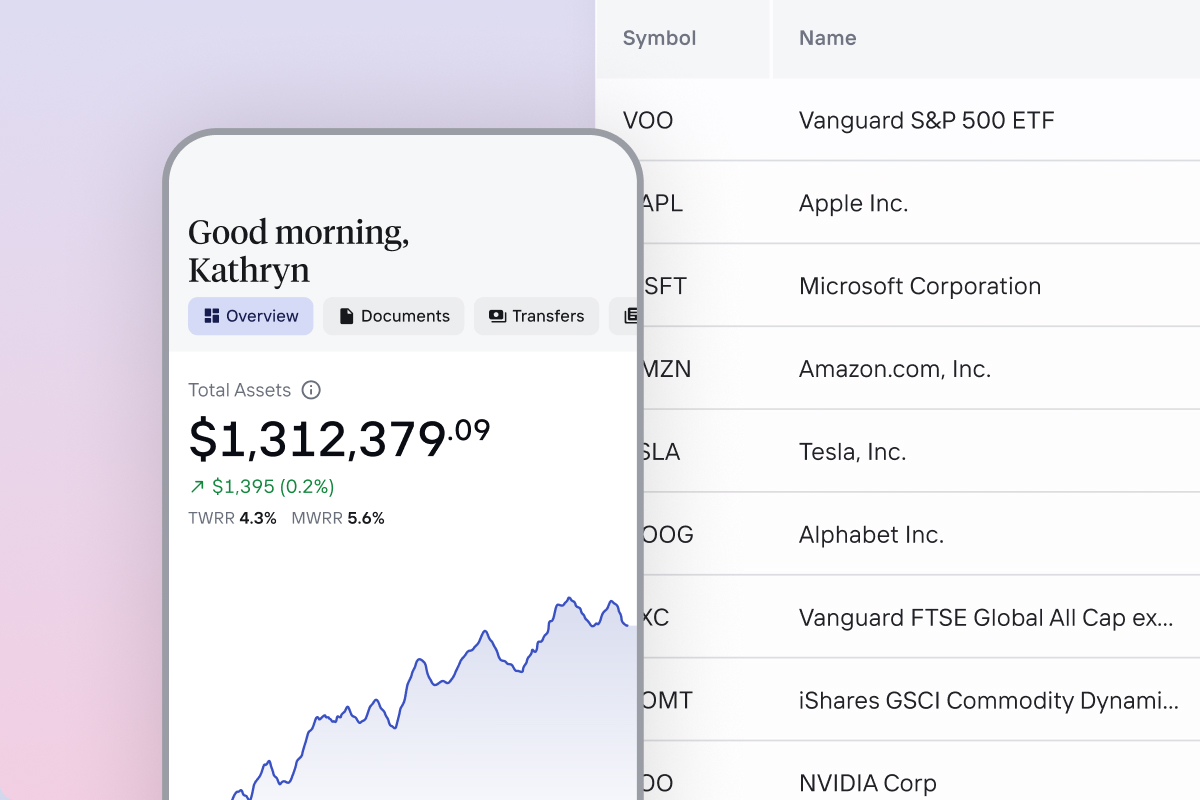
Clients and advisors expect a comprehensive view of wealth contained in one place. OneVest’s Net Worth experience brings together liabilities, held-away accounts, real estate, private investments, and other assets in a clean, real-time interface. Plaid integration enables clients to securely connect external accounts, while additional assets can be added manually to ensure that every aspect of a client’s financial picture is captured. This unified view supports more complete planning conversations and reduces reliance on fragmented tools.
Built Through Customer Collaboration
Every enhancement released in 2025 reflects direct input from the firms using OneVest’s technology every day. The goal remains consistent: to build a modern, intelligent wealth management infrastructure that adapts to the realities of advisory work and supports the home office. From advisor-led RIAs to enterprise wealth firms operating across regions, OneVest empowers institutions to implement rapidly, maintain control and brand identity, and deliver connected client and advisor experiences.
Keep Reading
BlogHow to Reduce Manual Wealth Management Operations: A Step-by-Step Guide
Manual Processes Are Costing Wealth Management Firms More Than They Realize In 2026, wealth management firms that eliminate operational drag are unlocking faster growth, stronger compliance posture, and better client outcomes. The firms falling behind are not short on talent. They are short on infrastructure. Executive Summary Wealth ops automation meaningfully reduces the time advisors spend on administrative tasks, freeing capacity for revenue-generating work. Operational drag quietly costs mid-sized firms in lost advisor productivity and error-driven rework. Firms that adopt scalable wealth platforms consistently report faster onboarding, fewer compliance incidents, and improved client satisfaction within the first few months of implementation. The 2026 to 2030 outlook favors firms that prioritize fintech integration solutions and back-office optimization now. What Does "Manual Wealth Management Operations" Actually Mean? Manual wealth management operations refer to any back-office or middle-office task performed by people without automation support. This includes data entry, trade reconciliation, client onboarding paperwork, compliance reporting, and fee billing. According to experts in financial operations streamlining, these tasks consume a significant portion of a typical advisor's working week. That figure represents a substantial administrative burden reduction opportunity for firms willing to act. The problem is not a lack of skilled people. The problem is skilled people doing work that technology handles better. A back-office optimization strategy reclaims that time and redirects it toward client-facing and revenue-generating activity. Why Operational Drag Is a Growth Killer in 2026? Operational drag compounds silently. Every manual touchpoint adds latency, introduces error risk, and consumes headcount. In 2026, most wealth management firms are still carrying more of it than they realize. The administrative burden on advisory teams remains substantial. A meaningful portion of the work week across firms of all sizes gets absorbed by tasks that could be automated or eliminated, leaving advisors less time for the work that actually moves the needle. The financial cost is real, even if it often goes unmeasured. Inefficient data reconciliation and manual compliance workflows quietly erode margins, and the larger the firm, the larger the bleed. What looks like a process inefficiency on paper translates directly into lost revenue at scale. Client experience suffers too. Slow onboarding remains one of the leading reasons clients leave a firm, which means operational drag is not just an internal cost. It is a retention risk. Tightening those workflows is not just about efficiency. It is about giving clients a reason to stay. What Are the Biggest Sources of Manual Work in Wealth Ops? According to experts across the fintech integration solutions space, five categories dominate manual workload in wealth operations. Client onboarding tops the list. Gathering KYC documents, verifying identity, and populating account data manually takes far longer in firms without client onboarding automation than it should. Compliance reporting ranks second. Manual compliance task automation gaps force operations teams to compile regulatory reports by hand, increasing error rates compared to automated alternatives. Data reconciliation is the third major driver. Discrepancies between custodians, portfolio management systems, and CRMs require daily human review in most firms. Fee billing and calculation introduces another layer of manual risk. Complex billing structures applied manually generate billing errors at a rate that is simply not sustainable as firms scale. Performance reporting rounds out the top five. Producing customized client reports without automation is a time-intensive process that limits how frequently firms can deliver meaningful reporting to clients. Step-by-Step: How to Reduce Manual Wealth Management Operations This is the operational framework that leading firms use in 2026 to eliminate manual bottlenecks systematically. Step 1: Conduct a full operational audit. Map every manual task across the client lifecycle. Document frequency, time cost, and error rate. This baseline makes the ROI case undeniable. Step 2: Prioritize by impact and feasibility. Rank tasks using a simple matrix: high time cost plus high error rate equals highest priority. Client onboarding automation and compliance task automation typically surface at the top. Step 3: Select scalable wealth platforms that integrate with existing systems. Technology-driven advisory firms avoid rip-and-replace migrations. The priority is fintech integration solutions that connect to current custodians and CRMs. Step 4: Automate client onboarding first. This delivers the fastest visible ROI. Digital onboarding workflows dramatically reduce new client setup time in most implementations. Step 5: Implement compliance task automation. Automate regulatory data aggregation, report generation, and audit trail logging. This step alone reduces compliance labor costs considerably on average. Step 6: Address data reconciliation processes. Deploy reconciliation software that pulls from all data sources automatically. Daily exceptions shrink from hours of review to minutes. Step 7: Automate billing and performance reporting. Connect billing logic directly to portfolio data. Eliminate manual calculation entirely. Step 8: Train operations teams on exception management. Staff shift from task execution to oversight. This is the culture change that sustains automation gains long term. Step 9: Measure, report, and iterate. Track time saved, error rates, and client satisfaction quarterly. Use data to identify the next automation priority. Which Workflow Automation Tools Are Leading the Market in 2026? The workflow automation landscape in 2026 has moved beyond static, rule-based layers to agentic AI workflows and integrated operating systems designed specifically for the complexities of advisory firms. Unlike previous generations of automation, these systems utilize the Model Context Protocol (MCP) to create a standardized, secure connection between AI agents and fragmented financial data sources. Experts note that the most effective implementations leverage these connected MCP tools to allow AI agents to securely navigate between custodians, CRM data, and compliance engines. This protocol eliminates the "context rot" common in older systems, ensuring that AI agents have the real-time, high-fidelity data needed to execute multi-step tasks, such as rebalancing portfolios or flagging nuanced compliance risks, without manual intervention. Firms are reporting the highest operational efficiency gains by adopting platforms that offer end-to-end agentic orchestration across onboarding, billing, and reporting within a single environment. By moving away from fragmented point solutions and toward unified, agent-enabled ecosystems, firms are eliminating the operational drag of manual data syncing and finally achieving truly autonomous middle-office operations. How Does Client Onboarding Automation Change the Game? Client onboarding automation is the single highest-leverage automation investment a wealth ops team can make in 2026. The impact is direct. Firms using digital onboarding workflows process new accounts significantly faster than manual counterparts. Client satisfaction scores rise meaningfully within months of implementation, according to fintech research from 2026. Beyond speed, client onboarding automation dramatically reduces document errors. Digital forms with built-in validation eliminate the back-and-forth that frustrates both clients and staff. An operations manager implementing onboarding automation also reduces the risk of non-compliance at the point of account opening, since required fields and checks are enforced automatically. What Role Does Compliance Task Automation Play? Compliance task automation addresses one of the most persistent sources of administrative burden in wealth management. By offloading high-volume, low-discretion tasks to agentic AI workflows, firms are fundamentally shifting the compliance-to-admin ratio. Regulatory complexity increases every year. In 2026, wealth firms manage compliance obligations across multiple regulatory frameworks simultaneously. Manual processes simply cannot scale with that complexity. Connected MCP tools now handle the heavy lifting of data aggregation, report formatting, deadline tracking, and audit logging without human intervention. According to experts in financial operations streamlining, firms using these automated layers reduce regulatory review time substantially year over year. The true power of this automation lies in the reclamation of time. By automating the time-sink admin tasks, like cross-referencing trade logs or manual document filing, compliance officers are finally free to focus on activities that move the needle: Proactive Education: Designing and delivering tailored training programs that foster a culture of compliance rather than just checking boxes. Industry Foresight: Dedicating time to analyze emerging standards and shifting global regulations before they become bottlenecks. Strategic Oversight: Utilizing powerful, AI-driven analytics to identify subtle risk patterns that traditional manual sampling would likely miss. Beyond efficiency, this shift reduces regulatory penalties. Firms with automated compliance workflows report significantly fewer late or inaccurate regulatory submissions, allowing the compliance department to evolve from a defensive cost center into a strategic partner in firm growth. How Do Data Reconciliation Processes Benefit From Automation? Data reconciliation processes represent one of the most time-intensive manual activities in wealth operations. Portfolio data, custodian feeds, and client records rarely align perfectly without intervention. Manual reconciliation at a firm managing thousands of accounts can absorb the better part of a full workday. Automated reconciliation tools complete the same task in a fraction of the time, flagging only genuine exceptions for human review. The financial operations streamlining impact extends beyond time savings. Automated reconciliation reduces data errors substantially and provides real-time position accuracy that manual processes cannot match. Firms without automated reconciliation will face meaningful competitive disadvantages in reporting speed and data integrity as the industry continues to evolve. What Operational Efficiency Gains Can Firms Realistically Expect? The operational efficiency gains from wealth ops automation are well-documented in 2026. Here is what firms report after 12 months of systematic automation implementation. Advisor capacity increases meaningfully as administrative tasks are removed from their plates. Back-office headcount requirements drop without reducing service quality. Client onboarding time falls from days to hours. Billing error rates decline sharply. Compliance reporting time drops substantially. These outcomes represent conservative industry expectations. Firms with legacy system complexity may see slower initial gains. Firms with modern infrastructure report results at the higher end of these ranges. How Do Ops Managers Build the Business Case for Automation? An ops manager or COO building the case for back-office optimization should anchor the argument in three areas: cost, risk, and growth capacity. On cost, the math is direct. Identify current labor hours spent on manual tasks, multiply by fully loaded hourly cost, and compare against automation platform fees. Most firms see payback within months, not years. On risk, quantify current error rates and the cost of rework, compliance penalties, and client attrition linked to slow or inaccurate operations. Operational bottleneck elimination reduces all three. On growth capacity, present the advisor capacity data. A firm growing AUM without growing headcount proportionally requires automation as the enabling infrastructure. According to experts, a business case that combines all three dimensions secures executive alignment faster than cost reduction arguments alone. What Does Digital Transformation in Wealth Management Look Like by 2030? Digital transformation in wealth management accelerates sharply between 2026 and 2030. According to current industry projections, the vast majority of wealth management firms will operate fully automated back-office functions before the end of the decade. Technology-driven advisory models will become the baseline expectation rather than a differentiator. Firms that delay automation investment will face compounding competitive disadvantages in talent acquisition, client acquisition, and regulatory standing. Scalable wealth platforms that offer modular, API-first architecture will dominate the market through 2030. The firms that build on those platforms now develop compounding operational advantages over the next four years. Fintech integration solutions will increasingly include AI-powered anomaly detection, predictive compliance monitoring, and intelligent client communication workflows. The administrative burden reduction achievable by 2028 will far exceed what is possible today. FAQ: Reducing Manual Wealth Management Operations What is the fastest way to reduce manual wealth management operations? According to experts, client onboarding automation delivers the fastest measurable ROI. Most firms reduce onboarding time dramatically within the first 60 days of implementation. It requires minimal disruption to existing systems and produces immediate client satisfaction improvements. How much does wealth ops automation typically cost? Platform costs vary significantly by firm size and feature set. Mid-sized firms typically invest in comprehensive automation platforms on an annual basis. Most achieve full payback within 9 to 12 months through labor cost reduction and error elimination. Is compliance task automation safe from a regulatory standpoint? Yes, when implemented correctly. Automated compliance tools create more complete and accurate audit trails than manual processes. Regulators in 2026 increasingly view automated compliance infrastructure as a positive indicator of operational control. How does operational drag affect advisor retention? High operational drag is a significant advisor attrition driver. Industry research consistently shows that a notable share of advisors who leave their firms cite excessive administrative burden as a primary factor. Eliminating that burden improves advisor satisfaction scores on average. Can smaller advisory firms afford wealth ops automation? Yes. The 2026 market includes scalable wealth platforms designed specifically for smaller and mid-sized firms. Many operate on subscription models with pricing tied to AUM or account volume, making automation economically accessible at earlier stages of growth. How long does a full automation implementation take? A phased implementation covering onboarding, compliance, and reconciliation typically takes 90 to 180 days. Firms that attempt to automate everything simultaneously report longer timelines and higher change management costs. A step-by-step approach produces faster operational efficiency gains. Conclusion: The Operational Imperative for Wealth Firms in 2026 Operational drag is not a background inconvenience. It is a direct tax on growth, advisor productivity, and client experience. Firms that eliminate manual wealth management operations through systematic wealth ops automation position themselves for compounding advantages through 2030. The step-by-step framework outlined here gives ops managers and COOs a practical starting point. Begin with an audit. Prioritize by impact. Implement client onboarding automation first. Build from there. The firms leading the wealth management market in 2030 are making these decisions in 2026. The window for building operational competitive advantage through digital transformation in finance is open now. Ready to grow your advisory firm? Join leading advisory firms already using OneVest to modernize client experiences.
BlogThe Agentic Wealth OS: How Growing RIA Firms Are Scaling AUM Without Adding Operations Headcount
Agentic wealth management is reshaping how RIA firms grow. In 2026, the most competitive firms are not adding a back-office hire for every advisor they bring on. They are deploying intelligent, autonomous infrastructure that handles operational complexity at a pace and scale no manual team can match alone. Executive Summary Agentic AI platforms now manage end-to-end wealth management workflow operations, from client onboarding to account servicing and reporting, without requiring proportional increases in operations or administrative staff.RIA firms growing through consolidation and advisor recruitment are doing so without the traditional burden of scaling their back office in lockstep.Scaling AUM in 2026 requires infrastructure, not just advisors. The Agentic Wealth OS model is becoming the competitive standard for firms that want to grow without operational drag.RIA executives who adopt agentic systems now are positioning their firms for the 2026 to 2030 growth cycle, whether that growth comes through M&A, recruiting, or organic advisor expansion. 1. What Does "Agentic" Mean in the World of Wealth Management? Agentic wealth management refers to AI systems that execute workflows on behalf of a firm. These systems do not simply generate recommendations. They coordinate, execute, and manage client and operational workflows with minimal human oversight. The term "agentic" comes from AI research. It describes models capable of goal-directed, multi-step action. Applied to wealth management operations, this means an intelligent system that moves a new client through onboarding, triggers the right compliance checks, coordinates account opening across custodians, surfaces the next advisor action, and logs everything for audit, all without a coordinator manually orchestrating each step. For RIA firms, agentic infrastructure means the firm's operational capacity scales with the platform, not with the headcount behind it. 2. Why Traditional RIA Scaling Models Are Breaking Down For decades, RIA growth followed a predictable formula: bring on more advisors, add more clients, grow revenue, and hire proportional operations and administrative staff to support them. That model faces serious structural pressure in 2026. Every advisor added through a recruitment or acquisition has historically come with a corresponding demand for back-office support: client service associates, onboarding coordinators, compliance administrators, and reporting staff. Firms growing through consolidation face this multiplied. Each acquired practice brings its own operational complexity, and integrating it without additional headcount has historically been close to impossible. At the same time, client expectations have risen sharply. Clients increasingly expect proactive, personalized communication and fast, error-free onboarding and account servicing. Manual processes cannot meet that standard at scale without a growing operations team. The result is a capacity gap that hits hardest during consolidation. Firms that stick with traditional operating models find that growth through acquisition or recruiting creates immediate operational strain, slowing the very momentum they are trying to build. 3. What Does an Agentic Wealth OS Actually Look Like? The Agentic Wealth OS treats a firm's technology stack as an operating system rather than a collection of disconnected point solutions. It integrates client data, portfolio management, compliance, communication, and reporting into a single intelligent infrastructure layer. OneVest's Agentic Wealth OS is purpose-built for this. It is the operational infrastructure that sits underneath advisors and enables firms to run complex, multi-step wealth management workflows: onboarding, account opening, money movement, servicing, and reporting, without requiring a person to manually coordinate each step. Key components include: Agentic onboarding workflows that move new clients from KYC collection through account opening across custodians without manual handoffsIntelligent account servicing that coordinates money movement, updates, and administrative tasks automaticallyUnified data infrastructure that gives advisors a single, accurate view of each client without switching between disconnected systemsEmbedded compliance and audit logging that surfaces exceptions for human review rather than requiring manual oversight of every actionProactive advisor workflows that surface the next best action based on client data, portfolio state, and firm-defined rules The firm's advisors and investment decisions remain entirely in control. The OS handles the operational complexity underneath them. 4. How Are Firms Scaling AUM Without Adding Headcount? The answer lies in breaking the link between growth and operational headcount. When a firm acquires another practice or recruits a new advisor team, the traditional playbook demands immediate investment in operations support: someone to onboard the new clients, someone to handle the paperwork, someone to manage the data migration, someone to coordinate with custodians. That overhead slows integration, compresses margins, and limits how aggressively a firm can pursue consolidation. Firms operating on an Agentic Wealth OS break that equation. The platform handles the operational workflows that would otherwise require dedicated staff. A firm that acquires two practices in a quarter does not need to hire two new operations coordinators, because the infrastructure absorbs the volume. The same dynamic applies to organic advisor growth. As advisors join and build their books, the OS scales with them. Advisors are not waiting on overloaded ops teams to process paperwork or open accounts. The platform moves it forward automatically, with human oversight built into the points that require it. The result: AUM and advisor count grow, while operations headcount stays flat or grows far more slowly than it would under a traditional model. Each advisor on the platform can serve a larger book with less administrative friction, and the firm can pursue growth through M&A, recruiting, or both, without hitting operational capacity walls. 5. What Role Does Wealth Management Workflow Automation Play? Workflow automation is the connective tissue of the Agentic Wealth OS. It ensures that every client action, market event, or compliance requirement triggers the right response automatically and routes it to the right person or system without a coordinator in the middle. When a client completes onboarding or updates a financial goal, the platform surfaces the next required actions across CRM, portfolio management, and compliance, without manual handoffs or duplicate data entry. Advisors remain in control, but operational effort shifts from task management to oversight and client engagement. The point of automation is not to remove the human touch. It is to make that human touch possible at scale. No advisor can independently track hundreds of clients' birthdays, tax situations, and life goals simultaneously, and no operations team can manually coordinate account opening and servicing across a large concurrent client base without errors and delays. A well-configured agentic system can, and it frees advisors and operations teams to focus on the work that actually requires their judgment. 6. Who Is Already Using Agentic Wealth Systems? Adoption is accelerating across firm sizes. Larger RIAs and enterprise wealth management firms pursuing active consolidation strategies have been the earliest movers, drawn by the scalability benefits when integrating acquired practices. But mid-sized independents are closing the gap quickly as agentic platforms become more accessible and implementation timelines shorten. The pattern is consistent: firms that deploy this infrastructure early are expanding advisor and client capacity without proportional headcount growth in their operations functions, and that advantage compounds with each subsequent acquisition or advisor hire. 7. How Do Firms Implement an Agentic Wealth OS? Implementation does not require a complete technology overhaul. A structured approach reduces risk and accelerates time to value. Step 1: Audit current operational bottlenecks. Map every manual process in the client and advisor lifecycle. Identify where operations and admin staff spend time on tasks that do not require human judgment: data entry, status coordination, document collection, account follow-up. Step 2: Define scaling objectives. Set specific targets for AUM growth, advisors per operations FTE, integration timelines for acquisitions, and service quality benchmarks. These targets guide platform configuration. Step 3: Select unified infrastructure over point solutions. OneVest's Agentic Wealth OS provides integrated infrastructure rather than disconnected tools. Integration reduces the friction that creates the need for manual coordination in the first place. Step 4: Begin with high-volume, high-friction workflows. Start with client onboarding and account opening, the areas where manual coordination is most expensive and error-prone. Build operational confidence before expanding to more complex agentic functions. Step 5: Train advisors as system orchestrators. Advisors in an agentic model shift from task executors to relationship strategists. Their role is to review, approve, and engage, not to coordinate paperwork. Investment in this role transition is critical to adoption. Step 6: Configure human-in-the-loop oversight. Build in approval steps for high-stakes actions: large transfers, final account approvals, exception handling. The system should surface decisions that require human judgment, not replace it. Step 7: Measure, iterate, and expand. Track advisor capacity, operations team workload, AUM per advisor, and integration timelines for new practices. Use data to guide system expansion and to build the business case for continued investment. Frequently Asked Questions What is an Agentic Wealth Operating System? An Agentic Wealth OS is a unified, AI-native infrastructure designed to orchestrate the complex operational workflows of a wealth management firm. Unlike traditional software that records data and requires people to act on it, an agentic system uses intelligent agents to execute multi-step workflows such as client onboarding, account opening, money movement, and account servicing, with high precision and without manual coordination at every step. It acts as the firm's operational backbone, handling the complexity underneath advisors so they can focus on client relationships and growth. How does "agentic AI" differ from standard automation? Standard automation follows linear, rule-based logic: if this, then that. Agentic systems are goal-oriented. They can navigate multi-step processes, adapt to new data inputs, coordinate across multiple systems, and handle exceptions, all in service of completing a workflow outcome. This shift moves firms away from static, siloed tools toward a dynamic infrastructure layer that actively manages the operational lifecycle of the firm without requiring a person to manage the automation itself. Is there human oversight in an agentic system? Absolutely. Modern agentic platforms are built on a human-in-the-loop philosophy. The technology handles the operational heavy lifting while ensuring that people remain the ultimate decision-makers. This is managed through: Embedded approvals: High-stakes actions such as final account approvals or large fund transfers require human validation before execution.Exception management: The system is configured to flag inconsistencies and edge cases for expert human review rather than proceeding with incomplete or potentially flawed data.Audit trails: Every action taken by the system is logged, creating a transparent record for compliance, supervisory review, and regulatory purposes. What is an MCP server, and why does it matter for wealth tech? The Model Context Protocol (MCP) is an open standard that enables seamless integration between AI models and the data sources and tools they need to act on. OneVest offers MCP servers that allow firms to connect their proprietary AI or third-party LLMs directly to their wealth management data and workflows. This gives the AI the operational context it needs to surface accurate insights or initiate tasks within a secure, controlled environment, without compromising data integrity or requiring custom engineering work for every integration. How is client data protected within these systems? Data sovereignty is a core design principle. OneVest functions as a secure processor, acting strictly on the instructions of the firm. Security is maintained through enterprise-grade, role-based access controls that ensure only authorized personnel can view sensitive client information, and through infrastructure built to align with modern regulatory guidance, including SEC cybersecurity standards, using bank-grade encryption for data at rest and in transit. Which workflows should a firm prioritize first? To see the fastest results and build organizational confidence, firms should prioritize the high-friction operational workflows that sit between the advisor, the client, and the custodian: Digital onboarding: Automating KYC collection, document extraction, and the coordination required to move a prospect to a funded client without manual handoffs.Account servicing: Streamlining money movement requests, administrative updates, and routine account maintenance that currently require operations staff to coordinate manually.Unified data consolidation: Bringing fragmented client and portfolio data into a single source of truth so advisors are not jumping between legacy platforms to get a complete picture of a client's situation. Conclusion and Next Steps Agentic wealth management is not a trend to watch from a distance. It is the operating model defining competitive advantage in 2026, particularly for RIA firms pursuing growth through consolidation, advisor recruitment, and expanding books of business. The firms winning right now are not necessarily the ones with the most advisors. They are the ones that have built intelligent operational infrastructure underneath their advisors, infrastructure that absorbs the complexity of growth without requiring a proportional expansion of the back office. Every acquisition a firm makes, every advisor team it recruits, every new client relationship it opens, these become leverage points when the firm is operating on an Agentic Wealth OS. Without it, each one creates operational drag. The gap between firms that have made this infrastructure investment and those that have not will only widen as the pace of consolidation accelerates through 2027 and beyond. The next step for any RIA executive is practical. Audit your current operational workflows, identify where manual coordination is the bottleneck to growth, and evaluate whether your current technology stack can support the advisor count and AUM targets your firm is building toward. Intelligent wealth infrastructure is not about replacing what makes your firm great. It is about giving that greatness the operational room to scale. Ready to Grow Your Advisory Firm? Join leading RIA firms already using OneVest to scale their operations without scaling their headcount. Explore OneVest
BlogOneVest Pulse: The Live Activity Stream Where Conversation Becomes Command
Fast-growing wealth management firms require solutions that can keep pace with the shifting operational needs of wealth management firms and their advisors. As firms scale, the way teams collaborate becomes a critical factor in their success. When we look closely at the challenges that slow firms down, fragmented collaboration and repetitive manual work are consistently the biggest hurdles. Advisors and operations teams often find that email is the ultimate "swivel-chair" tool, it is where they live, yet it is disconnected from their core systems. Constantly toggling between an inbox and a wealth platform to move a single task forward creates a drag on productivity. Bridging the Gap Between Chat and Execution To solve the friction of "operational drag," firms need more than just another internal chat tool; they require a unified interface where communication and data exist in the same space. The ideal solution is a system that bridges the gap between high-level advisor conversations and back-office execution. It should allow team members to communicate, assign tasks, and trigger complex workflows without ever losing the context of the client or the account they are discussing. By centralizing these interactions, a firm can ensure that every decision is logged, every handoff is seamless, and every team member, from the advisor to the home office, is looking at a single source of truth. OneVest Pulse was created as a direct response to these specific challenges. It serves as a live command layer that integrates real-time messaging, team collaboration, and agentic execution into a single, context-aware stream. Pulse runs alongside the main content of every workspace, whether you are viewing a client, an opportunity, or a specific case. It provides a chronological, audit-ready history of every action taken within the firm, finally enabling advisors and their teams to communicate and execute in one place. Why Pulse is the Strategic Link in Your Tech Stack 1. Unified Integration with Microsoft Teams & Slack The biggest barrier to institutional speed is the disconnect between communication and execution. OneVest Pulse bridges this gap: Centralized Visibility: Pulse syncs your team chats and assigned tasks directly with Slack and Microsoft Teams so updates exist in both places. This ensures that whether a task is assigned in the platform or discussed in a channel, the entire team stays aligned in real-time.Bi-Directional AI Command: Beyond simple notifications, you can chat directly with the OneVest agent within Slack or Teams. This allows you to create tasks, trigger cases, and execute workflows using natural language from your mobile device or desktop without ever leaving your primary communication tool. 2. Context-Aware Messaging & Smart Tagging Unlike a standard chat app, every entry in Pulse is inherently linked to a specific record. Smart Mentions (@): Tag specific users, teams, or the AI Agent to bring them into a workflow.Email Synchronization: On client pages, Pulse syncs emails from connected inboxes, placing client communications directly alongside internal notes and system events.Secure Client-to-Advisor Chat: Pulse serves as the bridge between the advisor team and the client. Through secure messaging, advisors and operations can communicate directly with clients via the client app. These conversations flow into the same Pulse stream, keeping all client-facing and internal dialogue in one organized, context-rich location. In a world of increasing financial fraud, this encrypted channel provides clients with the peace of mind that they are always interacting within a verified, protected environment rather than over vulnerable email. 3. Ask Anything, Execute Anywhere Pulse introduces a conversational interface for firm-wide data. Using the + Quick Actions menu or natural language chat, teams can: Log Activities: Enter recorded calls, meetings, or notes as activities for the rest of the team to see.Execute: Launch new Tasks or Opportunities that are automatically linked to the current client or account. You can ask Pulse to start workflows like onboarding, account opening or money movement.AI Enrichment: Use the AI Enrich action to extract key data from stored emails and attachments, transforming raw text into actionable insights.Voice-to-Action Commands: Use natural voice language to command and refine tasks on the fly. Simply speak to Pulse to update records or adjust workflows, making it faster to execute and manage operations while on the go. The Benefits of Unified Team Collaboration OneVest Pulse serves as a high-speed collaboration hub, enabling seamless chat communication between advisors, operations, and home office teams. By housing these interactions in one place, firms can move away from scattered email threads and siloed spreadsheets. Centralized Communication: Pulse enables real-time chat between advisors and their support teams, ensuring everyone is aligned on client needs without leaving the platform.Organization by Context: Because messages and discussions are attached directly to relevant files and records, teams stay organized. You no longer spend time looking for the "latest version" of a document or the status of a request; the context is always right there.Operational Efficiency: Collaboration happens more efficiently when the data is adjacent to the discussion. Teams can resolve questions and move workflows forward in significantly less time.Compliance & Audit Readiness: Compliance teams have a full audit trail available at their fingertips. Every internal discussion, file attachment, and system change is logged, making regulatory reviews straightforward and transparent. From Back-Office Productivity to Front-End Client Results OneVest Pulse serves as the central hub for the entire firm, housing all communication between advisors, operations, support, and home office teams in one place. By centralizing these chats, firms ensure that every internal stakeholder stays aligned without the need for fragmented email chains. For Advisors Advisors can manage their book of business more efficiently by triggering commands via conversation. By interacting with the AI Agent via Slack or Teams, they can pull data or launch workflows while on the move, reducing time spent on administrative data entry and manual follow-ups with support teams. For Operations & Support Teams Pulse places operations and support at the center of a streamlined flow. Because the communication with the advisor is housed directly alongside the record, teams have immediate context. With Related Items such as upcoming tasks and open opportunities on display, they no longer have to dig through menus to identify what requires attention. For the Home Office & Compliance By consolidating advisor, ops, and support communications into one place, Pulse provides the Home Office with a "Master View" of firm activity. Every action, whether human-driven or AI-driven, is logged in a permanent, read-only audit trail. Compliance teams can filter by System events to see a transparent history of record changes, ensuring the firm remains audit-ready at all times. Frequently Asked Questions What is an Agentic Wealth OS? An Agentic Wealth OS is a comprehensive platform where AI does more than just summarize data. It acts as an agent capable of executing complex workflows, routing approvals, and managing back-office tasks autonomously. OneVest Pulse serves as the interface for this interaction. How does AI improve wealth management platforms? AI increases firm capacity by automating repetitive administrative tasks, such as data extraction and meeting logging. In OneVest, the AI Assistant provides context-aware support directly within the Pulse feed to help teams make faster, data-driven decisions. Why is integration with Slack and Microsoft Teams important for RIAs? Most wealth management communication happens outside the CRM. By integrating with Slack and Teams, OneVest Pulse ensures that these conversations are captured, compliant, and linked to actual operational tasks. Can OneVest Pulse help with regulatory compliance? Yes. Pulse maintains a permanent, read-only audit trail of all system and audit events. This ensures that every record change or approval is logged and traceable, simplifying the reporting process for compliance officers. How does Context-Awareness work in a wealth platform? Context-awareness means the system knows exactly which client, account, or task you are discussing. When you post in Pulse on a client’s page, the system automatically links that data, preventing the information silos common in traditional software. Stop Managing Software. Start Deploying Intelligence. The future of wealth management is found in the elimination of friction. By integrating with Microsoft Teams and Slack and turning every message into a context-aware command, OneVest Pulse ensures your firm moves as fast as the markets. Book a Demo Today and see how we’re turning talk into action.