 Skip to main content
The Investor-Led Revolution: How Client Expectations Are Redefining Wealth Management Software for RIAs
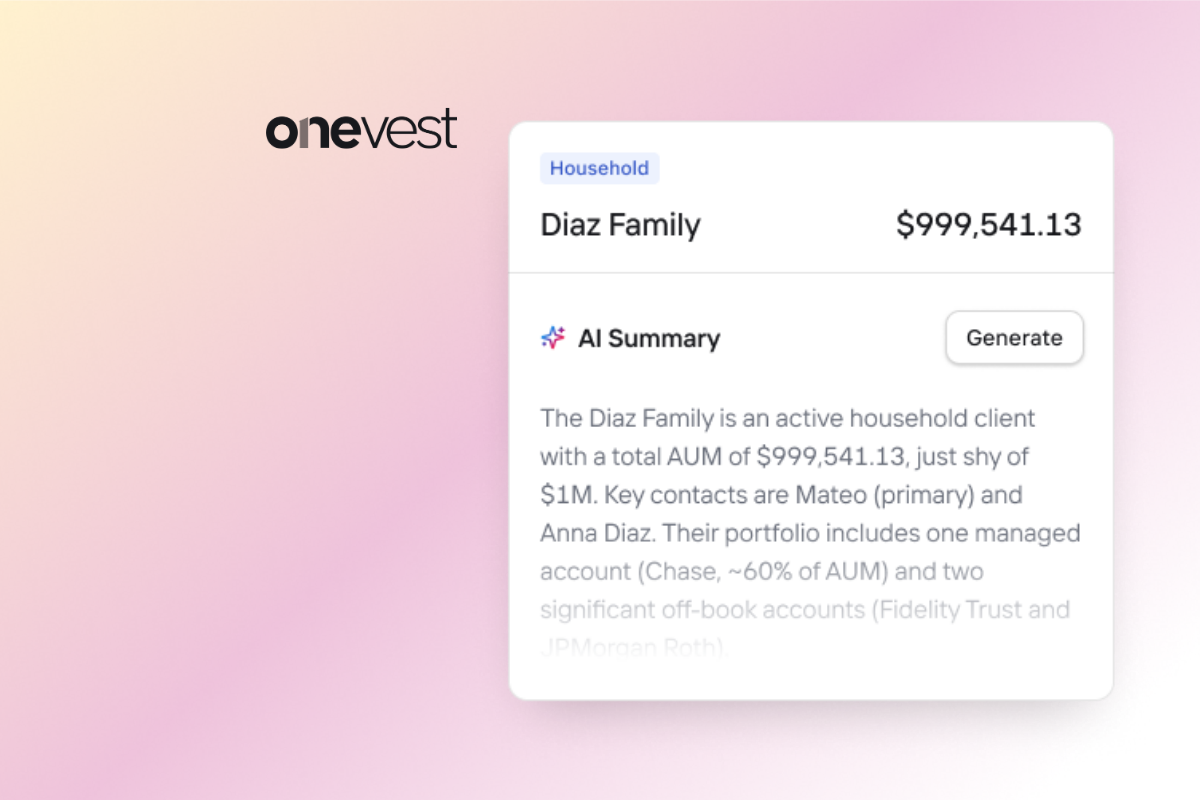
The strategic mandate for 2026 is clear: digital wealth management has become the primary interface of trust. In this AI-native era, the investor is now the primary architect of your technology requirements. We have moved beyond the days when digital tools were merely an option; they are now the foundation of the advisor-client relationship.
As investors’ lives become more complex, their expectations for wealth management software have shifted from simple portfolio reporting to a demand for a complete picture of their financial health.
This article is the first installment in our comprehensive series, The Top 7 Criteria for an AI-Native Wealth Management Platform: A Buyer’s Guide for Growing RIA Firms. As the wealth management industry enters an AI-native era, firm leaders must evaluate technology not just as a tool, but as a strategic operating system that drives advisor productivity and scales hyper-personalization for investors. This guide provides a roadmap for CEOs, CTOs, and Heads of Wealth at mid-sized RIAs to identify the critical features, from data unification to agentic workflows, that will distinguish market leaders by 2030.
You can read the full guide here: The Top 7 Criteria for an AI-Native Wealth Management Platform: A Buyer’s Guide
1. Transparency Through Unified Household Management
The modern investor no longer views their finances as a collection of isolated accounts. They expect their advisor to provide a "single pane of glass" view that encompasses taxable accounts, 401(k)s, and private market holdings. For a CTO, this means client portal software for financial advisors must move away from fragmented data toward true unification.
84% of advisors now view the ability to manage a client’s entire household through a single, coordinated portfolio as a "valuable" or "significant" advantage for the investor.
Currently, 63% of firms report their data is mostly or fully unified, meaning data flows seamlessly or with only minor manual processes.
Despite the push for modernization, 34% of advisors admit their data is only "minimally unified," requiring manual entry or reconciliation.
Strategic Insight: For mid-sized firms, data unification isn't just an operational preference; it is a retention strategy. The ability to show an investor their "Total Wealth" in real-time is the new baseline for the HNW experience.
Source: Orion 2026 Advisor Wealthtech Survey
2. Reclaiming the "Human Premium" Through Automation
Investors no longer want to pay for an advisor to handle paperwork; instead, they are looking for wisdom, behavioral coaching, and help with complex problems. While modern clients are explicitly asking for more one-on-one time, many advisors are bogged down by administrative tasks that keep them away from their investors. This "time scarcity" cycle means that instead of delivering high-value engagement, advisors are trapped doing manual work that could be handled by a more efficient system.
Advisors currently spend a staggering 59% of their time on non-client-facing tasks like administration, compliance, and firm management (Fidelity: The Time-Value Equation, 2025).
Shifting just five hours a week toward client-facing activities could generate an additional $270,000 in annual revenue per advisor (Fidelity: The Time-Value Equation, 2025).
Strategic Insight: CEOs must view wealth management software as a capacity-building tool. Every manual hour reclaimed from the back office is an hour reinvested into the "human premium" that keeps investors loyal.
Source: Fidelity: The Time-Value Equation (2025)
3. Hyper-Personalization and the Alts Surge
The "next-gen" investor is not interested in a standardized 60/40 model. They expect hyper-personalization that includes tax-loss harvesting at the individual security level and access to institutional-grade alternative assets.
77% of advisors managing portfolios for investors in the $3M to $5M range and $6M to $10M range expect to have dedicated allocations to alternative assets by the end of 2026.
High fees are cited by 31% of advisors as the primary challenge in helping clients invest in alternatives.
28% of advisors state that simplified onboarding and subscription processes are the most helpful technological capability for incorporating these assets.
Strategic Insight: For a Head of Wealth, the "product" is no longer just the investment; it is the access and the experience. Modern digital wealth management must make complex assets as easy to subscribe to as a mutual fund.
Source: Orion 2026 Advisor Wealthtech Survey
4. The Human-AI Hybrid: Scaling High-Touch Trust
As we move toward 2030, the investor’s relationship with technology will shift from "tool" to "intelligence." The expectation is that AI will provide the analytical heavy lifting, while the advisor provides the ethical and emotional guardrails.
Only 38% of affluent investors currently report being comfortable with AI technology in their financial relationships, highlighting a significant "trust gap" that advisors must bridge (Cerulli Associates, February 2026).
One-quarter of large-scale RIAs are now moving beyond back-office automation to use AI for client engagement tracking and CRM updates, aiming to create more personalized investor touchpoints (Cerulli Associates, January 2026).
The shift toward an AI-augmented model is less about replacing the advisor and more about refining their role. As AI agents begin to handle complex decision flows and data processing, the advisor's value proposition moves toward "advice intellectual property", the unique ability to navigate emotional nuances and ethical dilemmas that machines cannot yet grasp. For mid-sized firms, the goal is to build an infrastructure where AI acts as a "client brain," consolidating data to ensure that every recommendation is grounded in the investor's specific life context.
Strategic Insight: For the CTO, an AI strategy isn't about replacing the advisor; it's about providing the advisor with "superpowers." Investors want an advisor who is augmented by AI, not one who is distracted by it.
Source: Cerulli Associates: Billion-Dollar RIAs Accelerate AI and Data Investments (January 29, 2026); Cerulli Associates: Investors remain skeptical of AI in financial advice (March 17, 2026)
Frequently Asked Questions: Wealth Management Software and the AI-Native RIA
What is the role of wealth management software in the modern RIA firm?
Wealth management software serves as the primary operating system for a firm, integrating portfolio management, client communication, and back-office workflows into a single ecosystem. In the AI-native era, this software has shifted from a simple record-keeping tool to a "force multiplier" that uses automation to amplify advisor effectiveness and firm-wide growth.
How does a seamless mobile experience benefit both the advisor and the investor?
Seamless mobile experience ensures that wealth relationships keep moving, regardless of location. For the investor, it provides "always-on" access to their unified household records and portfolio data, which is essential for building trust in a digital-first era. For the advisor, a mobile-optimized application like OneVest Go allows for instant client readiness, enabling them to search communications, answer questions, and view automated activity summaries directly from their device. This mobility reduces the administrative "noise" of jumping between tools and ensures that prospecting and client management happen in a continuous, efficient stream of work.
How does digital wealth management software help firms meet investor expectations?
Investors today expect a "Personal CFO" experience characterized by high transparency and hyper-personalization. Modern digital wealth management platforms meet these demands by providing unified household reporting and the ability to seamlessly incorporate complex assets, like private equity or private credit, into a coordinated portfolio strategy.
What are the key features to look for in a client portal software for financial advisors?
A high-quality client portal software for financial advisors should prioritize data unification, ensuring that information flows seamlessly across all systems without requiring manual reconciliation. Key features include real-time access to holistic performance data, secure document management, and AI-driven insights that help investors understand their financial progress in the context of their personal goals.
Can wealth management software effectively solve "time scarcity" for advisors?
Yes. By automating administrative "heavy lifting", such as meeting preparation, compliance monitoring, and data management, wealth management software allows advisors to reclaim significant portions of their day. Modern platforms specifically target the "administrative drag" of onboarding, reducing the constant back-and-forth between advisors, admins, and clients through simplified subscription processes and automated data extraction. Research suggests that cutting down these manual hurdles is essential for shifting focus back to the client-facing activities that drive organic growth. Reducing this friction ensures that wealth relationships keep moving forward rather than getting stuck in a cycle of paperwork and repetitive follow-ups.
What is the benefit of an AI-native approach to wealth management?
An AI-native platform eliminates traditional data silos and enables "agentic" workflows where the software can anticipate client needs automatically. This allows mid-sized firms to scale their operations and deliver a sophisticated, white-glove investor experience without a proportional increase in operational headcount.
Why is data unification critical for the future of wealth management?
Disconnected systems and point solutions are currently the top pain point for advisors, leading to incomplete data that cannot be aggregated. A unified platform ensures a single source of truth, which is vital for building investor trust and providing the high-level, data-driven advice that will distinguish successful firms in the coming years.
Keep Reading
 Blog
BlogThe Top 7 Criteria for an AI-Native Wealth Management Platform: A Buyer’s Guide for Growing RIA Firms
Wealth management firms no longer compete solely on advice quality. They compete on experience, efficiency, and trust. Increasingly, those outcomes are shaped by the platform that runs the firm. The next generation of wealth management technology is AI-native by design, with intelligence embedded directly into data models, workflows, and execution. For RIAs and wealth firms, this represents a shift away from disconnected tools and surface-level AI features toward unified platforms that actively support how firms operate, scale, and deliver consistent client outcomes.An AI-native wealth management platform is built with intelligence at its core, not layered on after the fact. Rather than simply displaying data or generating isolated insights, AI-native platforms use agentic intelligence to interpret context, coordinate workflows, and support decision-making across the firm. This enables advisors, operations, and compliance teams to move from manual task execution to orchestrated, outcome-driven work. The result is a platform that functions as an operating system for wealth management, improving productivity, consistency, and scalability as firms grow.Industry research shows that firms using modern, integrated platforms outperform peers on productivity and retention. McKinsey highlights that increasing advisor productivity through technology is critical as the industry faces a structural advisor shortage, reinforcing the need for scalable, intelligent operating models. Yet many firms still rely on fragmented systems that create operational friction, limit visibility, and reduce the real-world impact AI can have across the business.This guide is the first in a series exploring the core capabilities RIAs and wealth firms should evaluate when selecting a wealth management platform. In upcoming articles, we will dive deeper into each of these areas, examining best practices, practical considerations, and how AI-native platforms are redefining how modern wealth firms operate. 1. How Client Expectations Are Redefining Wealth Management Software for RIAs in an AI-Native Era Client expectations now define the baseline for wealth management software. Investors expect the same speed, transparency, and personalization they experience with leading consumer technology. Static reports, paper forms, and delayed updates no longer meet those expectations.Modern wealth management software must provide real-time access to portfolio data, documents, and insights through secure, branded client portals. Increasingly, clients also expect intelligent, context-aware experiences, where AI-native platforms surface relevant information based on goals, life events, and financial behavior rather than relying on static dashboards alone.Key Takeaway: Client expectations now center on intelligent, real-time experiences. AI-native wealth management software helps firms move beyond static portals by delivering context-aware insights that strengthen engagement and trust. 2. How AI-Native Wealth Management Platforms Enable RIAs to Scale Without Adding Headcount Growth should not require proportional increases in operational staff. Yet many firms experience exactly that when outdated systems fail to scale.Modern wealth management platforms enable scale by unifying CRM, portfolio data, plans, and client goals into a single workflow. AI-native and agentic automation reduces manual effort across onboarding, servicing, rebalancing, and reporting by coordinating tasks and surfacing next best actions within existing workflows. This allows advisors and operations teams to manage larger books of business without sacrificing quality.In practice, this means firms can configure agentic workflows that automatically coordinate work across teams. For example, when a client completes onboarding or updates a financial goal, an AI-native platform can surface the next required actions across CRM, portfolio management, and compliance without manual handoffs or duplicate data entry. Advisors remain in control, but operational effort shifts from task management to oversight and client engagement.Scalability is not accidental. It is the result of selecting wealth management software built for growth, where intelligence is embedded into the platform itself rather than layered on as point solutions.Key Takeaway: AI-native platforms allow firms to scale by coordinating work across teams, not by adding more tools or staff. When intelligence is embedded into workflows, growth becomes a function of orchestration rather than headcount. 3. Why Embedded, AI-Supported Compliance Is Essential in Modern Wealth Management Software Compliance expectations continue to rise for RIAs and wealth firms. Manual checklists and after-the-fact reviews introduce risk, slow advisors down, and increase audit burden.Modern wealth management software embeds compliance directly into daily workflows. This includes automated alerts for outdated risk profiles, real-time audit trails tracking advisor actions and approvals, and built-in checks to ensure documentation completeness. In AI-native platforms, agentic intelligence helps monitor workflows in real time, flagging exceptions and guiding users to resolution while maintaining human oversight.Embedded compliance reduces operational risk while allowing advisors to stay focused on clients. It is no longer a differentiator. It is a requirement.Key Takeaway: Compliance is most effective when it operates continuously within daily workflows. AI-supported monitoring helps firms identify issues earlier and reduce audit risk without slowing advisors down. 4. How AI-Native Wealth Management Software Enables Personalized Advice at Scale Clients expect advice tailored to their lives, goals, and values. Delivering personalization at scale requires unified data across accounts, households, and external sources.Modern wealth management platforms aggregate client data into a single view, support goal-based segmentation, and deliver personalized dashboards tied to real objectives. AI-native platforms use agentic insights to interpret client context, helping advisors identify timely planning opportunities and behavioral signals without relying on manual analysis.When personalization is powered by unified data, automation, and embedded intelligence, it becomes repeatable and scalable rather than manual and inconsistent.Key Takeaway: AI-native personalization turns fragmented client data into actionable insights, enabling advisors to deliver tailored advice consistently without increasing manual effort. 5. Unified vs. Siloed Wealth Management Systems: Why Integration Matters for AI-Native Platforms Disconnected systems create data errors, duplicate work, and inconsistent client experiences. As firms grow, siloed tools become operational bottlenecks and sources of risk.Best-in-class wealth management software is built on an integrated, API-first architecture that connects CRM, custodians, portfolio data, compliance, and reporting. AI-native platforms depend on this unified data foundation, enabling agentic workflows that operate across the firm rather than within isolated tools. A unified platform provides a single source of truth and a single pane of glass for advisors and operations teams.This unified foundation becomes even more critical as firms introduce AI into their operating model. Agentic AI depends on consistent, high-quality data across systems to interpret context and act reliably. Without a unified platform, AI insights remain fragmented, limited to individual tools rather than enabling coordinated workflows across the firm.Key Takeaway: Agentic AI depends on unified data and workflows to deliver real operational value. Without an integrated platform, AI remains fragmented and unable to drive coordinated action across the firm. AI-Native vs. AI-Enabled: Why Architecture Matters AI-enabled tools apply intelligence at the surface level, generating insights or recommendations within individual applications. While useful, these capabilities are constrained by fragmented data and disconnected workflows.AI-native platforms embed intelligence directly into the system’s architecture. By unifying data, workflows, and permissions, they enable agentic AI to interpret context, coordinate actions across teams, and support execution across the firm. The difference is not whether AI exists, but whether intelligence can operate across the business or remains confined to isolated tools. 6. How Digital and Intelligent Onboarding Improves Client Experience and Advisor Efficiency Onboarding is one of the most critical moments in the client lifecycle. Friction at this stage erodes trust before the relationship even begins.Modern wealth management platforms streamline onboarding through digital KYC and AML verification, automated document collection, e-signatures, and pre-populated forms that reduce errors and rework. In AI-native platforms, agentic workflows help coordinate onboarding steps, reducing delays and ensuring requirements are met before accounts move forward.Faster onboarding benefits both sides. Advisors engage clients sooner and recognize revenue faster. Clients experience a smooth, professional start that builds confidence in the firm.Key Takeaway: Digital, AI-coordinated onboarding reduces friction for clients while accelerating advisor workflows, helping firms improve first impressions and recognize revenue sooner. 7. How to Choose the Right AI-Native Wealth Management Platform for Long-Term Growth Selecting wealth management software is one of the most consequential decisions an RIA or wealth firm can make. The right platform impacts every aspect of the business, from client experience and advisor productivity to compliance, scalability, and profitability.Firms that treat technology as strategy invest in AI-native, unified platforms with embedded compliance, intelligent automation, and scalable personalization. These investments compound over time by reducing operational friction and enabling consistent execution across the firm.The result is efficient operations, differentiated client experiences, and the freedom to keep the focus where it belongs: on clients, not technology.Key Takeaway: Choosing an AI-native wealth management platform is a long-term strategic decision. Firms that prioritize unified architecture and embedded intelligence position themselves to scale efficiently and adapt as client expectations evolve. Conclusion Wealth management software is no longer just infrastructure. It is a strategic lever for growth, trust, and long-term differentiation. By evaluating platforms through the lens of experience, scalability, compliance, integration, and AI-native architecture, RIAs and wealth firms can make confident decisions that support both today’s needs and tomorrow’s growth. What’s Next in This Series This Buyer’s Guide sets the foundation for evaluating wealth management software at a high level. In the next articles in this series, we will dive deeper into each of the seven areas covered here, including client experience, scalability, compliance, personalization, integration, onboarding, and the role of agentic AI in modern wealth management platforms, with practical insights to help firms make confident, informed technology decisions. FAQ: Wealth Management Software for RIAs and Wealth Firms What is wealth management software? Wealth management software is the core platform RIAs and wealth firms use to manage clients, portfolios, operations, and compliance. Increasingly, AI-native platforms serve as the operating system that supports advisor productivity, client experience, and scalable growth.What should RIAs and wealth firms look for in wealth management software? Firms should look for unified, AI-native platforms that combine CRM, portfolio data, workflows, compliance, and reporting. Key considerations include intelligent automation, scalability, embedded compliance, personalization, and integration capabilities.How does wealth management software improve client experience? Modern platforms provide real-time access to portfolio data, documents, and insights through secure client portals. AI-native platforms enhance this experience by surfacing relevant, context-aware insights that help clients better understand their financial progress.Can wealth management software help firms scale without adding staff? Yes. AI-native automation and unified workflows reduce manual effort, allowing advisors and operations teams to manage more clients and assets without proportional increases in headcount.Why is embedded compliance important in wealth management software? Embedded compliance ensures regulatory checks, documentation, and audit trails are built into daily workflows. AI-supported monitoring helps identify exceptions early, reducing risk and improving advisor efficiency.What is the advantage of a unified, AI-native wealth management platform? Unified, AI-native platforms eliminate data silos, improve data accuracy, and enable intelligent, agentic workflows across advisors, operations, and compliance teams. Sources 1. McKinsey & Company, Advisor Productivity and Capacity https://www.wealthmanagement.com/wealth-management-industry-trends/mckinsey-estimates-advisor-shortage-of-100-000-by-20342. Accenture, The New State of Advice https://www.institutionalinvestor.com/article/2dnl8j9j1apvk1054iayo/ria-intel/the-new-state-of-advice
7 min Blog
BlogBuilt for Scale: How Customer Feedback Shaped OneVest’s 2025 Product Advancements
Over the past year, OneVest partnered closely with our customers, RIAs and enterprise wealth organizations to understand the day-to-day challenges that slow advisory teams down. What firms asked for wasn’t more features; it was better foundations. Wealth managers wanted cleaner data, more flexible account structures, smarter automation, and infrastructure that scales as the business grows. The product advancements introduced throughout 2025 were shaped directly by those needs. Below are the four themes we heard most consistently from customers, and the investments we made in response. 1. “Our teams need to spend less time managing tasks and more time serving clients.” Advisors want to focus on relationship-building and strategic work, not administrative tasks. Firms requested tools that help teams stay on top of priorities without increasing operational overhead. That’s why we created: AI-Driven Next Best Actions The Next Best Action feature surfaces timely reminders, follow-up opportunities, and high-priority tasks based on activity patterns and book-of-business dynamics. It helps advisors allocate attention where it has the most impact, supporting deeper client engagement and more productive days. A No-Code Workflow Builder That Adapts to Each Firm Every firm operates differently, and workflows must reflect unique service models and regulatory requirements. OneVest’s improved dynamic workflow builder allows operations teams to design, deploy, and iterate on onboarding, compliance, and service workflows, all without engineering support. This provides firms with the flexibility to adapt processes as the business evolves. Role-Based Notifications for Home Office Control OneVest’s new and improved notification system delivers greater flexibility and oversight for home offices by allowing different types of notifications to be configured, controlled, and delivered based on role. The platform now supports a wide range of real-time, in-app alerts across the advisor portal and client web app, ensuring that each update reaches the right audience with the right context.Admins benefit from enhanced control over compliance-related and operational notifications. Advisors receive timely workflow and client updates that streamline communication and improve service responsiveness. Clients experience a more transparent, professional journey through proactive alerts that reinforce trust and reduce friction throughout their financial interactions. 2. “Our client relationships are more complex than traditional householding.” Modern clients increasingly manage multiple entities, trusts, investment goals, and region-specific accounts. Firms needed more flexibility to reflect these complexities in their systems. So we brought: Smarter Account Structures with Account Groups Account Groups allow firms to organize and manage accounts by trust, entity, investment objective, or any structure that mirrors a client’s real financial life, far beyond traditional householding. This makes planning and oversight easier for multi-entity or multi-goal relationships. Account-Level Role-Based Access To match more complex structures, firms also requested more granular access controls. OneVest introduced account-level permissions to define who can view and manage specific accounts, including support for POA and custom roles across multi-advisor or multi-region teams. This strengthens compliance while enabling more precise delegation. 3. “We need systems that scale without adding operational burden.” As firms expand into new regions, add advisors, or integrate new custodians and tools, they require technology that supports complexity without slowing down their teams. That means: Configurable, Branded Reporting OneVest introduced fully configurable, no-code reporting tools that enable firms to select key data points, customize layouts, and apply their own firm branding. Reports more easily support regulatory, operational, and client-facing needs without engineering assistance or manual workarounds. A Stronger, More Connected Infrastructure Behind the scenes, OneVest enhanced platform connectivity across custodians, CRMs, portfolio systems, and compliance tools. These upgrades create a unified operational view, reduce manual processes, and support faster onboarding, ensuring the platform scales alongside each firm. 4. “We need a clearer understanding of our clients and advisors.” Firms emphasized the importance of seeing how advisors and clients interact with technology. Better visibility helps improve onboarding, refine training, and strengthen digital experiences across the organization. So we introduced: Behavior Analytics with Mixpanel OneVest integrated Mixpanel to give firms deep behavioral intelligence across advisor and client journeys. This includes insight into: Onboarding drop-off pointsWorkflow adoption trendsEngagement patterns across regions, teams, or firm structuresClient adoption of our user-centric experiences, like the mobile app, helping firms identify what is gaining traction and where additional enablement is needed This investment ensures our technology evolves based on real user behavior, enabling continuous refinement and a smarter, more responsive platform over time A Real-Life View of Total Net Worth Clients and advisors expect a comprehensive view of wealth contained in one place. OneVest’s Net Worth experience brings together liabilities, held-away accounts, real estate, private investments, and other assets in a clean, real-time interface. Plaid integration enables clients to securely connect external accounts, while additional assets can be added manually to ensure that every aspect of a client’s financial picture is captured. This unified view supports more complete planning conversations and reduces reliance on fragmented tools. Built Through Customer Collaboration Every enhancement released in 2025 reflects direct input from the firms using OneVest’s technology every day. The goal remains consistent: to build a modern, intelligent wealth management infrastructure that adapts to the realities of advisory work and supports the home office. From advisor-led RIAs to enterprise wealth firms operating across regions, OneVest empowers institutions to implement rapidly, maintain control and brand identity, and deliver connected client and advisor experiences.
 News
NewsOneVest Launches OneVest GO: The AI-Native Wealth Relationship Workspace Built for the Modern Independent Advisor
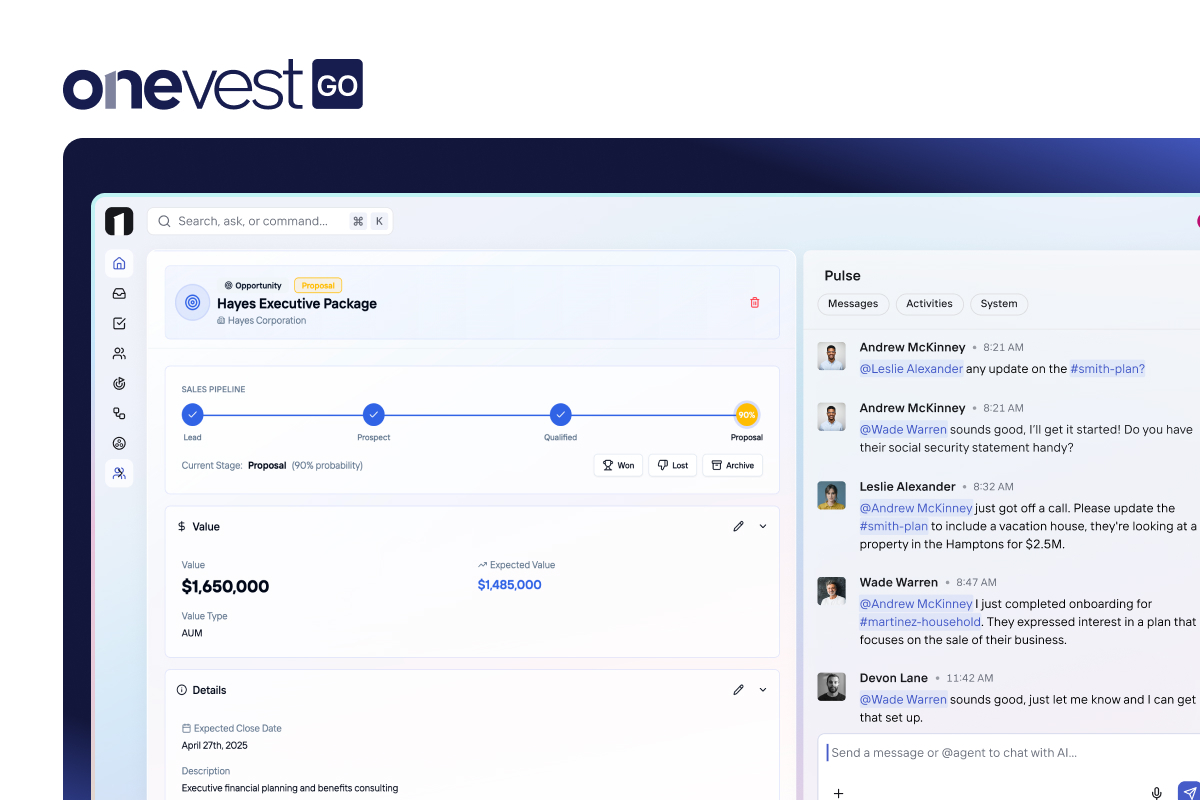
A collaboration-first, AI-native platform designed for Agile RIAs and Solo Practitioners who demand elite technology without the enterprise bloat. NEW YORK, NY – March 16th, 2026 – Following the successful launch of its Agentic Wealth Operating System, OneVest today announced OneVest GO. This standalone, AI-native wealth relationship workspace is built specifically for the independent powerhouse—the agile advisor and focused RIA team who prioritize client impact over administrative complexity. OneVest GO delivers an AI-native foundation that allows independent firms to manage prospects, clients, and complex workflows with unprecedented speed. By moving beyond the limitations of legacy CRMs and disconnected communication tools, OneVest GO empowers advisors to operate with the sophisticated infrastructure of a global institution while maintaining the personalized touch of an independent practice. “Independent advisors don’t need more software to manage; they need a system that actually moves work forward,” said Jakob Pizzera, COO at OneVest. “OneVest GO is built for the way agile firms actually operate: fast-paced, relationship-driven, and growth-focused. It’s designed to keep wealth relationships moving without the friction of traditional platforms.” Built for the Practitioner, Not the Administrator Traditional CRM tools were designed as static databases. OneVest GO is built for business momentum. Instead of requiring constant manual entry, the platform embeds intelligence directly into the advisor's daily routine: Zero-Friction Sync: Communications and calendars across Outlook and Google are captured and organized automatically.Autonomous Follow-ups: AI analyzes meetings to generate immediate action items, summaries, and client-ready notes.Intelligent Surfaces: The system proactively highlights the "next best action," ensuring that every prospect and client receives elite-level attention. The Wealth Relationship Workspace OneVest Go is more than a system of record; it is a dynamic Wealth Relationship Workspace built for the speed of modern advisory teams. By moving beyond the static data entry of traditional CRMs, we’ve created an AI-native environment where intelligence is embedded directly into your daily flow automating follow-ups and surfacing "next best actions" as you work. This is a workspace that is leveraging OneVest’s new Pulse feature, where messaging, meetings, and client history live in one continuous stream, allowing your team to collaborate in context instead of jumping between fragmented tools. OneVest GO unifies the disparate tools advisors use every day into one high-velocity workspace: Holistic Household Records: Deep relationship mapping, tagging, and real-time net worth tracking.AI Conversational Intelligence: Search your entire firm’s history using natural language to get instant summaries and insights.Kanban Opportunity Pipelines: A visual, intuitive way to move prospects through the conversion cycle.AI-Driven Document Management: Secure storage with automated data extraction to eliminate manual filing.Global Capabilities: Multi-language and multi-currency support to serve a modern, mobile client base. Start Agile. Scale Without Limits. OneVest GO allows solopreneurs and independent teams to start with a lean, powerful foundation. As a practice grows, the platform evolves naturally ensuring that workflows, conversations, and client histories remain connected without the need for future migrations or system resets. “For the advisor ready to evolve beyond spreadsheets and fragmented inboxes, OneVest GO offers the modern foundation built for the speed of today’s wealth management landscape,” added Pizzera. Whether you are prospecting or managing a long-term household, OneVest GO ensures your practice stays always on and always moving, providing a simple, scalable foundation that grows with your firm without the friction of new platform migrations. For more information and to get started, visit www.onevest.com/go. About OneVest OneVest is a financial technology company redefining wealth management through an intelligent, agentic operating system. By advancing fragmented legacy software with a unified, AI-native platform built for autonomous execution, OneVest enables firms to operate with greater speed, control, and scale. OneVest serves financial institutions and independent advisory firms across the U.S., Canada, and global markets. Media Contact: marketing@onevest.com